


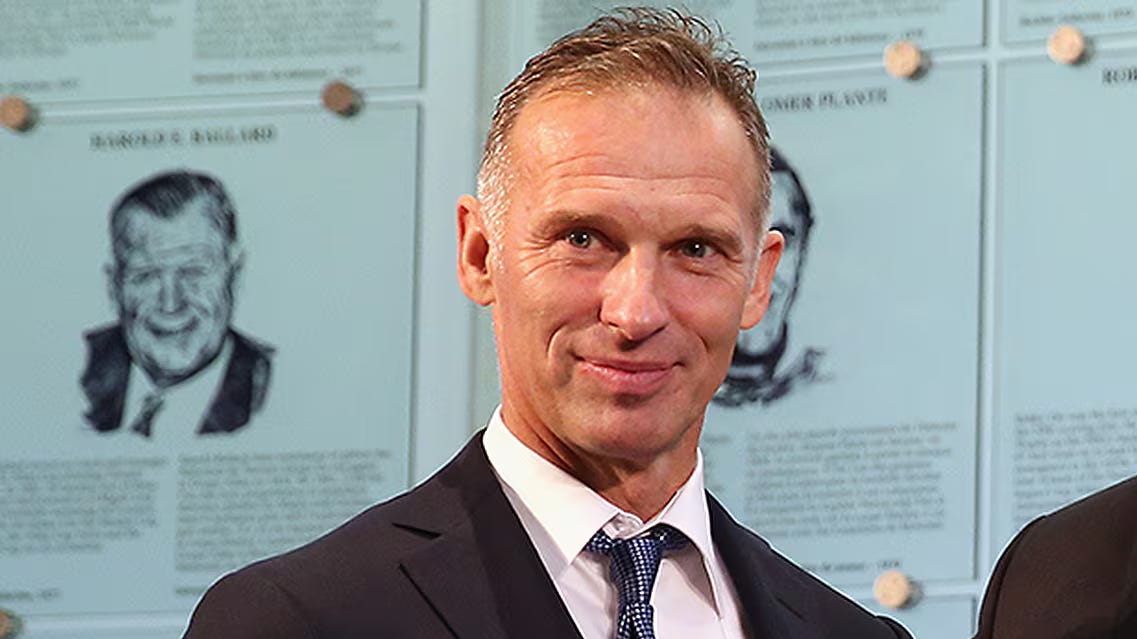
If you grew up a Buffalo Sabres fan in the 1990s, Dominik Hasek wasn’t just your favorite goalie. He was practically a superhero. The guy could stop a puck with his glove, his blocker, his skate, his back, or some body part you didn’t even realize a human being could bend in that direction. He was the Dominator. One of the greatest goaltenders ever to play the game, and someone who helped make being a Sabres fan a hell of a lot of fun.
But this isn’t an interview about the 1999 Stanley Cup Final, the Olympic gold medal, or his remarkable NHL career.
It’s about what happens after the cheering stops.
Over the past several years, Hasek has become one of the more outspoken former NHL players when it comes to politics, particularly Russia’s invasion of Ukraine, Donald Trump, and the responsibility of professional sports leagues.
And he’s certainly not afraid to upset people.
What I find fascinating about Hasek is that he doesn’t seem particularly interested in protecting his hockey legacy by keeping his mouth shut. He has his beliefs, he’s willing to defend them, and he’s perfectly comfortable criticizing the NHL, an organization where he spent much of his adult life.
I wanted to understand where those convictions came from. Was it growing up under communism? His experience representing his country? Or simply becoming more outspoken as he got older?
I also wanted to ask him something that doesn’t get discussed enough: How would he handle a teammate whose political views were the complete opposite of his own?
For this edition of Zoom & Tell, Hasek answered questions about his political activism, the relationship between sports and government, and what he hopes people remember about him long after his hockey career. These were done via email exchange.
Here is our Q&A.
You are one of those former NHL players who speak quite openly about political issues. Was there a specific moment or event that prompted you to become so actively involved, or was it a process that developed gradually after your playing career ended?
Dominik Hasek: It happened quite a few years after my career ended. At first, I would occasionally comment on Czech politics. However, that changed completely following the outbreak of Russia’s imperialist war in Ukraine. Given this war—and the lax attitude the world has shown toward it and the horrific Russian atrocities from the very beginning—I consider this to be of great importance. Furthermore, as a former national team player and a long-time professional hockey player, I am a public figure in this part of the world, and I therefore view this as a duty I owe to society.
You grew up in Czechoslovakia during the Communist era. How much did those experiences shape your political beliefs, and do you think growing up in that environment gives you a different perspective on what’s happening in the United States today?
Dominik Hasek: The experience of living the first 25 years of my life in a communist environment—specifically in the Czech Republic, which was occupied by the Russian (or, at the time, Soviet) army—certainly has some influence on my perspective. However, I believe my political views were shaped even more by my lifelong interest in history—and, in particular, the interconnectedness of historical events. That is why I studied history at university for five years before leaving for the NHL at the age of 25.
You’ve been very critical of Donald Trump over the years. What specifically concerns you most about his leadership and policies, and have any of your opinions about him changed over time?
Dominik Hasek: To put it briefly: the man is a liar—a chronic liar, to be precise. He places his own personal interests above everything else—even above the interests of his country, or more accurately, his fellow citizens. And given that the USA remains a major power, this has a very, very detrimental impact on the entire world. The fact that he supports mobsters, dictators, and the worst kinds of criminals is a direct consequence of what I stated in the opening sentences of this paragraph.
Let’s say you were still playing in the NHL today and had a teammate who absolutely loved Donald Trump, supported his policies and openly praised what he was doing. How would you handle that relationship? Would you challenge him politically, have conversations behind closed doors, or simply respect that you had different opinions?
Dominik Hasek: I would certainly feel sorry for such a teammate—and for those closest to him—because supporting a habitual liar, someone who admires criminals and even mass murderers like Putin, is, to say the least, very sad. Nevertheless, as his teammate, I would do everything in my power—not just on the ice, but also in the locker room and off the ice—to ensure our success as a team.
Do you think that politics/Trump have played a role in US players demanding trades from Canadian teams?
I have no idea. I’m not familiar with the specific situations. Players have requested trades to other teams in the past as well. As for what exactly lies behind these requests in each individual case, the players themselves—or perhaps those close to them—would know best. That said, it must be noted that during Trump’s first term, and especially his second, his conduct led to increased tension—and even a certain degree of animosity—between the U.S. and the vast majority of the democratic world. Whether this specifically influenced the trade requests made by certain U.S. players in Canada, I honestly don’t know.
When Team USA won Olympic hockey gold, Donald Trump and members of his administration were very enthusiastic about celebrating the team’s success. What was your reaction to seeing the American government embrace that victory, particularly given your own views about Trump? Do you think international sporting achievements should be kept separate from politics?
Dominik Hasek: I viewed it as a completely normal occurrence. Every country—without exception—and, above all, those currently in power, leverage the achievements of their citizens to advance their own agendas. All nations and their governments do this, without exception. I might add that I am aware that American athletes, as a group, have been losing a certain level of global support in recent years—and they are feeling the effects. This is a direct consequence of the conduct of the President and his inner circle. And you asked about politics and sport? Politics and sport are inextricably linked; they are inseparable human activities. That is how it has always been, how it is now, and how it will always be.
During your playing career, how often did politics come up in the locker room? Were there teammates who held political beliefs very different from yours, and did players generally feel comfortable discussing those differences?
Dominik Hasek: Very rarely. Or, I’d almost say, not at all. Unless, of course, you’re referring to the “politics” inside the locker room—who should play, who should be in goal, who the coach should put out for the power play, or how much the team should be training. That kind of thing went on from the first day of the season to the last! :-) But back to what you likely had in mind: I don’t think that topic is discussed much in the locker room these days—which is actually necessary for the team to function well on the ice. However, one thing must be said: the bombs falling today aren’t killing the family members of the players, coaches, or front-office staff, and Russian drones aren’t tearing the limbs off their children. If that were happening to them, their stance would change in an instant, and it would be a constant topic of conversation. And it wouldn’t just be a matter of talk—the rules—or rather, the laws—would change very quickly, too.
You’ve been outspoken about Russia’s invasion of Ukraine and the role of Russian athletes in international competition. What do you believe the NHL and international hockey organizations should be doing differently, and how do you respond to people who argue that athletes shouldn’t be held responsible for the actions of their governments?
Dominik Hasek: I will start from the end. Naturally, athletes bear no responsibility for the actions of their governments. For this reason, I am fundamentally opposed to any form of collective guilt—a concept I will always condemn. However, this does not alter the following points. Under the current rules, Russian citizens—athletes, including hockey players—effectively represent the actions and crimes of their country, and by extension, Russia’s imperialist war and the atrocities associated with it. The NHL (and not just the NHL) has thus become a massive advertisement for Russia’s imperialist war, helping to legitimize the horrific Russian crimes linked to this conflict. Consequently, the NHL’s stance contributes to the prolongation of the war, resulting in a significantly higher death toll. These are the facts; sooner or later, the NHL will be required to pay reparations to Ukraine for this.
If the NHL wishes to change this, it must establish new rules. For nearly five years, I have offered to assist the league in this regard. Of course, the damage caused by the NHL over the nearly five years since the war began is already irreversible.
Today, professional athletes have enormous platforms through social media, but many avoid discussing controversial political issues. Do you believe athletes have a responsibility to speak out when they see something they disagree with, or do you understand why some prefer to remain silent?
Dominik Hasek: Why active athletes don’t get involved in this—why they don’t take such a step—is a topic for a longer discussion. In short: because they are afraid. And I don’t mean that in a negative way at all; fear is a normal human trait. Simply put, they fear that not only will it yield no benefit, but it could actually be detrimental to them in many ways. I also believe that for athletes in team sports, this is even more difficult.
I am convinced that if I were playing in the NHL right now, I wouldn’t be speaking out the way I do today. As you can see from my comments, I never blame active athletes—including hockey players—for this. I would like to add one important point here: the specific league, or the country where the competition takes place, must establish rules that give hockey players—and other athletes—an incentive to speak out publicly on these matters. Or, at the very least, ensure they aren’t discouraged from doing so, as is the case now.
You’ve received both support and criticism for your political comments on social media. Have you ever lost friendships or relationships with former teammates, coaches or people in the hockey community because of your views? And has there ever been a moment when you reconsidered posting something because of the potential reaction?
Dominik Hasek: I’ll start from the middle. I haven’t lost a single friend because of my public stance—or at least, I’m not aware of any. As for whether I’ve ever reconsidered publishing something? Certainly—more than once. Or rather, it’s more a matter of specific wording. I always try to choose a less aggressive tone; and even when I’m almost certain about something but lack the evidence to back it up, I make sure not to cross the line. That’s pretty much how I see it.
When people look back at Dominik Hašek decades from now, they’ll obviously remember the Stanley Cups, Olympic gold medal and your incredible NHL career. But how important is it to you that people also remember what you stood for away from hockey? Is there something you still hope to accomplish through your political activism?
Dominik Hasek: Let me put it this way. I thrive on responsibility and on doing things where the joy isn’t just mine alone, but shared with those around me—in hockey, that meant the team, the fans, and so on. In my current work, I’m essentially continuing along that same path, only now the stakes are far higher—we are talking about human lives. My actions are driven by a clear purpose: to see this war end as soon as possible and to establish a framework that guarantees a lasting peace.
This requires Russia to withdraw from all Ukrainian territories (including Crimea, of course), to accept full responsibility for everything it has caused (not only the lives lost or shattered, but also the destruction of property, the environment, and more) and to ensure that war criminals are tried and punished, just as the fascists were in Nuremberg. This is the only way to maintain peace in Europe. I feel a profound sense of responsibility—shared by society, and not just here in the Czech Republic—to ensure this is achieved. And so, I act accordingly—much as I once did in my role as a goaltender.
My Final Thoughts
There was one answer from Hasek that really stood out to me, and it wasn’t necessarily the one about Donald Trump or even his criticism of the NHL. It was his admission that if he were still playing today, he probably wouldn’t be speaking out the way he does now.
That’s an interesting admission from someone who has become so outspoken.
I think it’s easy for fans, myself included, to sit around and demand that athletes use their platforms to address every major issue. But we’re also not the ones sharing a locker room with 20-plus teammates, dealing with sponsors, or wondering whether a public statement might create problems for our careers.
Hasek seems to understand that distinction.
You don’t have to agree with every statement he makes to find the perspective interesting. But one thing is apparent: he doesn’t see his responsibility ending when he hung up his skates. For so many years, Dominik Hasek’s job was to stop people from scoring goals.
Now he sees his job differently.
And whether you agree with his politics or not, it’s fascinating to hear how someone who spent decades in one of the most pressure-filled positions in professional sports views the world outside the crease.
A big thank-you to Dominik for taking the time to answer these questions for Joe from Queens.
Thanks for reading!
If you enjoy what I do, consider upgrading your subscription for as little as $6 a month. You’ll get exclusive bonus content and a FREE gift just for subscribing!

You can also support Joe From Queens by shopping with any of our great partners. Check out the deals and discounts here:

Thanks for all the support!
Not being a hockey fan I was initially going to skip today’s article. I’m glad I decided to read it. Not only was he a great hockey player but more importantly he turns out to be an extremely intelligent person .He is willing to stand up for what he believes.
I wish more athletes and retired athletes would speak up .
Trump is truly
a disgrace and a traitor to this country
Great interview