

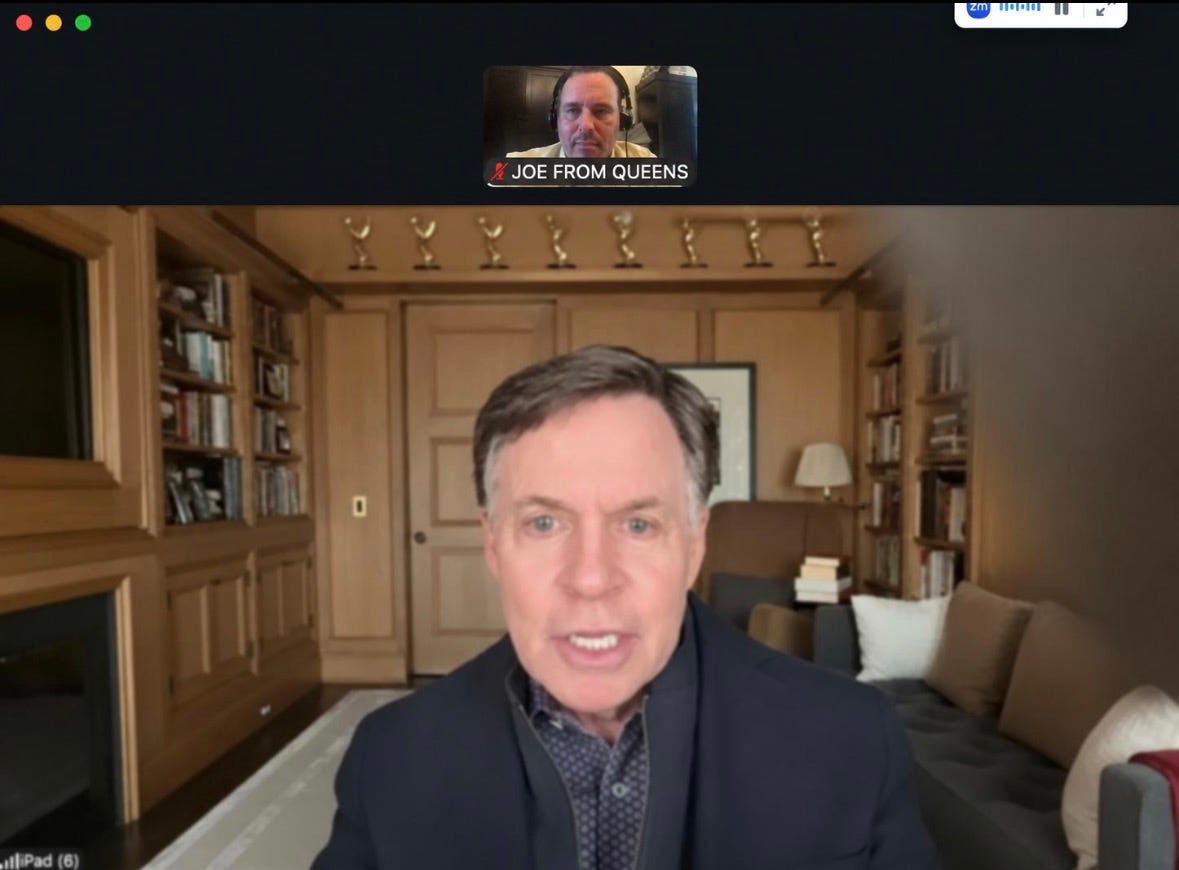
When I was growing up in Buffalo, Bob Costas was one of those voices you just knew. Whether it was NFL Live, baseball, basketball or the Olympics, he seemed to be everywhere. For someone like me, whose brain is probably 60 percent Buffalo Bills and 40 percent everything else, Costas was part of the soundtrack of growing up as a sports fan.
What I didn’t realize until researching this interview was just how many connections he had to the Bills, dating all the way back to 1980. His first NFL play-by-play assignment for NBC was the Bills’ historic victory over the Miami Dolphins, when Buffalo finally ended its decade-long losing streak against its division rival. He later hosted NFL Live during the franchise’s greatest stretch, worked alongside several former Bills players and covered the team’s remarkable run to four consecutive Super Bowls.
We talked about those years, the personalities he worked with, his admiration for Marv Levy, how national broadcasters navigate relationships with local media, and the changing landscape of sports journalism. And yes, we even briefly discussed the complicated question of O.J. Simpson and the Bills’ new stadium.
Here is our 40 minute conversation, lightly edited for clarity and length.
The Bills, NFL Live and the Early NBC Years
Joe from Queens: When I was researching your history with Buffalo, I had no idea you had done NFL play-by-play. I remember you doing the NBA and baseball, but your first NFL game for NBC was Bills-Dolphins in 1980. That’s probably one of the ten biggest moments in Bills franchise history. What do you remember about heading into that game?
Bob Costas: That was my first game doing play-by-play for NBC. But I had done a handful of regional games between 1976 and 1979 on CBS. I had a weekly role. I was part of the regular rotation at CBS, and if they had as many as six, seven or even eight regional games on a given Sunday, they’d throw the kid a bone. When I came to NBC, I was on a full-time contract with a variety of duties that included NFL play-by-play.
That first game was with Bob Griese, and it was Bills-Dolphins. The Bills had not beaten the Dolphins in something like 17 straight games. When the Bills won, the fans tore down the goalposts as if it were a huge college football victory. At that point, the Bills had experienced some success in the AFL. They won the AFL championship in the mid-1960s. But in the NFL, they had yet to hit that stride that eventually took them to four straight Super Bowls. So you took your little victories when they came, and that was one of their little victories.
Joe: The Bills were 0-for-the-1970s against Miami. They had lost 20 consecutive games to them. And you’re calling this game with Bob Griese, who was responsible for a good number of those wins. Did you have any idea what might happen if Buffalo finally won? Did you anticipate the fans going crazy?
Costas: I had a sense that Bills fans were itching for a victory and to have this losing streak end. We mentioned it several times during the broadcast because how could you not? It was one of the storylines. I didn’t know they’d tear down the goalposts or that several fans would rush the field in a good-natured way, not in the way you sometimes see today. I didn’t know that for sure, but I would say it didn’t surprise me when it happened, given all the built-up frustration of all those losing games.
Joe: Eventually you became the host of NFL Live, and there were a lot of Buffalo connections on that show. Paul Maguire played for the Bills. O.J. Simpson played for the Bills. Ahmad Rashad had a cup of coffee with Buffalo. I remember O.J. talking about “my Bills” all the time. As a broadcaster, you’re not supposed to root for a team, but he was obviously a fan. Was that ever annoying, or was it just part of what made the show work?
Costas: It wasn’t an annoyance at all. We have to remember that before the events of 1994, O.J. Simpson was a beloved national figure. Someone like that, who’s not the host, whether that’s me or Brent Musburger at the time or James Brown now, has more leeway. He was O.J. Simpson. He could openly root for the Bills. In fact, it was probably an asset to the show that people felt like he was pulling for the Bills.
Paul Maguire lived, and still does live, in Buffalo. He’s in his 80s now. One of the best I’ve ever worked with. Just a joy. Funny, knew the game off the top of his head. Even when he was doing games on ESPN on Sunday nights, he didn’t prepare in the way most of us did. He grabbed the flip card, looked at the depth chart, and did the game off the top of his head, based on his conversations beforehand with coaches and players and his knowledge of the game. And he was very, very good. I really enjoyed his company.
Same thing with O.J. I realize people see things differently through the rearview mirror. O.J. was great company. And Ahmad Rashad is one of my favorite people I’ve ever worked with, on both the NFL and the NBA. We stay in touch to this day. All I remember about that group was how good it was on air and how enjoyable it was both on and off the air.
Joe: I watched a documentary about Brent Musburger and The NFL Today on CBS, and they discussed how he and Jimmy the Greek nearly came to blows because Jimmy felt he wasn’t getting enough opportunities to speak. Did you ever deal with anything like that on NFL Live? Did anyone ever pull you aside and complain about not getting enough airtime?
Costas: No. Producers might say, “Hey, a little less of this, a little more of that,” or ask why you didn’t do something better. But for the most part, 40-plus years at NBC was a pretty smooth ride. Ninety-nine-point-nine percent of it. Not much acrimony or friction.
Joe: What advice would you give a former player or coach who was going to be sitting next to you on television?
Costas: Don’t worry about the nuts and bolts. That’s what I’m there for. And I’m sure Brent said the same thing to his colleagues at CBS. I’ll set you up. My job isn’t just to toss it to you but to make you look good. So tell me, if you can, before we come on the air, or during a commercial break, what’s the point you want to make? I want to throw you a batting-practice fastball, to mix metaphors with a football show, so you can hit it out of the park or take it to the end zone.
I wanted those guys to do well. After a while, you begin to sense what their power zone is. O.J. sometimes, on a halftime show, might be watching the Cincinnati-Cleveland game more than the Chargers against the then-Oilers. So I’m observing that. “O.J., you want to talk about the Bengals?” “Yeah.” “Okay, we’ll get it there.”
But he would also sometimes go off on a tangent, and I don’t mean that in a negative way. I’ve been known to do that myself. So a lot of times I would turn to O.J., and it almost became a running joke. I’d say, “Juice, your thoughts.” Not, “Hey, Juice, Ken Anderson is really having a big game for the Bengals.” Just, “Juice, your thoughts.” Then he could take it anywhere he wanted. You learn what the strengths and maybe the little weaknesses are, and you try to stay away from the weaknesses and play to the strengths.
Four Super Bowls, Marv Levy and the What-Ifs
Joe: Let’s talk about the Bills’ AFC Championship games. NBC would go to the site of the championship game, and you were there. I remember the 1990 season championship game against the Raiders, played in January 1991. The Gulf War had just started, and as a kid, it seemed like an enormous deal. The coverage felt different, with NBC going back and forth to Tom Brokaw. What was that like for you? Were you having meetings with the news division ahead of time about how to handle the game?
Costas: No. It was basically, Tom Brokaw was Tom Brokaw. He and I, by the way, were very good friends. We had a mutually respectful relationship, which meant a lot to me because he was the established guy. Him, in effect, giving me a thumbs-up meant much more than me giving him a thumbs-up.
The idea was that when the time came, sometimes it was scheduled, or if there were breaking developments, we’d have to break in. Not in the middle of the game, but maybe scratch a commercial and go to Tom Brokaw. Just throw it to Tom. That’s all. I didn’t pretend to be an expert. I didn’t pretend to comment on it. I just said, “Here’s Tom Brokaw,” and Tom did his part.
What I remember about 1991, the first time they went to the Super Bowl, was that they beat the Raiders in the AFC Championship Game. The Raiders and Bills went all the way back to the AFL. There was something about getting past the Raiders, a little bit like the Red Sox getting past the Yankees on their way to the World Series in 2004.
The only thing was that the Bills didn’t win that Super Bowl. They really had a personnel advantage, but Parcells and Belichick had a great game plan. And then, unfortunately, Scott Norwood missed the field goal at the end. I always wondered if the subsequent Super Bowls would have been different had they won the first one.
Especially after they lost two. Then it’s something they can’t get away from, even if they try. The press, the fans, everybody is mentioning it. It’s like a boulder rolling down the hill, and it takes on additional size as it goes. If they had won that first game, and they were the better team, but they ran into a brilliant game plan and then the misfortune of a missed field goal, I think it would have changed the whole course of how people felt about that team.
Joe: It’s funny you mention that because I watched an interview with Chris Berman, who’s a huge Bills supporter, and he made almost the same argument. He thinks if the Bills had won that first Super Bowl, they might have won two. Maybe they would have beaten Dallas because they wouldn’t have been carrying that mentality of losing.
I’ve always wondered about another what-if. What if Buffalo hadn’t come back against Houston in that playoff game following the 1992 season? That was their third Super Bowl year. They were getting killed by Houston. Would they have fired people? Would everything have changed?
Costas: That’s the Frank Reich game. You know, that game is one of the most memorable games in the history of the NFL. A real feather in the cap of the Bills. Your question about whether they would have made changes? I think Marv Levy was pretty well entrenched. Everybody appreciated him, not just as an excellent Hall of Fame coach, but his presence. He was a good person. He radiated equanimity, and he was a very well-read guy. He made references to Churchill and literary figures and whatnot. I think Buffalo people were proud that Marv Levy was their coach. And to this day, he’s a revered figure.
Let me tell you what kind of guy Marv Levy was, and is. This is just a small thing, but sometimes the small things illustrate larger things. In the early days at NBC, before I wound up with Bob Trumpy in 1981, I was with a number of different analysts. I think I did a game in 1980 with Marv Levy, who was between the Chiefs and the Bills. He didn’t have that much television experience. I myself was pretty wet behind the ears, but I had more TV experience than he did.
I walked him through a lot of it, and we had dinner the night before. A few days later, I get a handwritten note thanking me for being a good colleague and helping to calm his nerves, or whatever he said. That’s an old-school thing. Let’s write a thank-you note. It impressed me so much. Every time I crossed paths with him subsequently, and of course the Bills being in the AFC, that was the NBC network, we had a lot of their games. I did interviews with him, and I remember doing a memorable one after they had lost four Super Bowls. It was him, Jim Kelly, Bruce Smith, Andre Reed and Thurman Thomas.
I interviewed them looking back on their achievements. The way Marv Levy summed it up, his deep respect and appreciation for those guys and the brotherhood they had, I may only be paraphrasing here, but they all said something to the effect of, “I wouldn’t trade one Super Bowl win someplace else for the team we had that went four times and lost.”
Because that run, which is a long run in sports where careers and eras are relatively short, bonded them together for life. I had such respect for all of them, and I think a lot of that came not just from the people they were, but from Levy himself as their leader.
Joe: You were also in the locker rooms for the AFC Championship trophy presentations. For Bills fans, those are some of the greatest moments in franchise history. What’s it like doing those interviews? Is it complete chaos? Do you have a producer in your ear telling you what to do?
Costas: You have a producer in your ear telling you how much time you have, or maybe we’re going to throw it to the loser’s locker room, where somebody is standing by. That’s just traffic they’re keeping you up to date on. It shouldn’t be chaotic because by then things have been worked out. There’s a podium, there’s room for the cameras, and everyone is savvy enough, including the players, to understand what this is. You’re looking for the coach, you’re looking for Kelly, the quarterback, you’re looking for stars for the most part.
But what if some special-teams guy, in the case of the Bills, Steve Tasker, does something essential to the game? Maybe somebody who’s unheralded, way down on the depth chart, did something important. Then you’re looking for that guy. But by and large, you’re looking for stars.
These interviews are actually pretty easy because it’s just the headlines. What about this play? What about that play? You’re going back to the Super Bowl. Why is it going to be different this time?
Joe: That’s something I’ve always wondered about. By the third AFC Championship, if you’re interviewing the Bills after they’ve already lost two Super Bowls, do you feel obligated to ask them about potentially losing a third? Or is that the wrong moment? It’s supposed to be a celebration, not 60 Minutes.
Costas: You have to respect the moment, and it is a celebration, but I have always leaned into the journalistic part quite a bit. You know the moment. There are times when it’s more or less appropriate to ask a somewhat hard-hitting question. I don’t think I ever would have said, “You guys could be the first team ever to lose three straight Super Bowls.” I think I would have said it along the lines of, “You’re going to the Super Bowl again. Third time. That’s an amazing achievement, but you’re yet to win it all. What have the first two experiences taught you that might make this time different?”
I don’t know that I did ask that question, but that strikes me as the way to frame it. Rather than, “Hey, losers, what are you gonna do?” That’s just wrong, especially in a moment of celebration.
Joe: I remember the fourth AFC Championship when Jim Kelly talked about having “one more river to cross.” I remember thinking, it’s not one more river, it’s an ocean. And in the fourth Super Bowl against Dallas, the Bills actually played a pretty good first half. They led 13-6, and then everything unraveled. You could almost sense that feeling of, “Oh my God, here we go again.”
Costas: That fourth game, they dominated the first half against the Cowboys, who were a powerhouse that had blown them out the year before. The Bills played a pretty darn good first half, and there was a fumble or some kind of play down in Cowboys territory that, had they been able to take it in and score, might have changed the outcome of the game.
I had stepped away from hosting the show, and Jim Lampley had replaced me, but I was still part of the coverage. I did interviews and whatnot. I was on the set, and I remember asking Mike Ditka, “Suppose the Bills had won one or two of the previous three games. Would the outcome of this one have been different? Or, no matter how professional they are, when the tide began to turn, is it only human to think, ‘Uh-oh, here we go again’? Was that a factor?”
As I remember, Ditka sort of poo-pooed that notion. Nah, wouldn’t have been any different. Dallas was the better team.
Covering the Bills and the Stories Behind the Broadcasts
Joe: Growing up in Buffalo, I read a lot of the local coverage, and sometimes there seemed to be friction between certain Bills players and the local reporters. Bruce Smith was one name that came up. There was this perception that some players didn’t like dealing with the local media, but when the national broadcasters arrived, everybody was suddenly much friendlier. Did you notice that in Buffalo or other cities? Did local reporters ever resent the access national broadcasters received?
Costas: Yeah, that happened. I wouldn’t say it was 100 percent, but everybody’s aware of it. Joe Buck shows up, whether it’s for the World Series, a Monday night game, a postseason game or a Super Bowl. These are the network guys. They give us a separate situation.
We meet with coaches and prominent players before the game on Saturday. In baseball, you get a separate meeting in the manager’s office, besides what you can glean in the dugout or at the batting cage. I think it’s probably only human nature that some writers or local people would resent the national people who are better paid and have a greater level of fame and glamour attached to them.
But I think the way you handle that, and this always worked well for me, is that any fair-minded member of the local media knew that I respected them. I would seek them out for insight. After all, they’re there every day. They know more than I do, at least about the granular stuff. I may have the big picture, but they’ve got the granular stuff.
So I would seek them out, and sometimes I would mention them. “As so-and-so pointed out in the Boston Globe,” or “in the Chicago Tribune.” I wasn’t doing that to curry favor. I was doing it because it’s the right thing to do. They’re the ones who had the insight. I’m just passing it along.
If somebody big-times other people, then they’re a horse’s ass, and people resent it. But if you treat everyone with respect and acknowledge what they do, then you should be okay.
Joe: You mentioned that interview you did with Levy, Kelly, Bruce Smith, Andre Reed and Thurman Thomas after the four Super Bowls. It’s actually on YouTube, and it’s about 10 minutes long. What went into producing those pieces? Did you travel with a producer and camera crew? How much preparation did you do?
Costas: It was all NBC people. They might hire some local people for various things, maybe lighting or whatever, but by and large, the core of it would be NBC people who came from New York.
I always had, as all the people on network television in sports do, my own editorial consultant or statistician. I would consult with that person beforehand. What are the storylines? It’s so much easier now because it’s all at your fingertips on the internet. We used to keep files on every team and prominent players.
I’d consult with those people and create a card that had some of the questions, or at least the areas of conversation I wanted to touch upon. But I was never locked into it. I was never locked into question four having to follow question three, because you have to listen to what they’re saying. Maybe what they’re saying deserves a follow-up or embellishment of some kind.
If you’ve been following it, then you shouldn’t come in cold. I was never a blank slate because I’d been around it for many years and had a good general understanding of the storylines and these guys’ careers.
Joe: Creatively, what was your favorite part of making those packages? The writing, going out in the field, or the interviews themselves?
Costas: The interviews themselves, because you got them away from all the other distractions. It wasn’t game day. You didn’t get them coming sweaty off the practice field. As you remember, they were in street clothes in that situation. You got their full attention, and all five recognized that this was a national broadcast. It wasn’t a sound bite. Six minutes is pretty substantial in network television.
Now, the whole conversation probably lasted half an hour. These days, if that happened, you’d play the six minutes on the air and then go to NBCSports.com and see the whole thing, or it would wind up on YouTube somewhere. After a while, these guys have seen you. They’ve decided whether you have credibility and whether you’re trustworthy. They know the breadth of the platform, and they come ready to play. You get the best of them in that situation.
I feel sorry for guys who have to battle through a scrum. Many of those guys and women are great at what they do. But at the network, you get the privilege of having their undivided attention.
The Complicated O.J. Simpson Question
Joe: I wanted to ask you briefly about O.J. Simpson because you knew him and worked alongside him for years. The Bills moved into a new stadium, and there’s a new recognition area called the Family Circle. O.J. was previously on the Wall of Fame at the old stadium, but he isn’t being included in the new Family Circle. It’s obviously a complicated subject, and I’m curious how you look at it.
Costas: It’s a tricky one. I’m not familiar with how the Family Circle works, and the word “family” kind of connotes something different than just a Hall of Fame. I mean, I can understand both sides of it.
I’m not fully versed on it. I don’t have a sense of what it feels like to walk through that area or what the tone of it is, so I’m trying to be careful here. If you are a huge O.J. Simpson fan, you can’t erase that a huge part of his life story is what happened in June of 1994. But neither can you erase his football exploits.
Joe: If they called it the Buffalo Sports Hall of Fame, for example, it might feel different than calling it a Family Circle.
Costas: The word “family” puts a different spin on it.
The Changing World of Sports Journalism
Joe: You recently gave Pablo Torre and his show, Pablo Torre Finds Out, a lot of praise, and I think he deserves it. I’m a big fan of his show. The way he tells stories, with some humor mixed into serious reporting, almost reminds me of John Oliver for sports. But when I watch it, I also see elements of Outside the Lines and the work you did at HBO. Do you think part of the reason his show has become so important is that programs like Real Sports and the older version of Outside the Lines are no longer around?
Costas: There’s overlap. They’re not identical, but there’s overlap and there are influences. Pablo himself will tell you that he was influenced by some of what I did. He was influenced by Bryant Gumbel and others. You had all the production might behind everything at HBO, or back when ESPN put a lot of time into Outside the Lines. A lot of time and focus. Much less so now. That kind of sports journalism, true sports broadcast journalism, still exists in print. The Athletic does it, and a few other outlets are still doing it.
But Sports Illustrated is once a month now and doesn’t have the primacy it once had, when it was the place you went for the definitive take. The Masters ends on Sunday. I want to see what Dan Jenkins says on Tuesday or Wednesday when it arrives in the mailbox.
That has faded, and there isn’t much left now except hot takes. And even if that hot take moves the needle sometimes, by definition, a hot take is not a journalistic examination. It doesn’t really even have to be that credible to qualify as a hot take.
So I don’t even mind the hot takes. What I mind is the absence of the more thoughtful stuff. Fine, you want hot takes? It’s over here. But the fact that you don’t have Real Sports anymore, and you don’t have the kind of broadcast sports journalism that I was proud to be part of, I think that’s a loss.
Joe: Over the years you’ve transitioned into more social commentary, sometimes involving politics and issues that go beyond sports. Was that something you always wanted to do, even 30 years ago? Or did it just develop naturally?
Costas: No, it just happened. There’s an intersection of sports and larger issues. Howard Cosell talked about that. The difference between me and Cosell is a difference of personality. He was more bombastic and occasionally abrasive, and my approach is a little bit different.Although I’ve found that if you say something people don’t want to hear, they’ll decide you’re abrasive. They’ll decide you’re obnoxious. They’ll pin you with a characterization that makes you seem like a less likable person rather than respect the content of what you’re saying and agree or disagree on the merits of the argument.
A lot of stuff is just ad hominem. He said this, therefore he is that. That’s easier than actually formulating a thoughtful response.
To me, as the host, not usually in a play-by-play situation, but as the host of the Olympics, for example, your role is different than the guy calling the action at track and field or cross-country skiing. Your role is the bigger picture.
They’re going to bring the president of the IOC in occasionally for an interview, or they’ll carve out two or three minutes for an essay or a comment. If you’re capable of it and inclined toward it, I think that should be part of the texture of what you do. In this environment, where stuff is yanked out of context and goes viral, some people think I did that all the time. As a percentage of the actual time I was on the air over the course of my career, it’s like one or two percent. And it was almost never during the game itself.
Even a couple of halftime essays that moved the needle on Sunday Night Football. The key word is halftime. It was halftime. Never during the game or the event itself.
How Bob Costas Remembers the Four Super Bowl Bills
Joe: Before we wrap up, is there anything else about your time covering the Bills in the 1990s that stands out to you? Anything we haven’t touched on?
Costas: I think I’ve hit upon this. I had great respect for them. I thought what they did was a remarkable achievement. Go to four Super Bowls and lose four. Isn’t that better than showing up one time and winning, and then you disappear? Of course it is. That’s sustained excellence.
They had something in common with the Indianapolis Colts of a later era. The Colts won the Super Bowl when they beat the Bears in the rain in Miami. But they might have been the best team in the league a number of times. They went to another Super Bowl and lost to New Orleans with Peyton Manning as their quarterback. They always had great regular seasons and then didn’t quite win it all.
Maybe there’s a comparison to the Atlanta Braves, who went to the World Series five times in the ‘90s, won it once, and won the division 14 straight times. You want to talk about sustained excellence? You can make a very good case that that’s more admirable and a greater accomplishment than having a couple of good seasons and winning it all in one of them.
Sometimes fans and the media want to label people. “Oh, they were losers.” “Or they choked.” That gets thrown around so often when it isn’t really fair and doesn’t really apply.
Just speaking for myself, I have great admiration for what the Bills did, great admiration for what the Colts did, and great admiration for what the Braves did. I understand some of the disappointment. That disappointment was felt by the players, the coaches and the front-office people themselves. But there’s no denying the excellence and the commitment to that excellence that brought them to the doorstep of winning it all so many times.
Plus, as I said before, I thought Marv Levy was just an exemplary person. Bruce Smith, Thurman Thomas, Andre Reed, just to mention the guys who were in that interview session, good people. The kind of people you feel good rooting for, even though you’re not supposed to root as a broadcaster. I think you can feel appreciation for them. I certainly did for the Bills as a team and for some of those people as individuals.
Joe: One last thing. I think if a team went to four straight Super Bowls today and lost all four, the reaction would be completely different. You can almost picture someone yelling about how they’re losers because they couldn’t finish the job. It feels like the conversation today is much more extreme than it was when the Bills were making those runs.
Costas: A lot of commentators are like hanging judges, and everything is binary. Up, down. Yes, no. Good, bad. Black, white. Everything is binary, and nuance is a nuisance, as I’ve sometimes said.
Empathy takes a backseat to someone just making a bold declaration. “I’m holding you to account.”
You know what? Ninety-nine percent of those guys were never as good for one minute at whatever it is they do as Jim Kelly and Marv Levy were. As Peyton Manning and Tony Dungy were. As Bobby Cox and all those Atlanta Braves were. Not for a minute.
That doesn’t mean you can’t criticize them or put their successes and failures in historical context. That’s part of what we do. But do it with some sense of proportion and some sense of empathy. At least that’s what I’d prefer.
Thanks again to Bob Costas for taking the time to talk about Buffalo, broadcasting and a whole lot more. This was my 2nd installment of Zoom & Tell and you can catch up on my previous episode with Trey Wingo.
If you enjoy interviews and deep dives like this, please consider becoming a paid subscriber to Joe from Queens. You’ll get exclusive content and a free gift from one of our partners.
You can also support the website by shopping through the links below. You’ll save some money, and I’ll receive a portion of qualifying sales.
Our Partners & Discounts/Promo Codes
New York Steak & Seafood — 10% off | JOEFROMQUEENS
Just Bagels — 10% off through link
Booty Fire — 10% off | JoeFromQueens
Old Saratoga Spice Rubs — 20% off $40+ and free shipping | joefromqueens
Popcorn Charlie’s — $5 off Home Movie Night Combo | JoeFromQueens
Shop Shady Lady — 10% off | JOE10 or free shipping | JOESHIPPING
Homage — 15% off first order | AFF15
Haka Hats — Shop through my link to support Joe from Queens as he gets 10 dollars per hat sold.
Thanks for supporting the website.
Great interview, I’ve always been a big Bob Costas fan and after the interview that just reinforces everything I thought about him.
A class guy , one of the best