

Growing up watching football, there were certain things you heard so often that they basically became commandments.
Establish the run.
Defense wins championships.
Win the battle in the trenches.
And, of course:
DON’T TURN THE BALL OVER.
Turnovers. Turnovers. Turnovers.
Turn on ESPN, CBS, NBC and Whatever pregame show happened to be on. Eventually some talking head, former quarterback or coach would start lecturing everyone about turnovers. Coaches preached it, broadcasters preached it, your dad probably screamed it from the couch, and your favorite WGR caller complained about it.
As a Bills fan, I certainly didn’t need anyone explaining what turnovers could do to a football team. I watched Buffalo commit what felt like one billion turnovers in those Super Bowls. There were obviously plenty of reasons the Bills lost four straight, but giving the football away sure as shit didn’t help. But over the last 15 years or so, I think football analysis has gotten smarter about this.
Especially the advanced-stats community.
A turnover isn’t just a turnover anymore.
Where did it happen?
What down was it?
What did it actually cost you?
Did the opponent turn it into points?
An interception on fourth-and-18 from the opponent’s 40 goes into the box score exactly the same way as a pick-six from your own 5.
INT.
Turnover.
But those are obviously not remotely the same football play and that’s what I wanted to dig into.
I went on stathead and went through the 2024 and 2025 seasons looking at how often teams won despite turning the ball over, which teams turned it over the most, what happened on the scoreboard because of turnovers, and — most importantly — where on the field these turnovers happened.
Because turnovers matter, but I just don’t think every turnover matters the same. There’s going to be a lot of words and charts and I don’t necessarily reach a definitive conclusion, but maybe you as a reader will…
Teams Win With Turnovers All The Time
Let’s start with the simplest question.
Can you turn the football over and still win?
Apparently, yes.
A lot.
In 2024, teams won 154 games despite committing at least one giveaway.
There were some absurd examples.
Washington beat Philadelphia 36-33 despite five giveaways.
Detroit beat Houston 26-23 despite five giveaways.
Cincinnati beat Tennessee 37-27 despite four.
Then in 2025, teams won another 134 games while turning it over at least once.
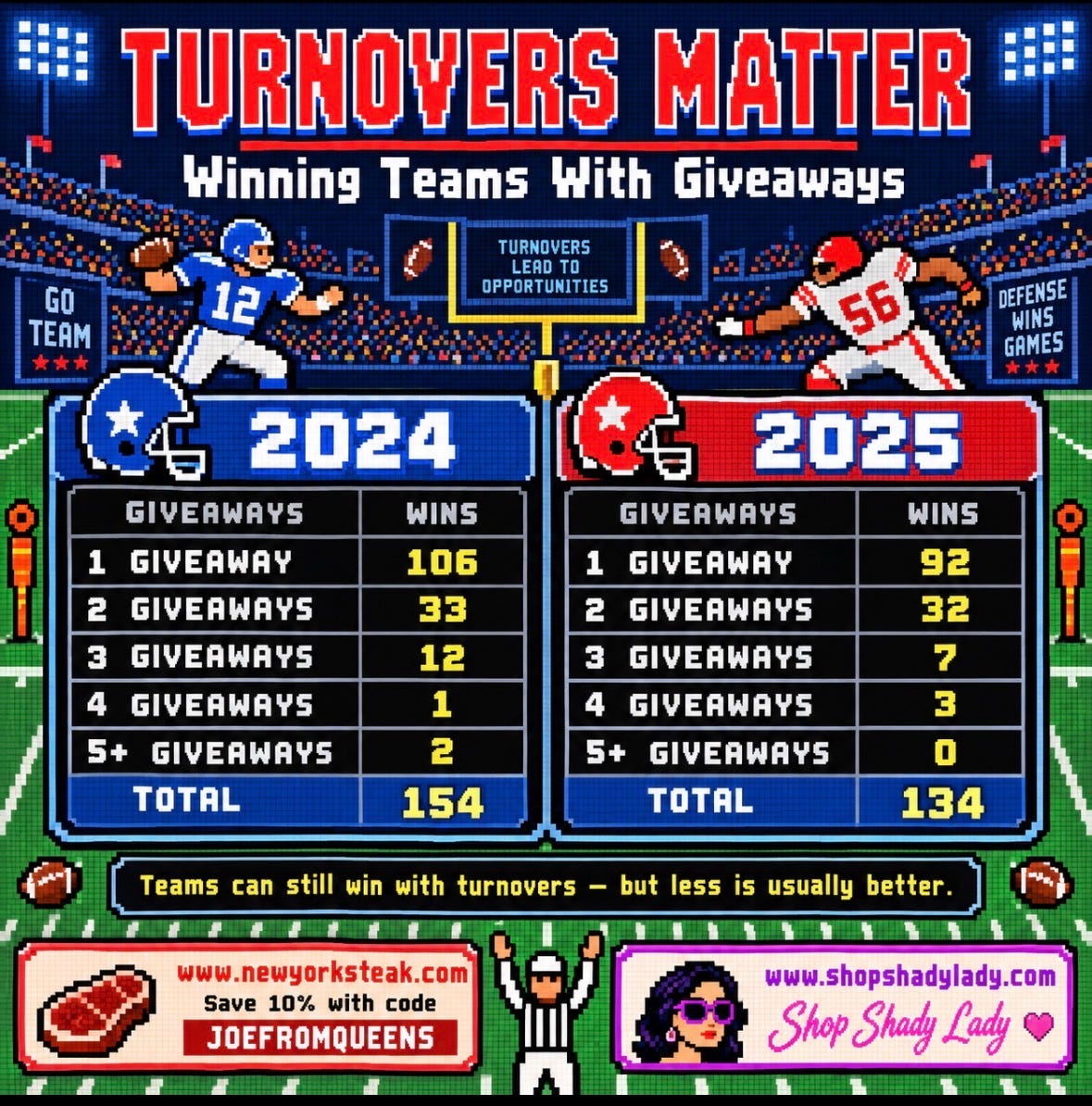
That’s 288 wins in two seasons where the winning team committed at least one turnover.
Even crazier: when both teams turned the ball over, the winner actually committed more turnovers 34 times over the two seasons.
But here’s where we shouldn’t get stupid with this argument.
When the two teams finished with different turnover totals, the team with fewer giveaways went 110-34.
That’s a .764 winning percentage.
So yes.
Winning the turnover battle is still extremely valuable.
It’s just not some automatic law of football.
Josh Allen
This is where Josh Allen has always made the turnover conversation fascinating to me.
I think Allen absolutely benefited in the 2024 MVP race from finally knocking down the raw turnover number.
For years the conversation was always:
Yeah, but Josh turns it over.
Then in 2024, the interceptions dropped dramatically and suddenly a lot of the old-school football writers who had spent years hammering him over turnovers could check that box.
Now he was the MVP.
And here’s the funny part:
I can sit here and argue that Josh Allen was a better pure quarterback in 2020 or 2021 than he was during his MVP season.
That’s not an insult to his MVP season.
It’s the point.
We sometimes use turnovers as this giant morality grade for quarterback play instead of asking how damaging those turnovers actually were.
Who Actually Turned It Over The Most?
You would expect the teams with the most giveaways to be terrible.
In 2024, that was mostly true.
None of the five made the postseason. NFL standings confirm Cleveland and Tennessee finished 3-14, Indianapolis 8-9, Las Vegas 4-13 and Dallas 7-10.
Pretty convincing argument for protecting the ball, right?
Then 2025 comes along.
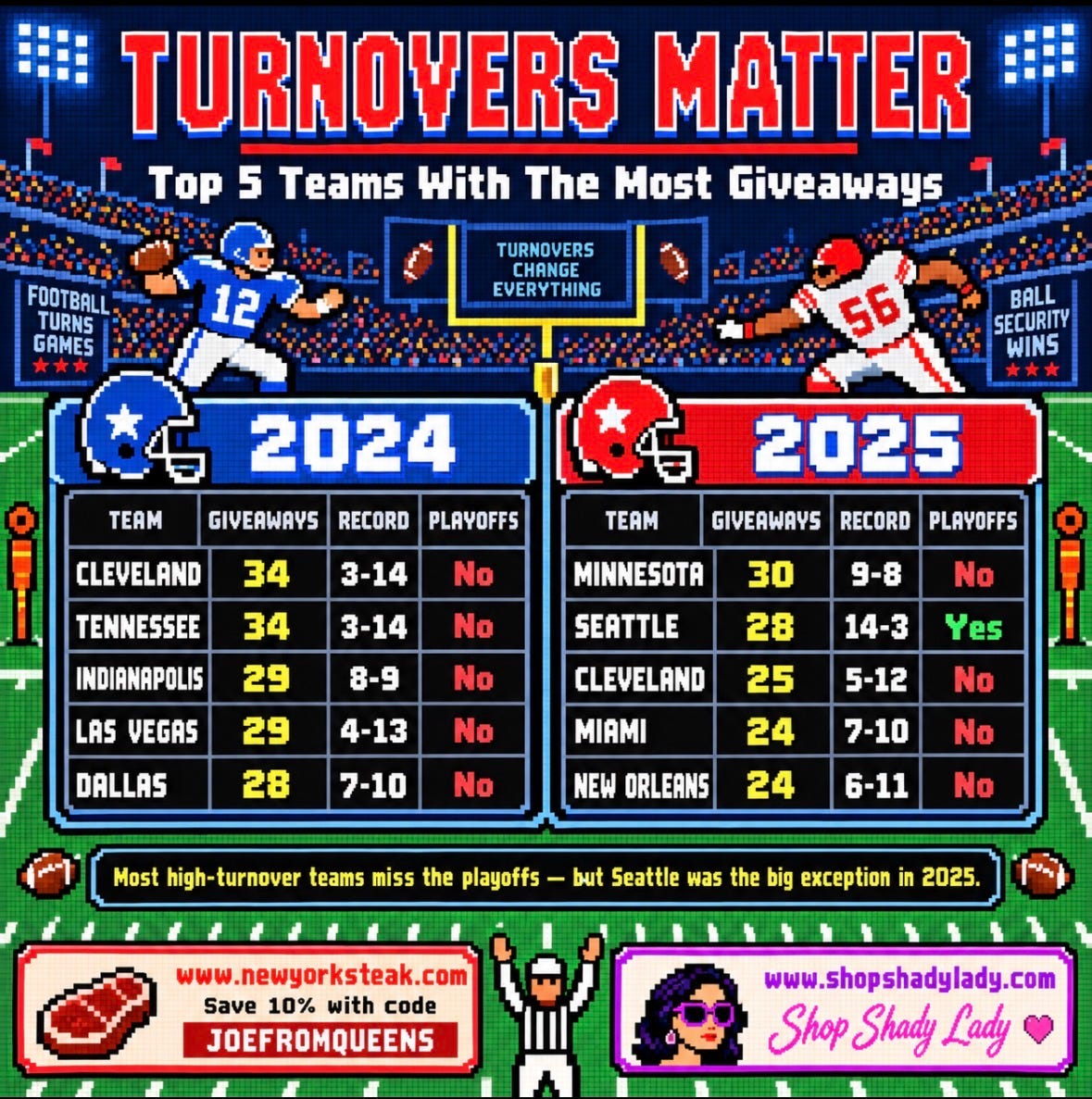
Four of the five missed the playoffs.
And then there is Seattle.
The Seahawks turned it over 28 times and went 14-3, won the NFC West and won the Super Bowl.
That’s the type of team that makes the turnover conversation more interesting.
Because clearly 28 turnovers didn’t destroy Seattle.
Why?
Because a team’s ability to survive a mistake matters too.
Points Off Turnovers Matter More Than The Raw Number
This is where I think the conversation gets much more useful.
Instead of only asking how many turnovers a team had, let’s look at net points off turnovers.
In 2024 and 2025 here is the top three teams in net points off turnovers were…
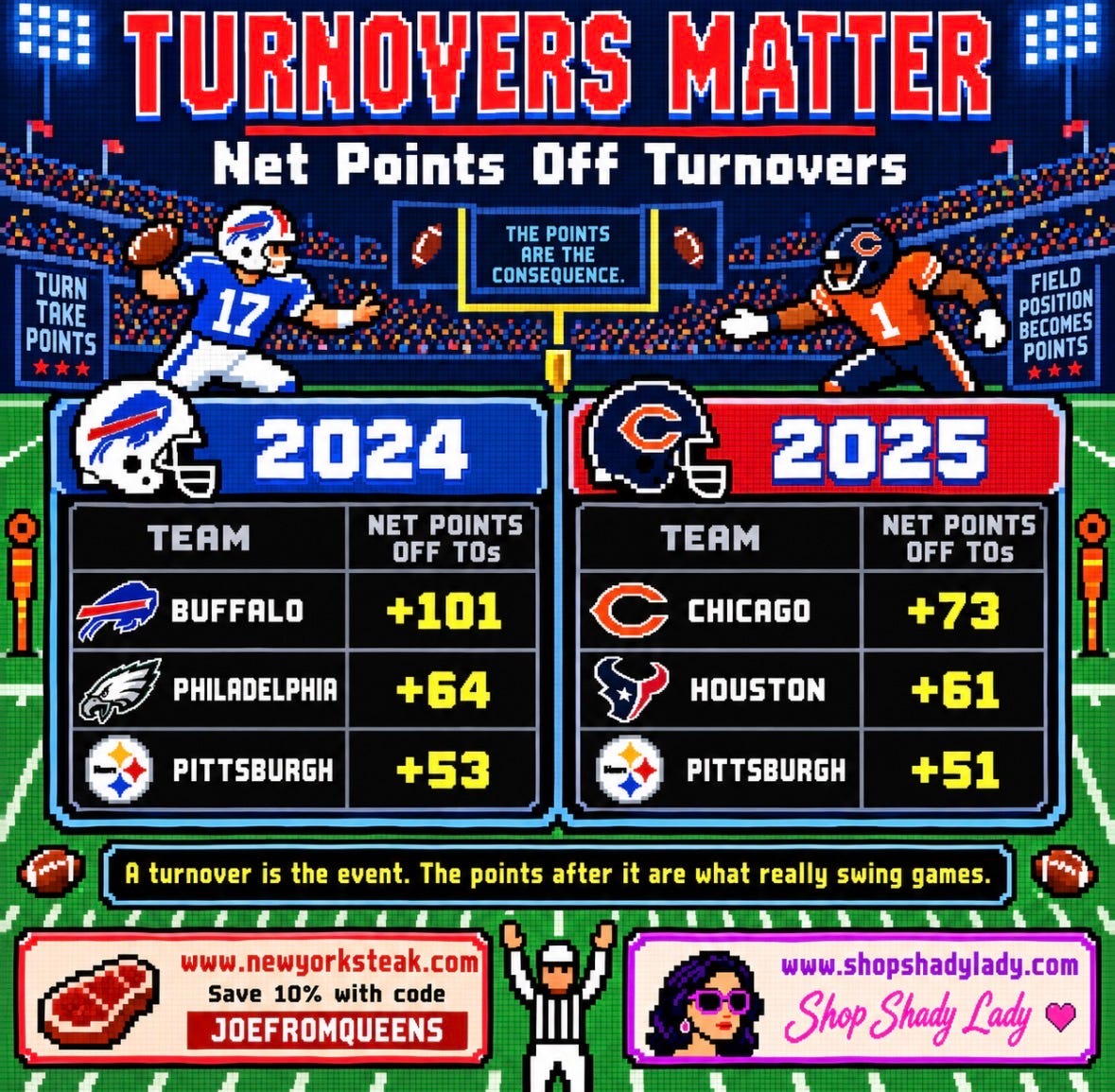
This tells me much more than a raw giveaway number.
Take Buffalo’s +101 in 2024.
That’s not simply an offense protecting the ball.
That’s takeaways.
That’s field position.
That’s turning the other team’s mistakes into touchdowns and field goals.
That’s Buffalo’s defense sometimes preventing the opponent from cashing in after the Bills screwed up.
A turnover is the event.
The points are the consequence.
And the consequence is what actually decides the game.
Where You Turn It Over Matters
This is the part that interested me most.
I went through the individual turnover plays from 2024 and 2025, removed penalty-erased plays, punts and other special-teams plays, and categorized the offensive giveaways based on where the play started.
That’s important.
This isn’t necessarily where the fumble was recovered or where an interception return ended.
It’s the offense’s field position when the snap happened.
Using non-overlapping sections of the field, here’s what I found:
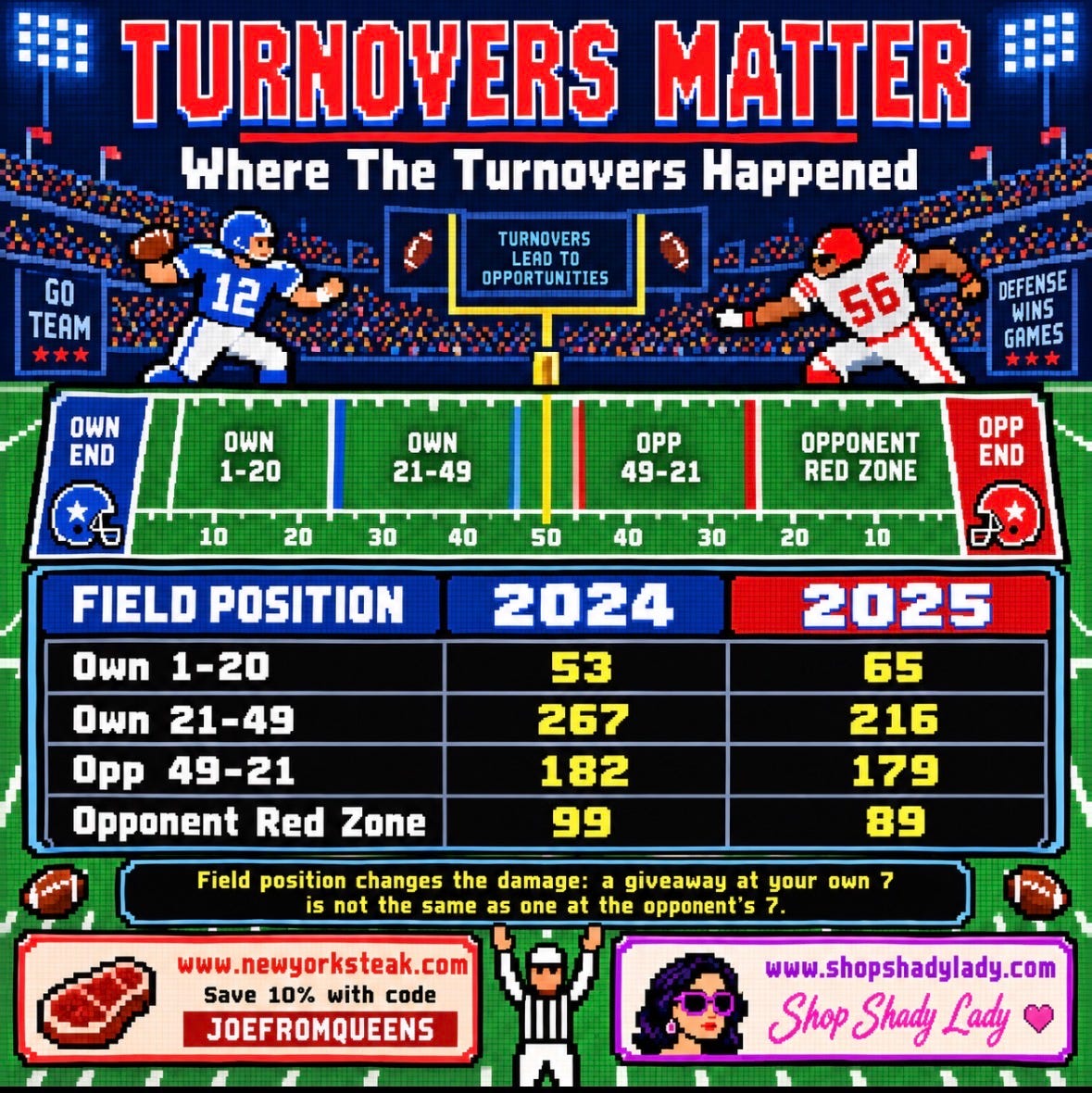
And this is exactly why I don’t like treating every turnover equally.
A turnover from your own 7 can practically hand the opponent points.
A turnover at the opponent’s 7 doesn’t give the opponent good field position at all, but it wipes out a scoring opportunity you already spent an entire drive creating.
Those are two completely different kinds of damage.
Who Turned It Over Deep In Their Own Territory?
Here’s another interesting way to look at it.
Which teams repeatedly gave opponents the ball after beginning a play inside their own 20?
In 2025, the leaders included:
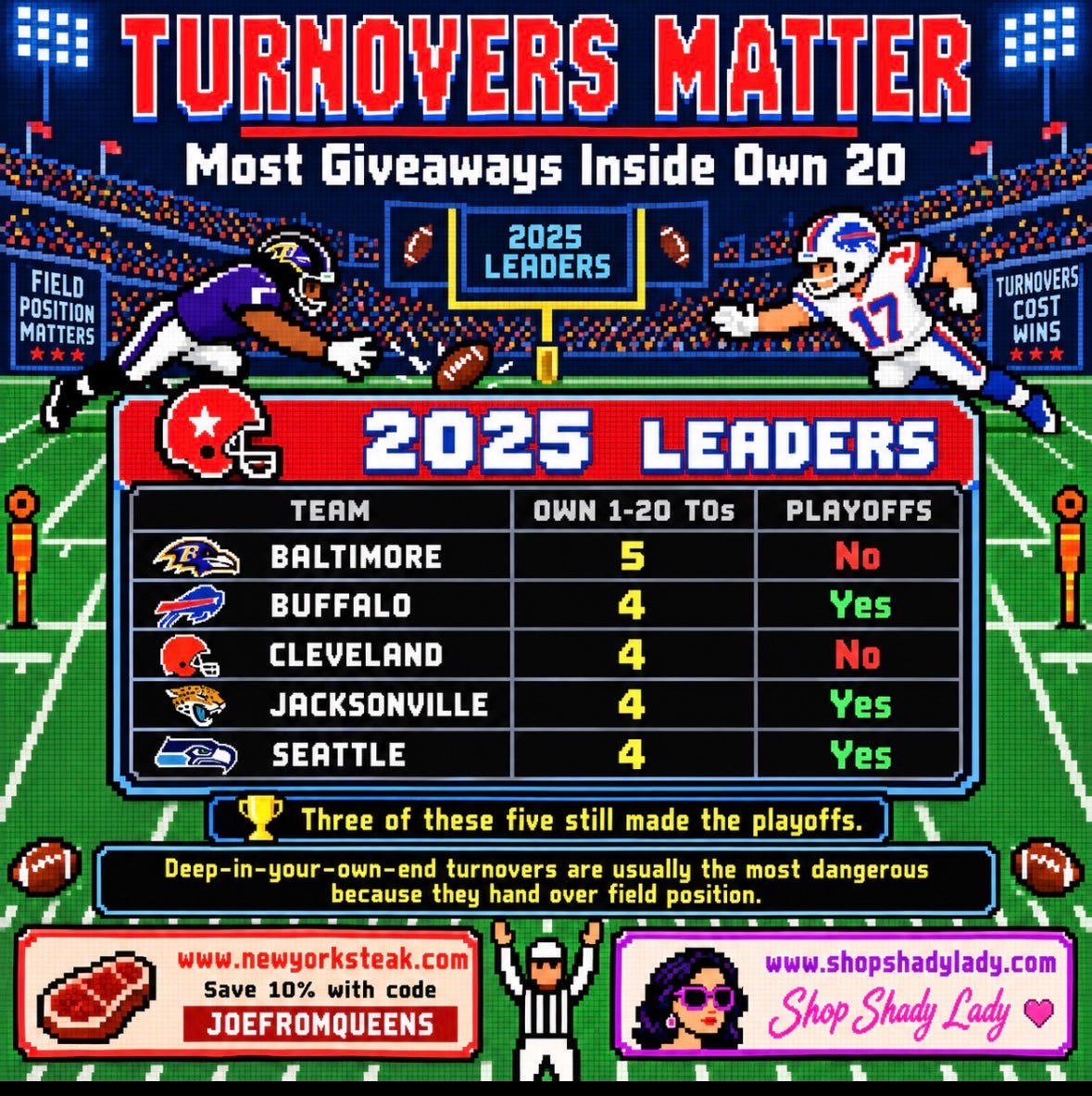
Buffalo finished 12-5 and made the playoffs, Jacksonville went 13-4 and won its division, and Seattle went 14-3. Baltimore finished 8-9 and Cleveland 5-12.
Again, this doesn’t mean those turnovers were harmless. It means good teams can survive them.
Buffalo is a perfect example.
In 2024, Buffalo had zero giveaways on plays beginning inside its own 20 in this dataset.
In 2025, they had four.
Allen himself had some ugly field-position turnovers, including an interception against Tampa Bay on a play beginning at the Buffalo 5.
That’s the kind of turnover where the location really matters.
It’s not just an interception.
It’s an interception where the opposing offense doesn’t have to do much work to turn your mistake into points.
That’s much more damaging than a deep interception from the opponent’s side of midfield.
What About Red-Zone Turnovers?
Now flip the field.
A red-zone turnover creates a different problem.
You’re not necessarily giving the opponent great field position.
You’re taking points away from yourself.
That’s why I wanted to isolate them.
In 2024, the biggest red-zone giveaway totals included:
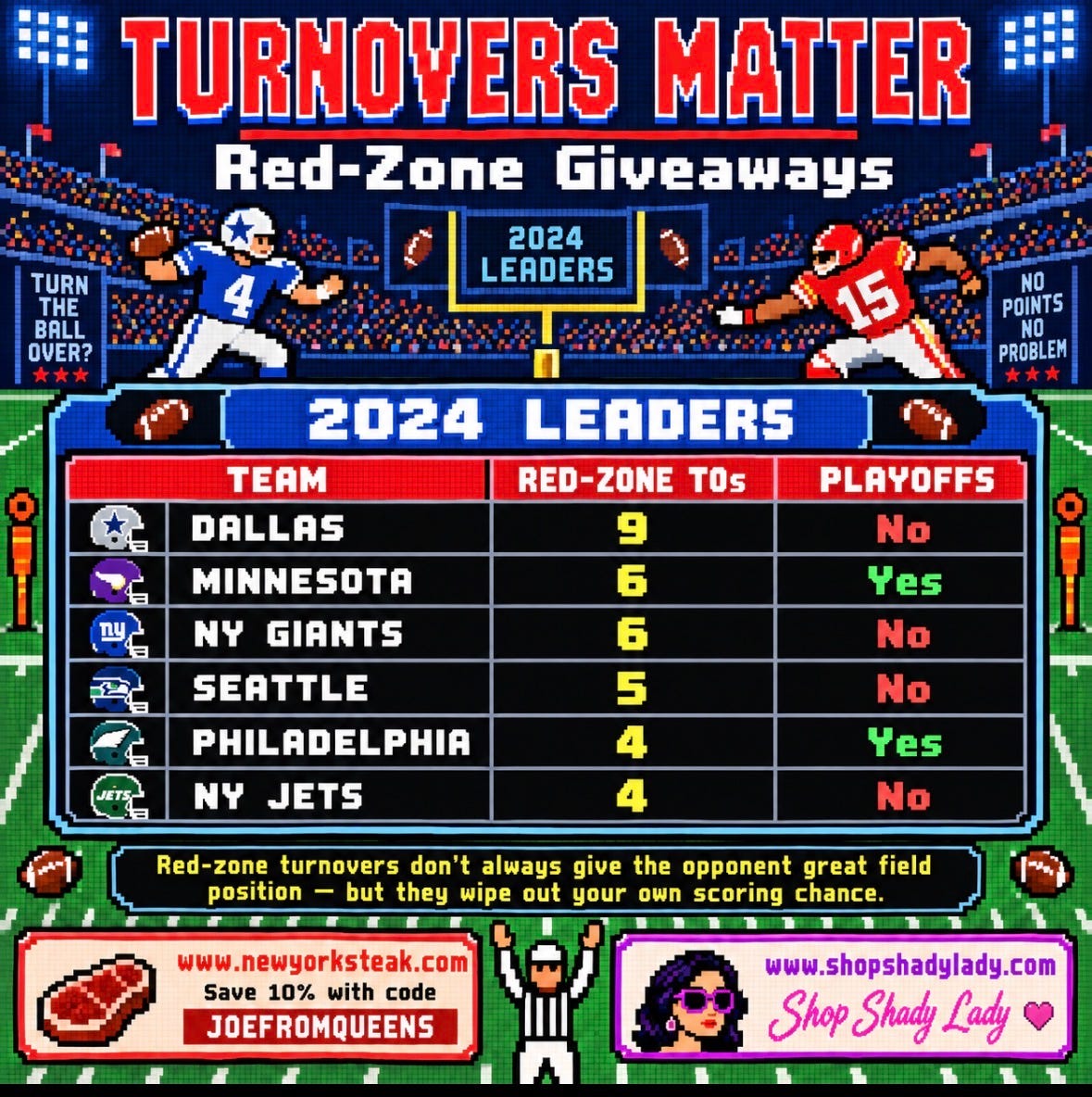
Minnesota went 14-3 and Philadelphia 14-3 and both reached the postseason, while Dallas, Seattle, the Giants and Jets missed it.
Then in 2025:
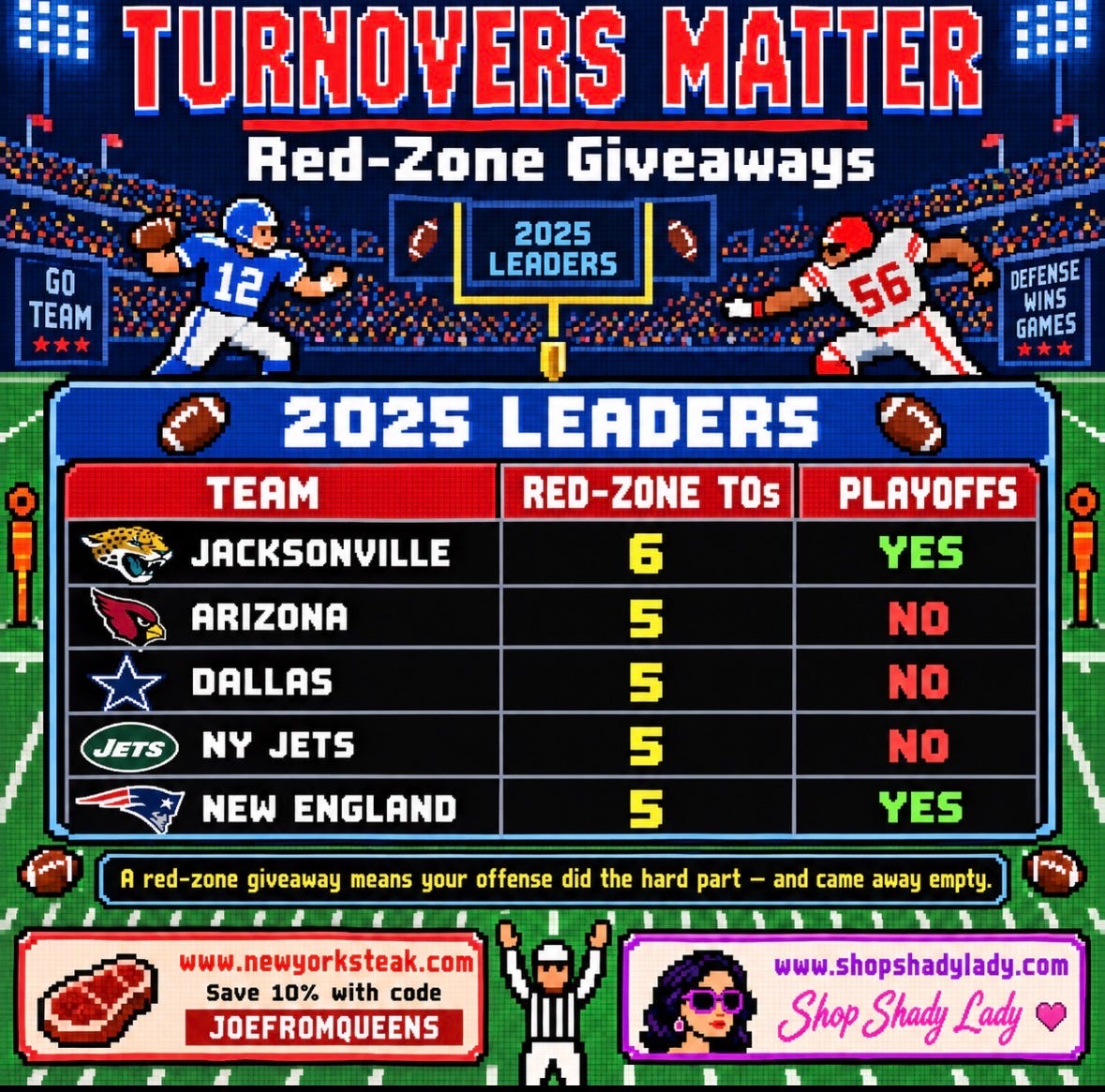
Jacksonville went 13-4 and New England 14-3 despite being among the league leaders in red-zone giveaways. Arizona and the Jets each finished 3-14, while Dallas went 7-9-1.
That’s another reminder that the turnover itself doesn’t tell you the entire story. Two of the top 5 teams in each category went to the Super Bowl. (Pats/Eagles)
Josh Allen
Buffalo had two red-zone giveaways in 2024 and four in 2025 in this study.
That’s where I think Allen’s turnovers deserve more criticism than the random raw interception number.
If Allen throws a pick from the opponent’s 5, Buffalo has potentially taken seven points off its own scoreboard.
That hurts.
A lot.
But that’s also precisely why we should separate it from a turnover that occurs in a completely different situation.
If you’re going to criticize the mistake, criticize the actual mistake and its actual cost.
Don’t just yell “TURNOVERS!”
So How Much Do Turnovers Actually Matter?
Teams that lose the turnover battle lose more often than they win and the five teams with the most giveaways in 2024 all missed the playoffs.
Four of the five teams with the most giveaways in 2025 missed the playoffs.
But then Seattle turns it over 28 times, goes 14-3 and wins superbowl
Buffalo goes from having no giveaways beginning inside its own 20 in 2024 to four in 2025 — and still finishes 12-5 and makes the playoffs.
Jacksonville has six red-zone giveaways in 2025 and still goes 13-4.
New England has five and goes 14-3.
So the modern turnover conversation probably needs to be somewhere between the two extremes. The old football guys were wrong if they treated every turnover like an automatic death sentence.
The advanced-stats crowd would be wrong if it acted like turnovers were mostly random noise that doesn’t matter.
They matter.
But context matters too.
Where did you turn it over?
How many points did it cost?
How good was the field position?
Did your defense bail you out?
How often were you turning the ball over compared with how much offense you were creating?
Those are much more interesting questions.
And that’s particularly true when talking about Josh Allen. I don’t want him throwing interceptions. I especially don’t want him throwing interceptions from his own 5 or in the opponent’s red zone. But I also don’t want him playing quarterback like the only goal is avoiding a negative statistic.
Because football isn’t played on a spreadsheet and the turnover column tells you that something bad happened.
It doesn’t necessarily tell you how bad it was.