


Welcome to The Wormhole, a new recurring Joe From Queens series where I have one simple sports question, start looking for the answer, and inevitably end up somewhere I never intended to go.
There are a million different ways to look at change in the NFL, especially when you’re talking about a defense changing coordinators, changing schemes and changing a bunch of the people actually playing in it.
Sometimes it works immediately. Sometimes it takes a year. Sometimes it takes two. And sometimes everybody spends six months talking themselves into how it’s eventually going to work before realizing the whole thing just sucks.
Bills fans have seen pretty much every version of this.
I remember Wade Phillips’ defense giving way to Gregg Williams, and that sure as hell wasn’t an overnight transformation. I remember Dave Wannstedt giving way to Mike Pettine and suddenly it felt like the Bills were playing a completely different sport. Then Pettine left, Jim Schwartz came in and changed it again. Then Rex Ryan arrived after Schwartz and inherited one of the best defenses in football, only to make everybody wonder why the hell we needed to change it in the first place.
Which brings us to Jim Leonhard.
Two games.
That’s it.
So I’m not going to sit here and tell you Jim Leonhard has fixed the Bills defense, and I’m also not ready to tell you this thing is a disaster because C.J. Stroud and Jared Goff threw the ball all over the place.
What I can tell you is that it’s different.
And the numbers are fucking weird.
Through two games, the Bills have allowed 62 points, 31 in each game. Opposing quarterbacks have completed 52 of 76 passes for 546 net passing yards, six touchdowns, zero interceptions and a 118.4 passer rating.
That’s terrible.
There really isn’t a nice way to dress that up.
But then I look at the pass rush and wonder what the hell I’m supposed to make of this defense.
Buffalo has seven sacks, 25 pressures, 10 quarterback knockdowns and seven hurries. Their pressure-to-sack rate is 29.1%, which ranks third in the NFL through two weeks. That’s up from 19% last season and 12.8% in 2024.
Here’s the strange part: their overall pressure rate is only 27.1%, which is in the bottom quarter of the league.
So the Bills aren’t constantly getting to the quarterback. But when they do, they’re actually putting his ass on the ground.
And that’s where I wanted to go back and look at this differently.


HOW DIFFERENT IS THIS FROM THE LAST SIX YEARS?
Instead of throwing another wall of numbers at you, I put the first two games of every Bills season since 2020 into the graphic below, and there are a couple things that immediately jump out.
First, blitzing and creating pressure are not remotely the same thing.
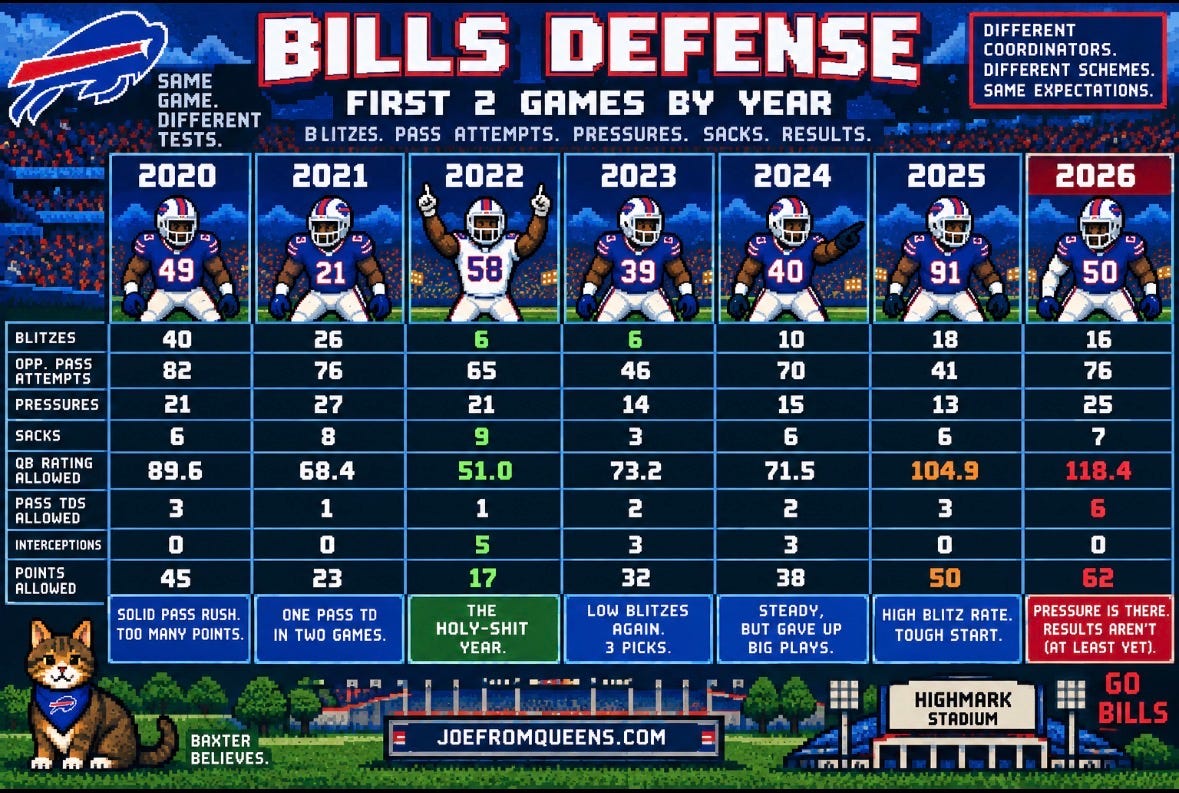
The best example is 2022, which remains the holy-shit comparison for me. Buffalo barely blitzed at all and still got to the quarterback constantly, while creating turnovers and keeping teams off the scoreboard.
Compare that with 2020, when the Bills were sending extra rushers all over the place without getting nearly the same return. That’s why I’m not particularly interested in whether Leonhard is blitzing more or less than Sean McDermott did. I’m interested in whether the pressure actually accomplishes something.
And through two games, that’s where this gets weird.
The Bills are getting pressure, sacks.l and hitting quarterbacks. They’re also getting absolutely torched when the quarterback gets the ball out. That’s the disconnect I’m trying to figure out with this defense.
The pass rush looks like it might be better.
The pass defense sure as hell doesn’t.
And somehow both things can be true at the same time.
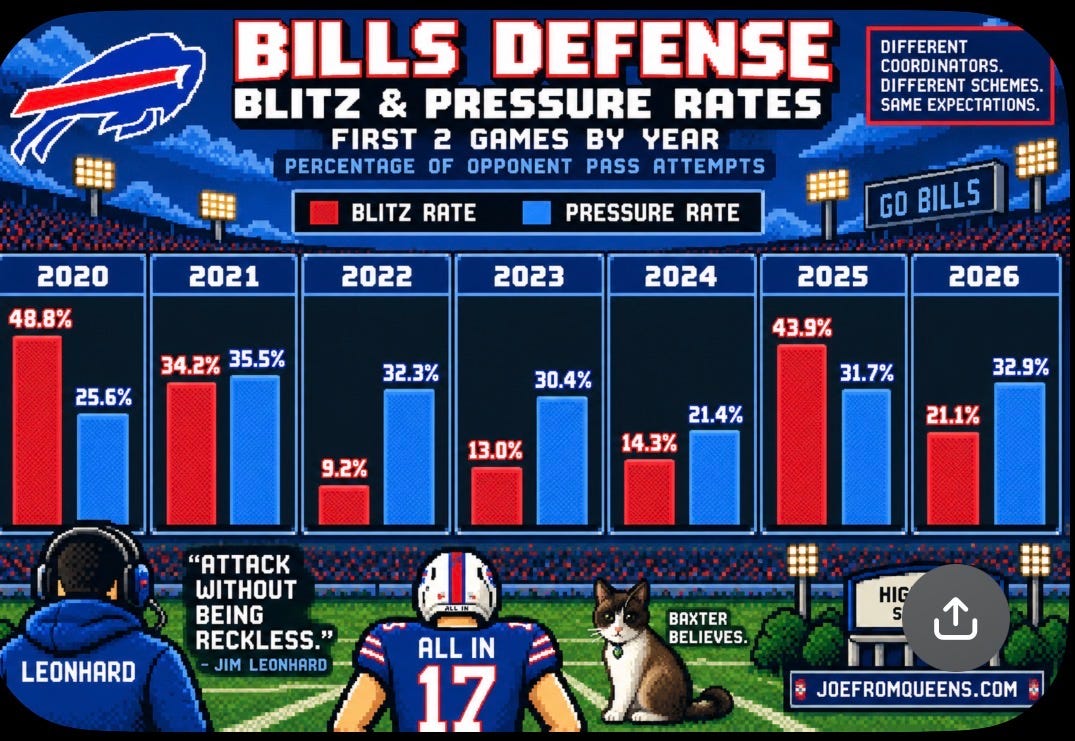
HERE ARE THE PERCENTAGES
I’m using opponent pass attempts as the common denominator because I wanted the same calculation for all seven seasons.
These are NOT official blitz and pressure rates. It’s simply blitzes and pressures divided by opponent pass attempts.
And look at that last number.
Buffalo’s 32.9 pressures per 100 opponent pass attempts is the second-highest figure through two games in this entire seven-year sample, trailing only 2021. Yet the 118.4 passer rating they’ve allowed is easily the worst.
That’s Jim Leonhard’s defense after two games in one sentence.
They’re affecting quarterbacks and simultaneously getting murdered by quarterbacks.
BUT WHO THE HELL WERE THEY PLAYING?
This is where I think the comparison gets more interesting, because allowing 45 points against one set of quarterbacks isn’t necessarily the same thing as allowing 45 against another.
So who did Buffalo actually face in those first two games…teams that weren’t very good. Only 3 teams here finished above .500 and that was 2020 and 2021.
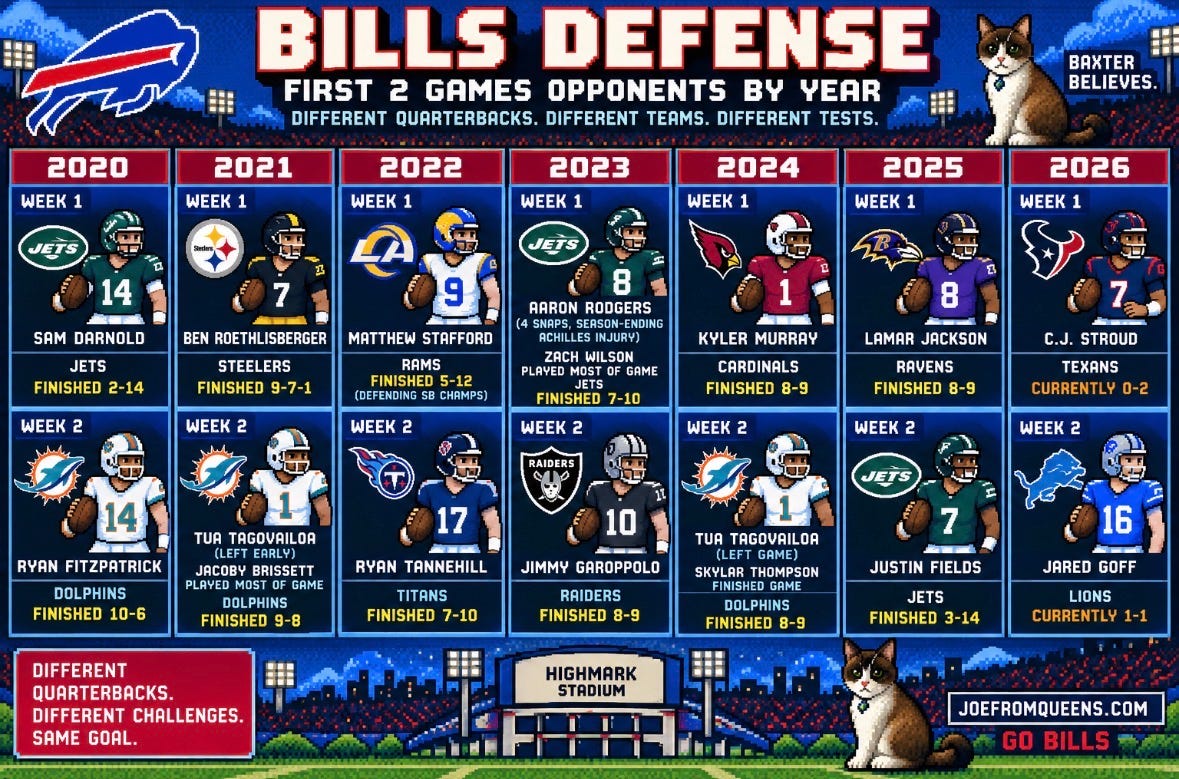
Houston is currently 0-2 and Detroit is 1-1, so obviously we can’t compare their records directly with see completed 17-game seasons yet.
But from a quarterback standpoint, that’s a pretty serious opening test.
Stroud threw for 274 yards and two touchdowns.
Then Goff threw for 327 yards and four touchdowns.
That’s 601 gross passing yards and six touchdowns in two games.
So when I say this is the worst opponent passer rating Buffalo has allowed through two games in this sample, there’s at least some context that has to come with it.
This isn’t Sam Darnold and Zach Wilson.
It’s Stroud and Goff.
Now, that doesn’t excuse a 118.4 passer rating, or six touchdown passes, and it sure as hell doesn’t excuse allowing 31 points in consecutive games.
But it does make me less interested in simply lining up the points-allowed column and declaring one Bills defense better than another.
The competition matters.
AND 2022 IS A GREAT EXAMPLE OF WHY
That 2022 start looks fucking ridiculous statistically.
Seventeen points allowed.
Nine sacks.
Five interceptions.
One passing touchdown.
51.0 opponent passer rating.
And at the time, it looked even better because Buffalo had just beaten the defending Super Bowl champions and then destroyed Derrick Henry and Tennessee.
But those teams eventually went a combined 12-22.
The 2025 opponents finished a combined 11-23.
The 2024 opponents went 16-18.
The 2023 opponents went 15-19.
The 2021 opponents went 18-15-1.
The 2020 opponents went 12-20.
Again, I’m not using that to excuse Leonhard.
I’m using it because if we’re going to compare seven different Bills defenses after exactly two games, we should probably acknowledge they didn’t take the same test.
AGGRESSIVE DOESN’T NECESSARILY MEAN BLITZING
This is something I think we got wrong when Leonhard was hired.
We heard aggressive.
We heard attacking.
We saw where he came from.
And I think a lot of us immediately translated that into blitzing the shit out of everybody. But Leonhard said before the season that Buffalo was going to be aggressive without being reckless, and that how you attack a quarterback has to change depending on who you’re playing.
That’s important.
The Bills went from the 4-3/nickel foundation we’ve watched forever under Sean McDermott to Leonhard’s 3-4 structure.
The outside linebackers can rush or they can drop or Buffalo can show five and send four or they can move people around before the snap.
The offense has to figure out where the fourth rusher is coming from instead of simply counting how many guys are standing near the line of scrimmage.
That’s aggression, too.
And we’re already seeing some evidence that it’s working.

GREG ROUSSEAU MIGHT BE EXHIBIT A
If you’re looking for the player who appears to have benefited most from this change so far, it’s Greg Rousseau.
Four sacks in two games.
Two against Houston.
Two against Detroit.
He’s now only the second Bills player in franchise history to record at least two sacks in each of the first two games of a season.The other guy was Bruce Smith. Pretty decent company.
Rousseau had six pressures against Detroit alone, and he’s talked about how the move to Leonhard’s 3-4 defense has helped him.
And Rousseau isn’t doing this by himself.
Deone Walker has been causing problems in the middle. Bradley Chubb got his first sack as a Bill against Detroit, and Buffalo finished with four sacks of Goff. Detroit was missing three starting offensive linemen, so I’m not hanging a banner for it. But that’s what you’re supposed to do when an offensive line is missing three starters.
Destroy it.
THE PART THAT SCARES THE SHIT OUT OF ME
Six passing touchdowns.
Zero interceptions.
That’s the part I can’t explain away with scheme changes or small samples.
Look at the first two games of every season for passing TDs:
2020: 3
2021: 1
2022: 1
2023: 2
2024: 2
2025: 3
2026: 6
That’s twice as many as any Bills defense in this seven-year sample. And while Buffalo has created turnovers with forced fumbles, the lack of interceptions still matters because Leonhard spent the offseason talking about attacking the football and creating turnovers.
The Bills are also allowing a ton after the catch.
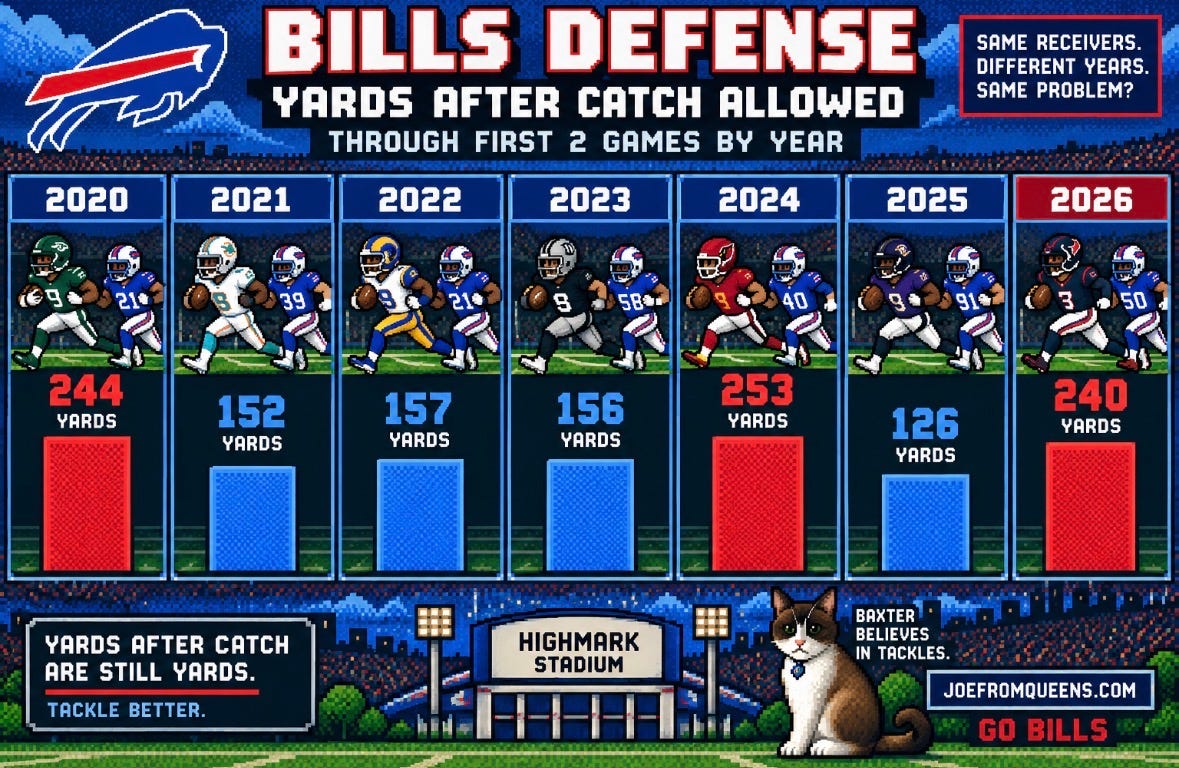
So the YAC itself isn’t unprecedented.
The problem is they’re getting hit everywhere. They’ve also allowed 361 air yards, the most in this seven-year sample. This isn’t just quarterbacks checking it down for seven yards while Bills defenders rally to the football. They’re giving up stuff downfield AND they’re giving up yards after the catch and that’s how you end up with a 118.4 passer rating.
AND THEN THERE’S THE RUN DEFENSE
This is where the whole thing gets even stranger. The Bills have allowed only 190 rushing yards through two games, 95 per game and 3.6 yards per carry.
So we’ve got a defense that can stop the run, sack the quarterback and produce 25 pressures in two games.
We’ve got a defense converting pressures into sacks at one of the best rates in football.
And we’ve got a defense allowing 31 points per game.
Make it make sense.
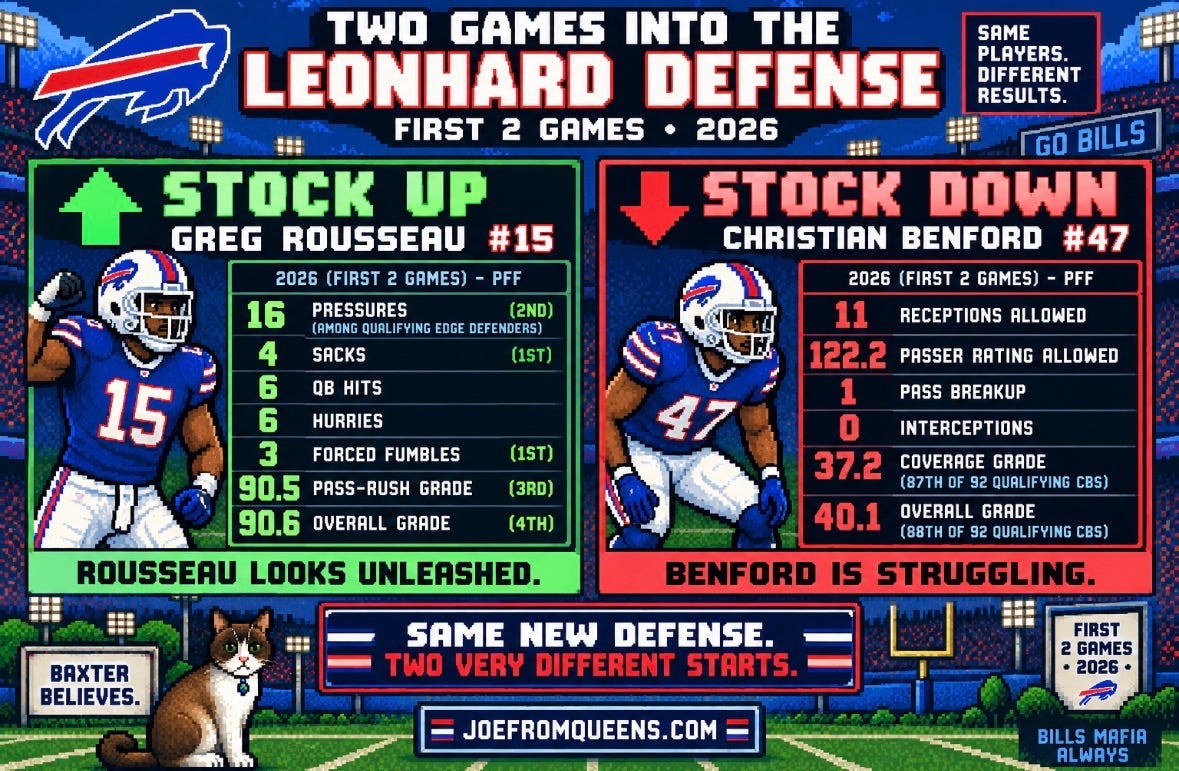
STOCK UP: GREG ROUSSEAU
If anybody looks like he was waiting his entire career for Jim Leonhard to show up, it’s Greg Rousseau.
Rousseau averaged about 26 pressures and six sacks per season over his first five years in Buffalo.
Two games into 2026, he already has 16 pressures and four sacks.
Sixteen pressures.
That’s more than 60% of what he averaged over an entire season before Leonhard got here.
And it isn’t just sacks.
PFF has him with six quarterback hits, six hurries and three forced fumbles already, while grading him as the third-best pass rusher among qualifying edge defenders.
This is what I mean when I say the defense can simultaneously look encouraging and terrifying.
Leonhard moved Rousseau from a traditional defensive-end role to outside linebacker in the new front, and so far Rousseau looks fucking unleashed.
STOCK DOWN: CHRISTIAN BENFORD
And then there’s Christian Benford, which might be the most concerning individual development on the entire defense.
From 2022 through 2025, quarterbacks targeting Benford had an 85.8 passer rating. He allowed 62.4% of those passes to be completed and only 6.7 yards per target.
This year?
PFF has his passer rating allowed at 122.2.
He’s already surrendered the following:
11 completions
zero interceptions
owns a 37.2 coverage grade
87th out of 92 qualifying cornerbacks.
That’s not a small drop….That’s falling off a fucking cliff.
And this is where I’m curious about Leonhard beyond simply looking at the box score, because Benford spent his career becoming one of the league’s better corners in a defense built heavily around zone coverage.
Before this season, quarterbacks had produced only a 68.5 rating targeting him in zone, compared with 110.7 in man.
If Leonhard is asking him to play differently, maybe we’re watching the growing pains happen in real time. That doesn’t mean Benford can’t play in this defense, and two games sure as hell don’t erase four years of evidence that he can play cornerback.
But through two games, the two players might be the perfect representation of the entire Jim Leonhard experiment.
Greg Rousseau looks like Leonhard unlocked something.
Christian Benford looks like Leonhard changed something.
Now we have to find out whether both of those things are permanent.

Final word
Maybe the best way to describe Jim Leonhard’s defense after two games: there’s enough working that I’m not ready to panic and enough going wrong that I’m sure as hell not ready to celebrate. The front looks better, Rousseau looks unleashed, they’re getting quarterbacks on the ground and the run defense has done its job.
But you don’t get to give up 31 points every week and point to pressure numbers as proof everything is fine. Eventually those pressures have to create bad throws, those bad throws have to become interceptions, and somebody in the secondary has to stop turning every completion into another first down.
That’s why I’m more fascinated by this defense than discouraged by it. The Bills didn’t make this change because the old defense was terrible, they made it because being pretty good wasn’t good enough anymore, especially when January kept ending the same fucking way. So I’m willing to live with some September growing pains if Leonhard is building a defense that looks different when the games actually matter. But that’s the standard now and they didn’t hire Jim Leonhard to make this defense different.
They hired him to make January different

STAT SOURCES: Statistical research for this story came from Pro Football Reference/Stathead and Pro Football Focus (PFF). PFR/Stathead was used for the historical Bills defensive comparisons, opponent passing numbers, blitzes, pressures, hurries, knockdowns, YAC and player career statistics. PFF was used for 2026 player-level advanced data and grades, including Greg Rousseau’s pass-rush numbers and Christian Benford’s coverage numbers. Because different providers can define and chart pressures differently, statistics from PFR and PFF are identified separately rather than treated as interchangeable.
Very interesting article-if they give up 30 + points to the chargers we have a big problem on our hands