

As I woke up Monday morning to take Andy to school, I did what I always do: checked X to see what was going on. A clip from WGR’s morning show came across my feed asking whether the Bills have a little bit of a Josh Allen problem in the final two minutes. I didn’t look at the mentions, but I’m going to assume they weren’t pretty. Or who knows? Maybe everyone had a thoughtful discussion and wished each other a wonderful Monday.
On this site, I like to operate under the philosophy that there’s no such thing as a stupid question. There might be a stupid answer, and I’ve probably supplied a few of those over the years, but asking the question is fair game. I also like going down wormholes, which is why this piece is called ‘The Wormhole.’ Something catches my attention, I start looking into it, and suddenly I’m digging through play-by-play logs when I should probably be doing something else. This morning, the question was whether there’s actually anything to this Josh Allen discussion.
As an NFL Primetime mark, I always think of that old saying Berman used to say: once is a mistake, twice is a trend, three times we have a problem. I don’t know where Allen falls on that scale in these situations, which is why I wanted to look. There have been some epic moments, and there have been endings that make you want to stare at the ceiling for an hour. Sometimes he’s delivered what should have been the winning score, only for the defense to give it back. Sometimes he’s had the ball with a chance to save the day and hasn’t gotten it done.
So I widened the question from the final two minutes to the final three and included overtime. Going back to the 2020 season, including the playoffs, how has Allen performed when the Bills were tied or trailing by one to seven points before the snap? And how do those numbers compare with Patrick Mahomes, Joe Burrow, Lamar Jackson, Jared Goff, Jalen Hurts and Matthew Stafford? I wanted to see what the numbers said before deciding what the story was. Down the wormhole we go.
Before we go year by year, here are the rules: three minutes or less remaining in the fourth quarter, plus all of overtime, with Buffalo tied or trailing by one to seven points before the snap. Postseason games are grouped under the season they belonged to. These are Allen’s numbers only in those situations, not his full-game stats. Eight-point deficits, two-point attempts and plays wiped out by penalties don’t qualify. Spikes and kneel-downs count, and the cutoff is October 4, 2026.
2020: Two late touchdown drives, two very different endings
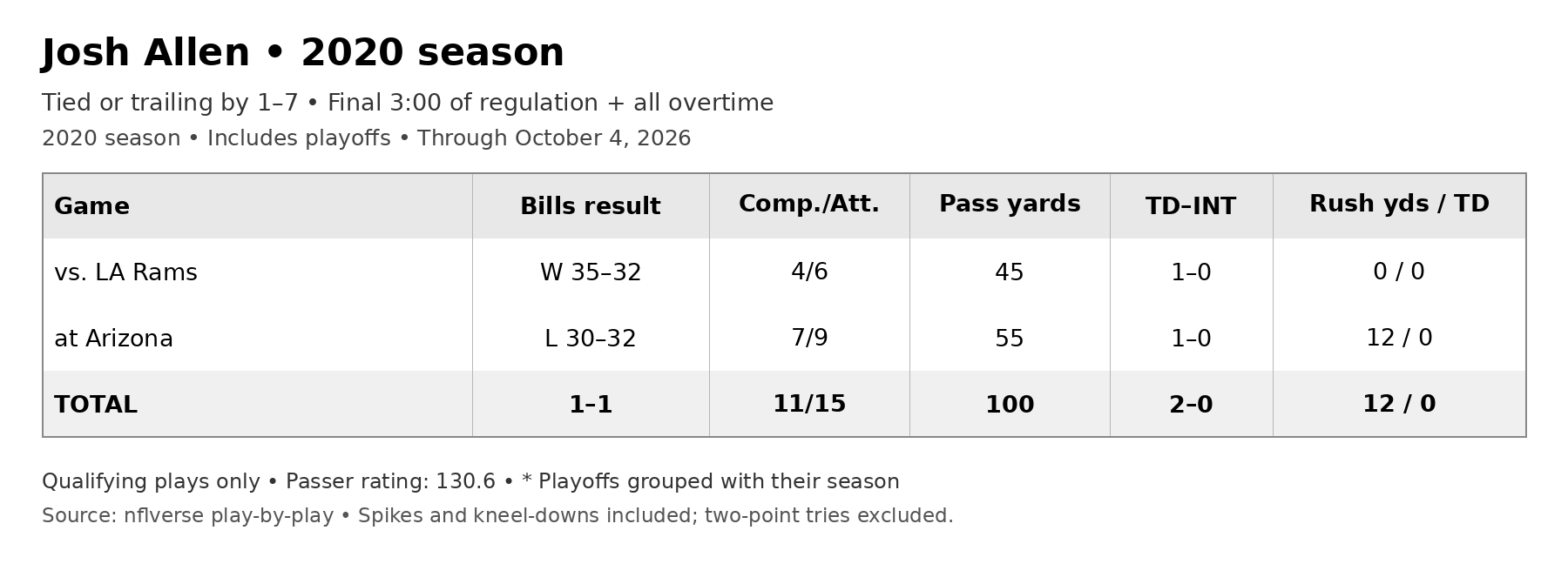
Rams: Allen threw the winning touchdown to Tyler Kroft with 15 seconds remaining. Buffalo needed him to rescue a game after letting a huge lead disappear, and he did.
Arizona: Allen threw the go-ahead touchdown to Stefon Diggs with 34 seconds left. Then the Hail Murray happened, which is your first reminder that a loss in this chart doesn’t automatically mean Allen failed.
That’s a pretty good opening chapter. He completed 73.3% of his passes in this sample, threw two touchdowns without an interception and put Buffalo ahead late in both games. The Bills won one of them. If you’re using the record alone to judge the quarterback, you’ve already lost part of the story.
2021: The record looks worse than the quarterback
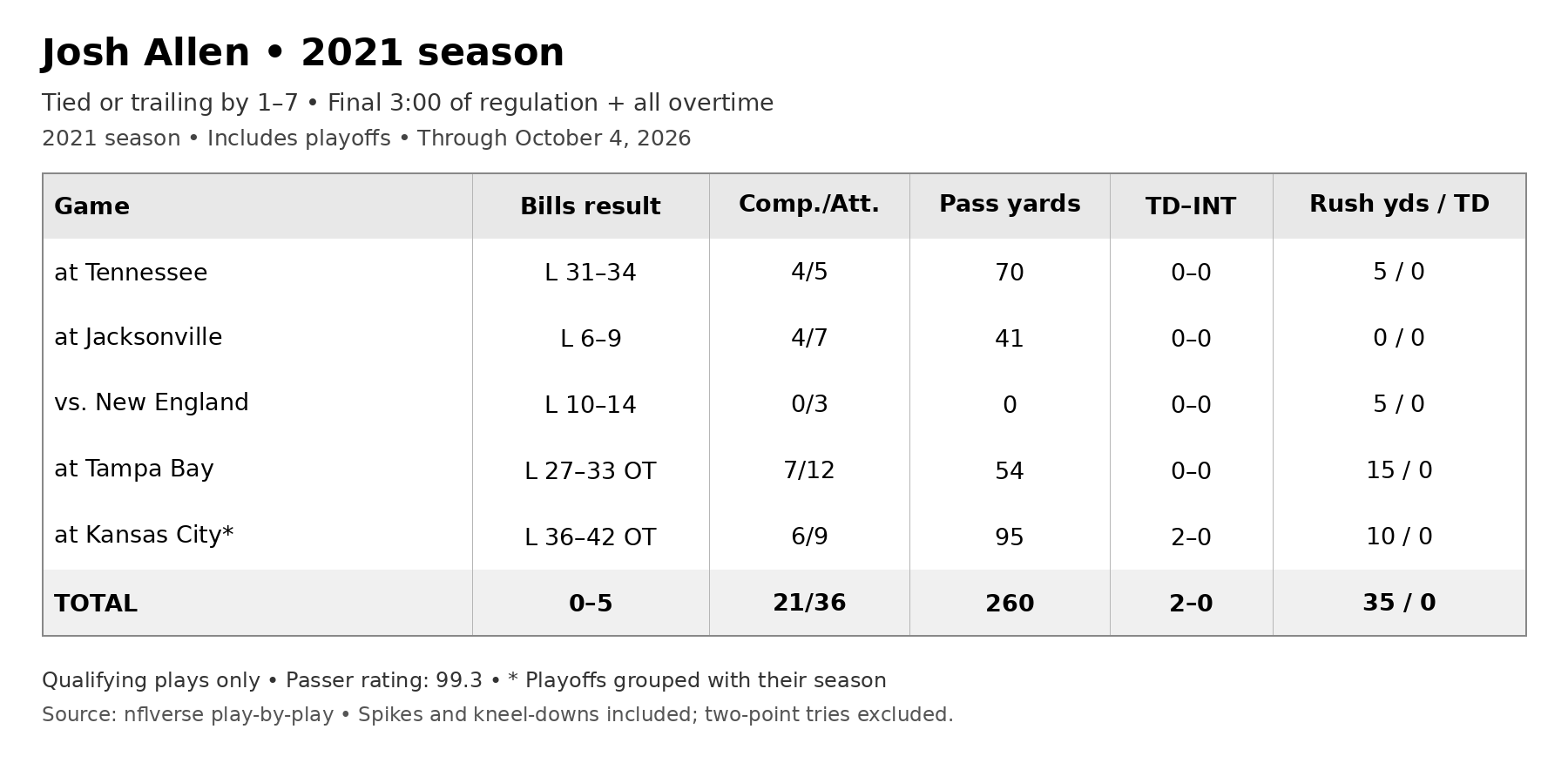
Tennessee: Allen went 4-for-5 for 70 yards in the window, moving Buffalo into scoring position. The fourth-down sneak came up short.
Jacksonville: He completed four passes for 41 yards, but the final possession ended without points. A sack helped derail the drive.
New England: The wind game ended with three qualifying incompletions and no winning score. This one belongs in the missed-opportunity pile.
Tampa Bay: Allen helped Buffalo get the tying field goal and force overtime. The overtime possession produced no points before Tampa Bay won.
Kansas City, playoffs: Two touchdown passes in the final two minutes, including the go-ahead score with 13 seconds left. He never touched the ball in overtime.
The Bills went 0–5 in these games, but Allen had a 99.3 passer rating in the situations we’re measuring. That doesn’t erase Jacksonville or New England. It does make lumping those games together with “13 seconds” pretty ridiculous. There were failed finishes, there was a drive that forced overtime, and there was a playoff performance that should have been enough.
2022: Productive late, with an overtime blemish
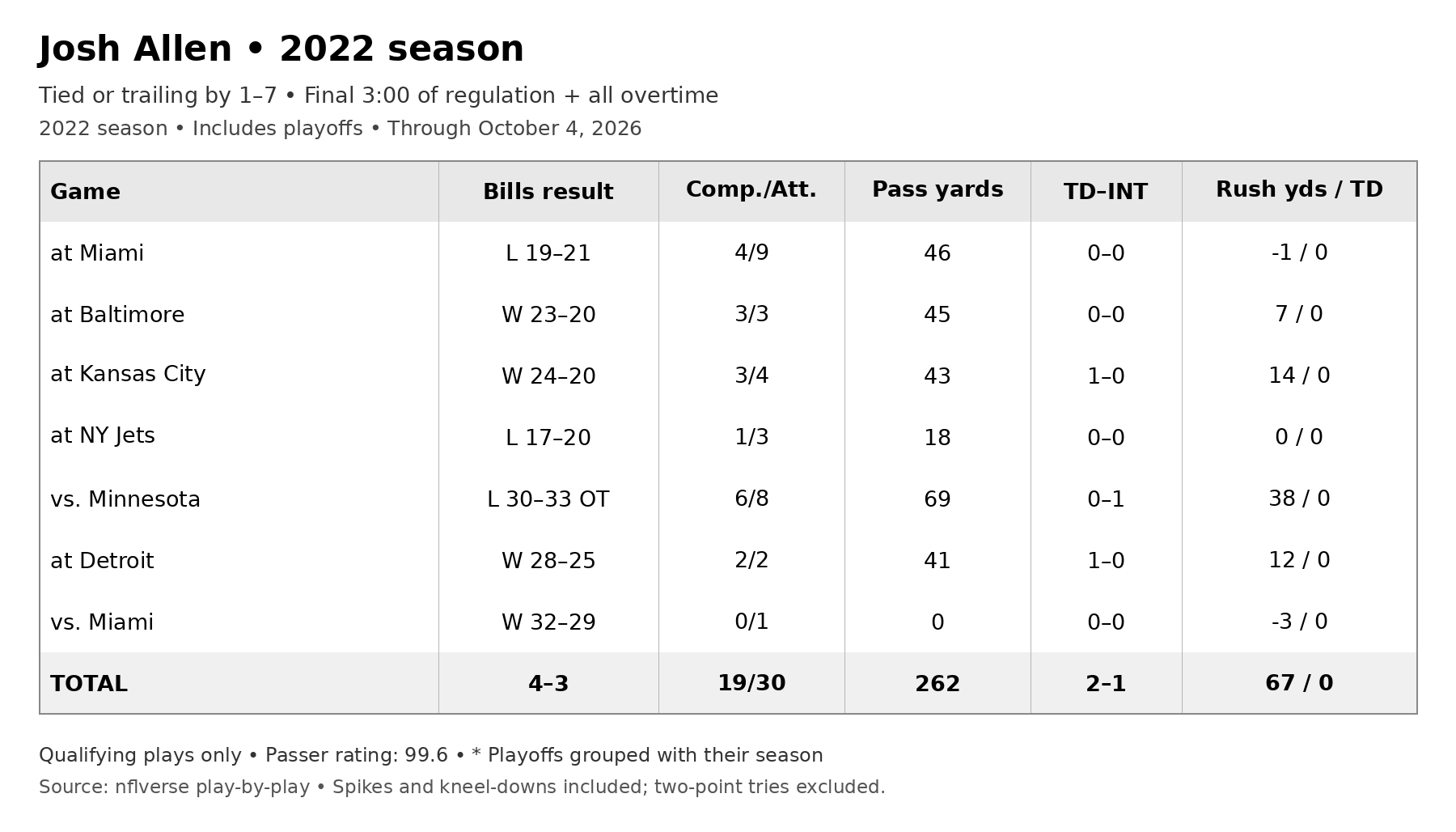
Miami, first meeting: Allen went 4-for-9 in the window, and Buffalo couldn’t finish either late opportunity with the points it needed. The final completion came with too little time left to get another play off.
Baltimore: Three completions on three attempts helped position Buffalo for the winning field goal. The seven rushing yards include kneel-downs used to manage the clock.
Kansas City: Allen contributed 43 passing yards and 14 rushing yards in the window. The touchdown pass to Dawson Knox delivered the winning score.
Jets: A holding penalty erased a completion, and Allen was strip-sacked on the final drive. Buffalo recovered the fumble but couldn’t produce the tying points.
Minnesota: Allen helped force overtime, then threw the interception that ended it. His earlier goal-line fumble is excluded here because Buffalo was leading before that snap.
Detroit: A touchdown pass to Diggs put Buffalo ahead, and another completion to Diggs helped set up the winning field goal after Detroit tied it. Allen also added 12 rushing yards.
Miami, second meeting: The qualifying passing line was only 0-for-1. Buffalo still won on a field goal, with runs and a defensive pass-interference penalty doing much of the late work.
This is another season where the quarterback’s passing line and the final result don’t always tell the same story. Allen’s best work in this window included wins over Kansas City and Detroit. Against Minnesota, he did enough to extend the game and then made the throw that ended it. Miami in December is the opposite kind of reminder: you can win without producing a pretty passing line.
2023: The passing efficiency starts to drop
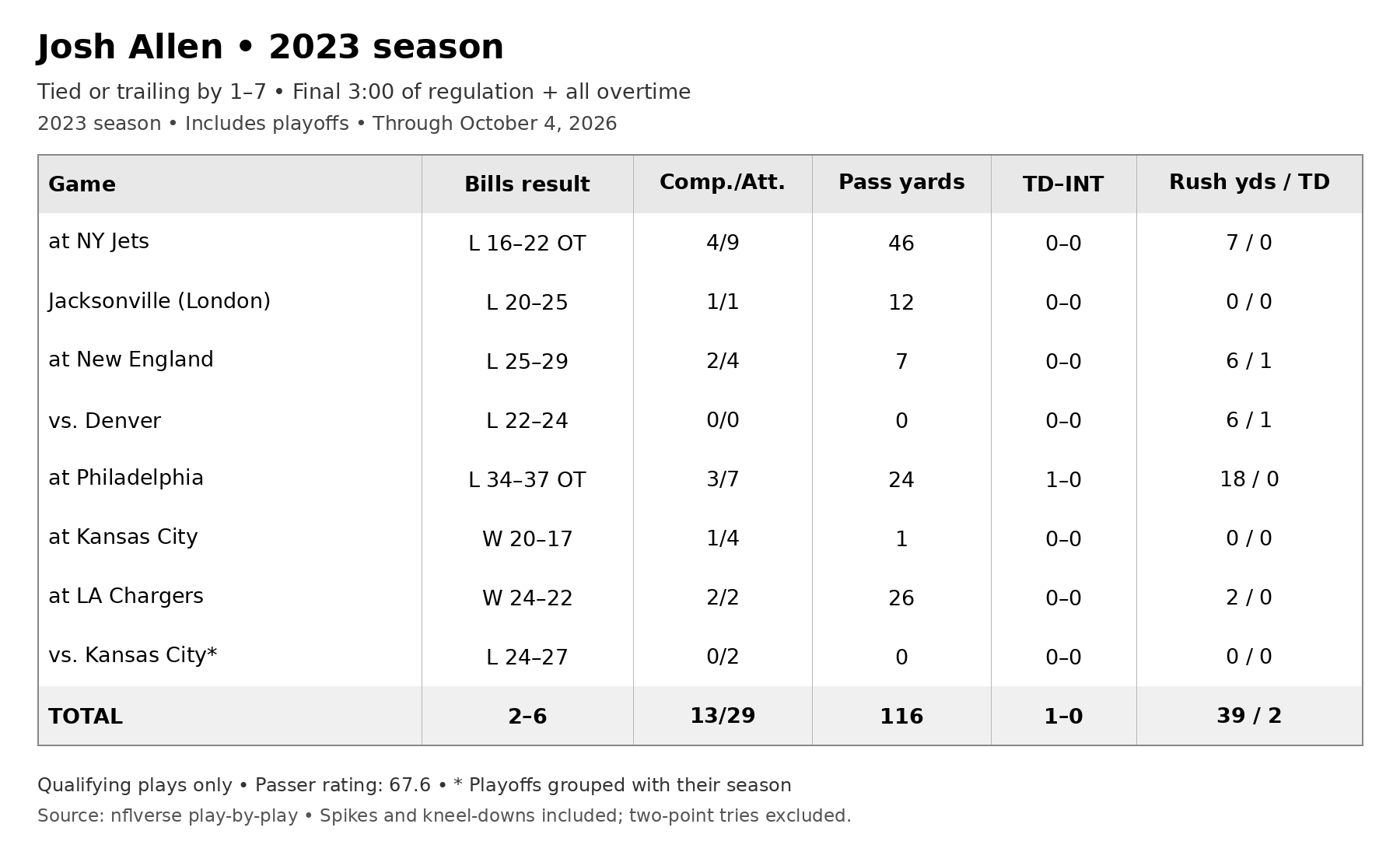
Jets: Allen helped Buffalo reach the tying field goal, but the offense went nowhere in overtime. The Jets won on the punt return.
Jacksonville: Only one Allen pass qualifies, on the desperate final possession. That tiny sample doesn’t capture the larger comeback attempt because plays while down more than seven are excluded.
New England: Allen ran for a go-ahead touchdown before the Patriots answered. His final scramble ended with a lost fumble.
Denver: His six-yard touchdown run put Buffalo ahead. Denver subsequently won on a field goal.
Philadelphia: Allen threw a go-ahead touchdown late in regulation and helped produce a field goal in overtime. Philadelphia answered with the winning touchdown.
Kansas City: Allen was 1-for-4 for one yard in the qualifying window. Buffalo got the field goal it needed and held on.
Chargers: He completed both qualifying passes for 26 yards. Buffalo finished with the winning field goal.
Kansas City, playoffs: Allen’s two qualifying passes were incomplete. The possession ended with the missed tying field goal.
Now there’s something worth discussing beyond the record. Allen completed fewer than half his passes in this season’s sample, although his two rushing touchdowns matter when you’re evaluating the entire performance. Buffalo also lost three games here after he supplied a late go-ahead touchdown: New England, Denver and Philadelphia. You can question the passing efficiency and still acknowledge that he gave his team chances to win.
2024: The smallest sample, and the ugliest passing line
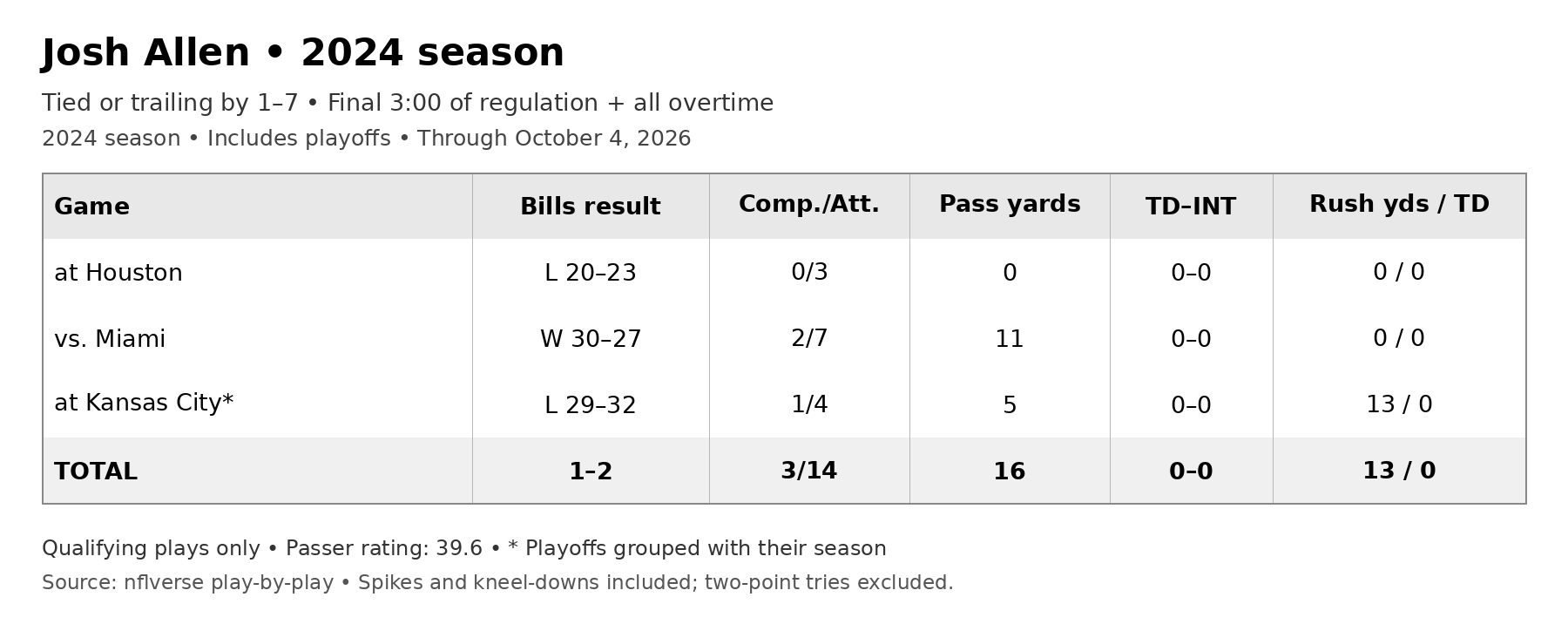
Houston: Three incompletions on Buffalo’s final possession gave the ball back. Houston won with a field goal.
Miami: Allen’s line includes a spike, and penalties helped Buffalo advance. Tyler Bass finished the job with the 61-yard winner.
Kansas City, playoffs: Allen’s 13-yard scramble contributed to the final possession, but he completed only one of four qualifying passes. The fourth-down throw to Dalton Kincaid fell incomplete.
Three completions for 16 yards is ugly however you arrange the columns. It’s also 14 attempts spread across three games, so I’m not using it to explain an entire MVP season. But if the question is whether there have been stretches when the late passing production hasn’t been good enough, here’s one. The Miami win doesn’t magically make that passing line better.
2025: Some big completions, some painful endings
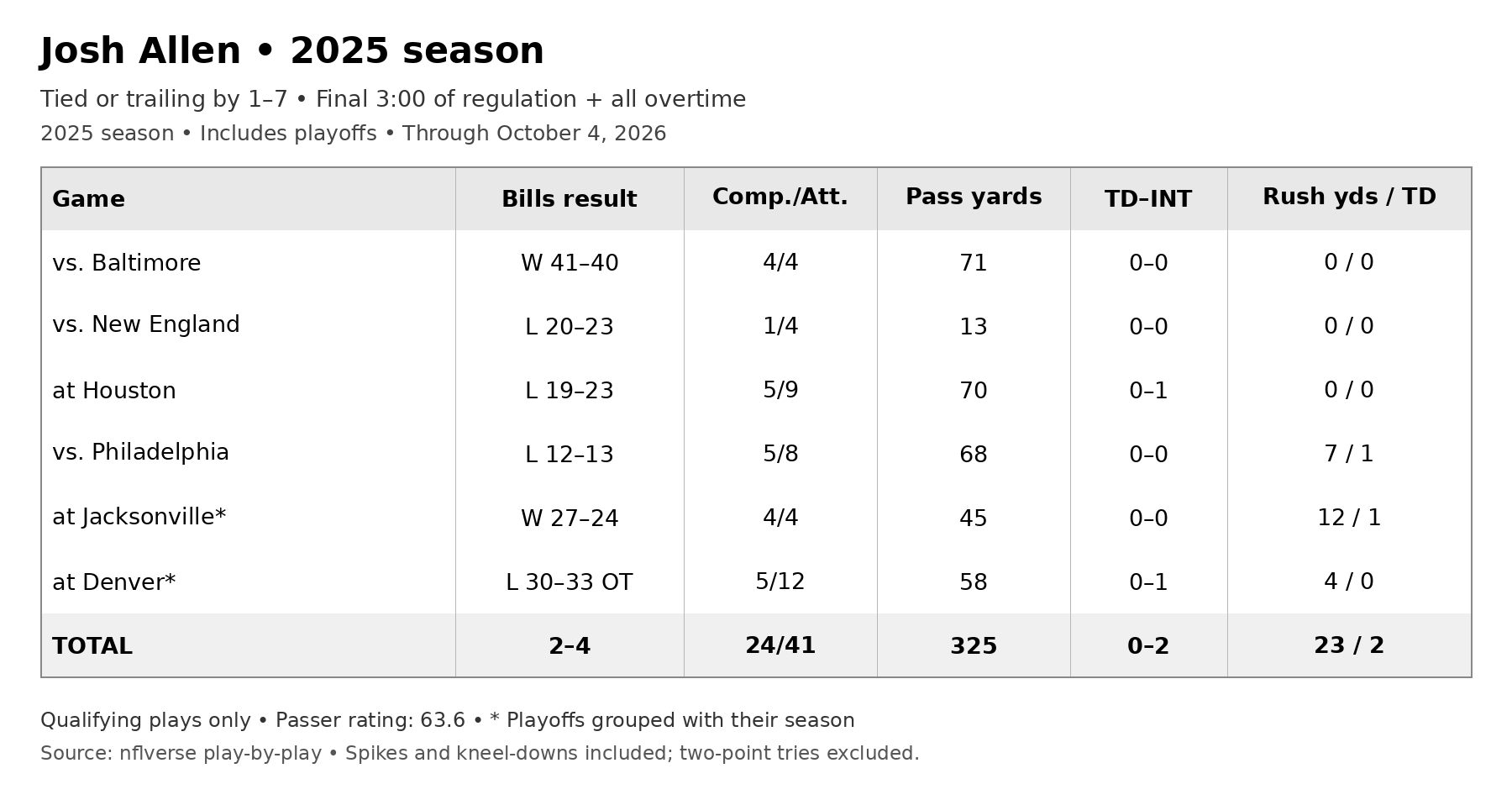
Baltimore: Allen completed all four qualifying passes for 71 yards. His zero net rushing yards include kneel-downs.
New England: He completed one of four qualifying attempts for 13 yards. Buffalo couldn’t get the late answer it needed.
Houston: Allen produced 70 passing yards in the window but also took two sacks. The interception ended the final opportunity.
Philadelphia: He contributed 68 passing yards and a rushing touchdown. The unsuccessful two-point attempt is separate from these statistics.
Jacksonville, playoffs: Four completions on four attempts, plus 12 rushing yards and the winning rushing touchdown. This is one of the cleanest finishes in the entire sample.
Denver, playoffs: Allen helped Buffalo get the tying field goal before regulation expired. His overtime interception ended Buffalo’s possession, and Denver eventually kicked the winner.
The zero in the passing-touchdown column needs the rushing column next to it. Allen scored on the ground against Philadelphia and Jacksonville, and those touchdowns count just as much on the scoreboard. Still, the Houston and Denver interceptions were costly. This season contains both the kind of finish you want from your franchise quarterback and the kind that keeps the argument going.
2026: Two qualifying games, two different answers
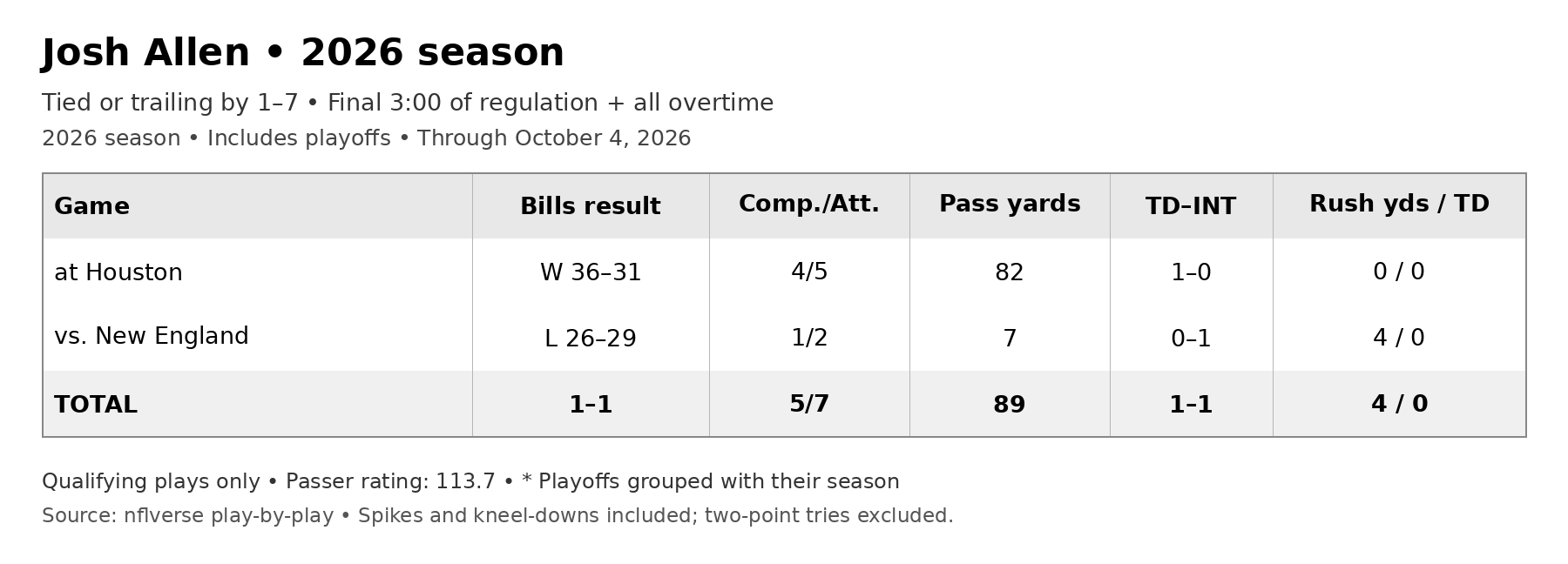
Houston: Allen completed four of five passes for 82 yards in the window. The touchdown to Joshua Palmer delivered the winning score.
New England: A completion to Kincaid and a scramble preceded the interception intended for Palmer. An incompletion erased by an illegal-contact penalty does not count as an attempt.
This is where the Monday-morning conversation started. Against New England, you can’t make that YOLO throw into double coverage when a field goal can tie the game. But Houston is also sitting right there, three weeks earlier, with a winning touchdown drive. Seven attempts aren’t enough to establish a season-long trend, even if the most recent one makes you want to throw your phone.
Next up beyond the shameless promotions section is how Josh Allen does by comparison to the best in today’s league..
New York Steak & Seafood — 10% off:JOEFROMQUEENS
Shady Lady — 10% off: JOE10 | Free shipping: JOESHIPPING
Just Bagels — 10% off automatically through this link
Popcorn Charlie’s — $5 off Home Movie Night 6 Pack: JoeFromQueens (one use per customer)
Homage — 15% off first-time orders:AFF15 (exclusions apply)
Where Allen ranks against the other quarterbacks
Using the exact same conditions for everyone, here’s the passing comparison.
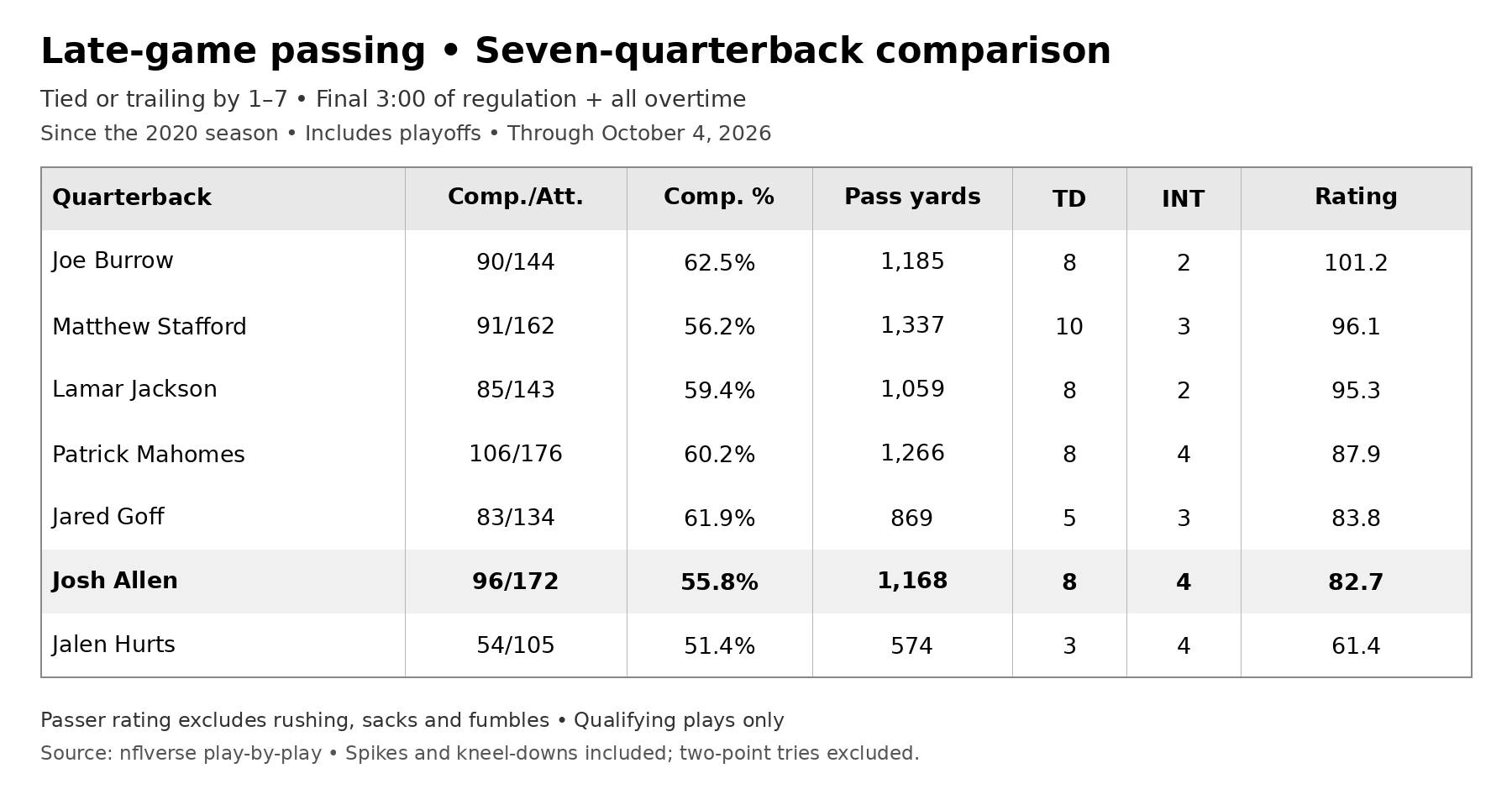
Allen ranks sixth in passer rating among these seven quarterbacks. That’s a real finding, but passer rating leaves out a pretty significant part of his game. Here’s the rest of the comparison.
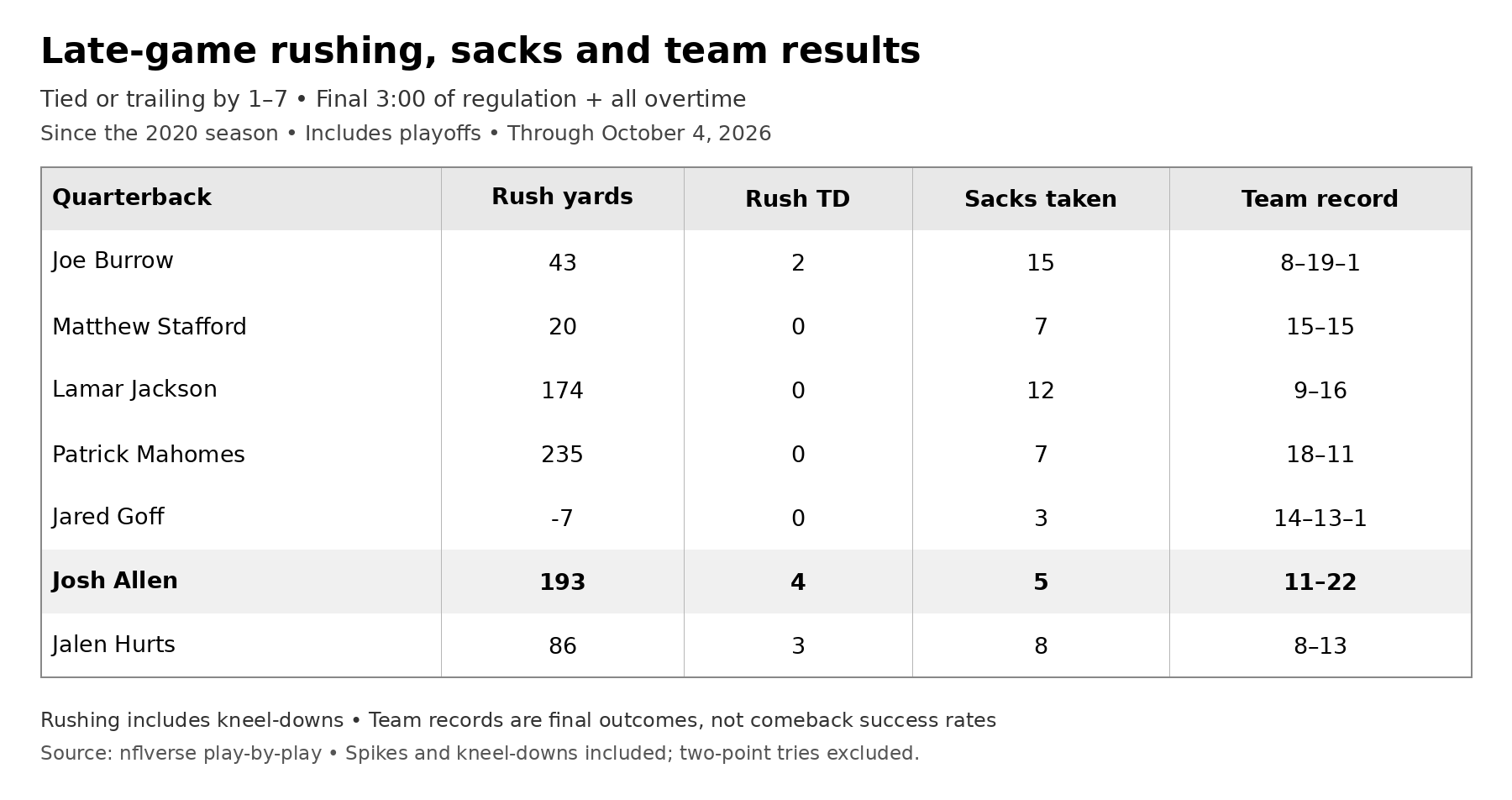
Allen leads this group in rushing touchdowns and has taken fewer sacks than everyone except Goff. Burrow has the best passer rating but an 8–19–1 team record in the qualifying games. That alone should make you careful about calling this a quarterback win-loss statistic. We’re looking at individual production inside games whose outcomes depend on plenty of other people.
The overtime difference
Then there’s the overtime split, which sent me down another hallway in this wormhole.
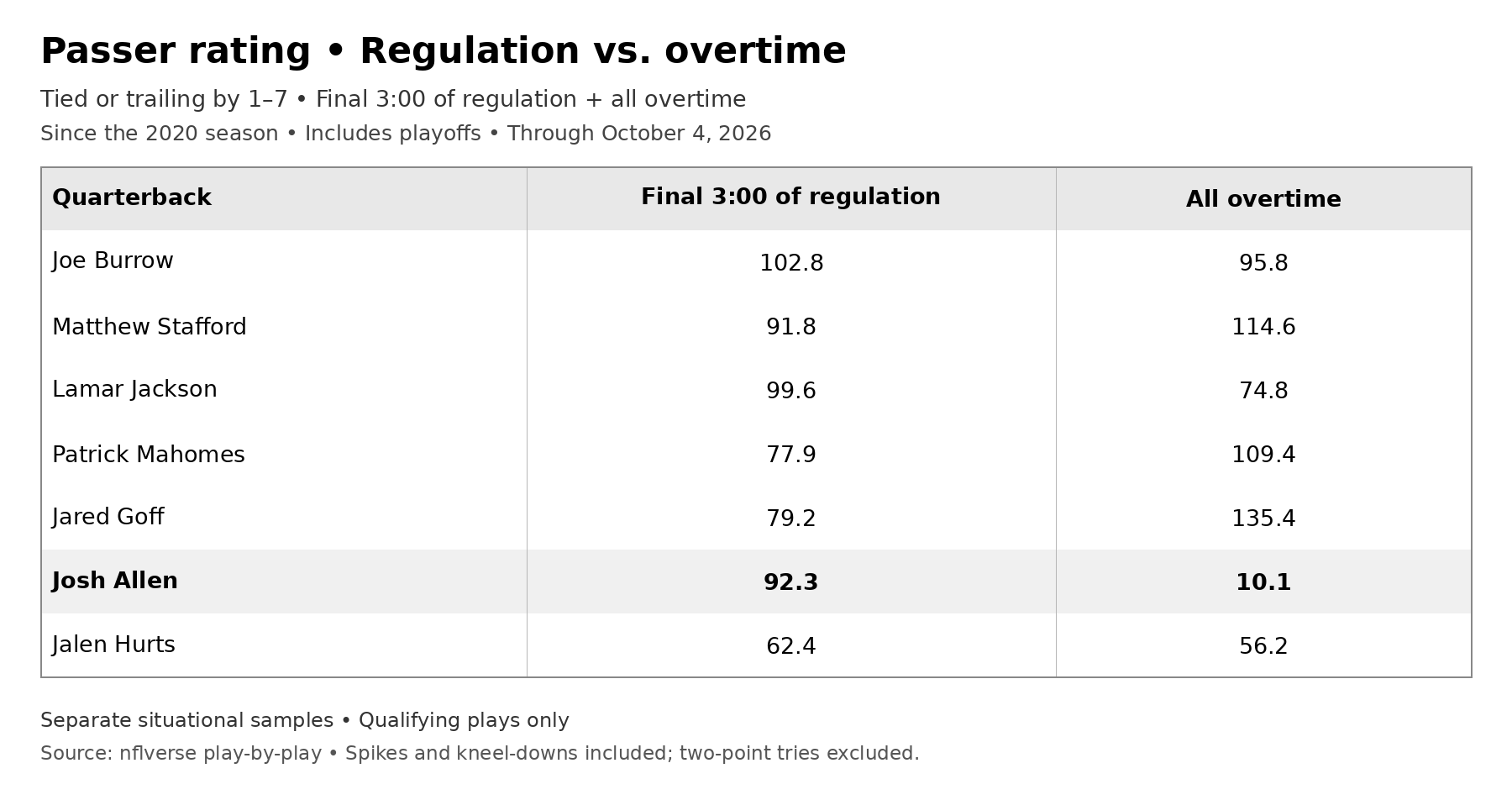
In regulation’s final three minutes, Allen has a better passer rating than Mahomes in this particular sample. Add overtime, and they switch places. Allen is 8-for-19 for 56 yards, no touchdowns and two interceptions in qualifying overtime situations; Mahomes is 41-for-56 for 483 yards, three touchdowns and one interception. Those are different-sized samples, but the difference in production is substantial. And remember: the Kansas City playoff loss after “13 seconds” contributes no overtime attempts to Allen’s line because he never got the ball.
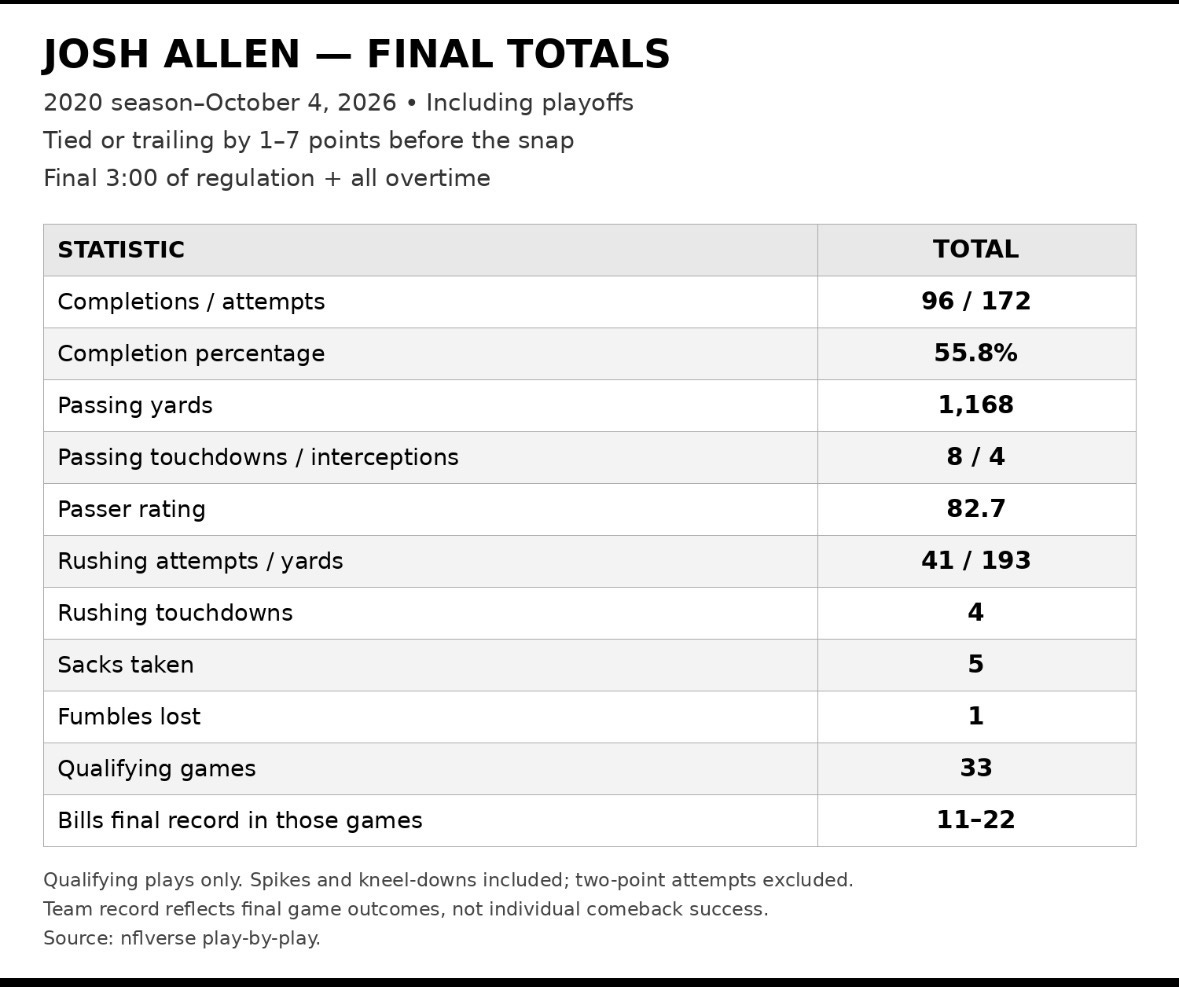
So was the question worth asking? Absolutely. Allen’s late passing efficiency has had some rough stretches, particularly from 2023 through 2025, and his overtime numbers here are poor.
There have also been winning drives, rushing touchdowns and losses after he put Buffalo ahead. After going through the games, I’m more interested in why the production varies so much than in slapping “clutch” or “choker” on the whole thing.
Source and scope
Source: nflverse play-by-play data, 2020–2026 seasons, through October 4, 2026. https://github.com/nflverse/nflverse-data/releases/tag/pbp
The tables use pre-snap score and clock conditions, not the score when a drive began. They include regular-season and postseason games, spikes and kneel-downs; they exclude eight-point deficits, two-point attempts and nullified plays. Team records describe games with qualifying quarterback plays. They are not a measure of individual comeback success.
If you enjoy the work, consider pledging or contributing through Venmo. Every bit helps me turn this into more of a business than a hobby.
Dang. Joe’s cookin’ the record books to serve some food for thought! 🥣