
Since I can remember, one of the biggest clichés I’ve heard in football is that when a team hires a new defensive coordinator, you have to give the players time to learn the system. You hear it from coaches, broadcasters, former players, and fans who seem to have convinced themselves that the first half of the season is basically one giant learning experience.
And look, I get it. A new coordinator comes in, maybe he’s changing the terminology, asking players to do different things, or even switching the defense from a 4–3 to a 3–4. Obviously, there’s going to be some sort of adjustment period. I’m not suggesting that everyone should be able to learn a completely different defense in the same amount of time it takes me to figure out how to assemble a piece of furniture from IKEA.
But I’ve always wondered how much truth there actually is to this argument. Are defenses really getting better as the season goes along because the players are becoming more comfortable with the system? Or is this just one of those things that gets repeated so often in football that everyone accepts it as fact without ever bothering to check?
Because here’s the thing about NFL clichés: There’s usually some truth buried in them, but that doesn’t necessarily mean they’re universally true. And I feel like whenever a defense stinks during the first month or two of the season, the explanation is almost always the same. Give it time. They’re still learning. The communication isn’t there yet. Wait until November or December.
Okay. Fine. But what happens when November and December actually arrive?
So, naturally, I decided to go down another one of my statistical wormholes and look at every NFL team that hired a new defensive coordinator from 2020 through 2025. I wanted to compare what those defenses did during their first eight games against what they did over the remainder of the regular season. Not what they did the year before, not whether they made the playoffs, and not whether the coordinator eventually got fired. I wanted to know whether the defense actually got better during his first season running it.
And I didn’t want to just look at points allowed, because that can be incredibly misleading. A defense might give up fewer points while still getting gashed for yards, or it might allow more points because its offense keeps turning the ball over and giving opponents a short field. So I went through Stathead and pulled just about everything I could think of: points allowed, total yards, yards per play, passing yards, rushing yards, yards per carry, completion percentage, opposing quarterback rating, sacks, pressures, hurries, interceptions, and takeaways. I also want to look at defensive EPA per play, because that should help give us a better idea of how efficiently these defenses were actually performing.
I was also curious about something else. How many of these teams hired a new defensive coordinator but basically kept the same defensive scheme, and how many actually changed formations? Because I would think there’s a pretty significant difference between bringing in a new guy who runs a similar defense and completely changing what you’ve been doing for years. If anything, wouldn’t the teams changing from a 4–3 to a 3–4, or vice versa, have a stronger argument for needing more time?
Now, obviously, this isn’t a perfect science. Injuries happen, schedules get tougher or easier, players get traded, and sometimes a defense improves simply because it’s no longer facing Patrick Mahomes and Josh Allen every other week. There are plenty of variables that can influence these numbers, and I’m not pretending otherwise.
But that’s also why I wanted to examine six seasons instead of cherry-picking two or three teams that happen to support whatever argument I’m trying to make. If this idea that defenses improve as they learn a new coordinator’s system is as legitimate as people make it sound, shouldn’t we see some sort of consistent pattern?
We’ll go year by year, looking at every team that made a change at defensive coordinator, comparing its first-half and second-half statistics, and pointing out which defenses improved the most and which ones went completely in the toilet. At the end, we’ll put all six years together and see how many teams actually got better, how many got worse, and whether changing defensive schemes made any real difference.
I’m not going into this expecting every defense to turn into the 1985 Bears by Christmas. But if we’re going to keep using the excuse that players need half a season to learn a new defensive system, I think it’s fair to ask a pretty simple question.
Do the numbers actually back up what everyone keeps telling us?
2020: The First Test
We start with 2020, when 11 NFL teams entered the season with a new defensive coordinator. If there was ever a season where you could make the argument that defenses needed extra time to learn a new system, this was probably it. No preseason, weird COVID protocols, limited practice time, and a generally bizarre year all around. So if the cliché that “a new defense gets better in the second half of the season” was ever going to hold up, 2020 felt like the perfect place to start.
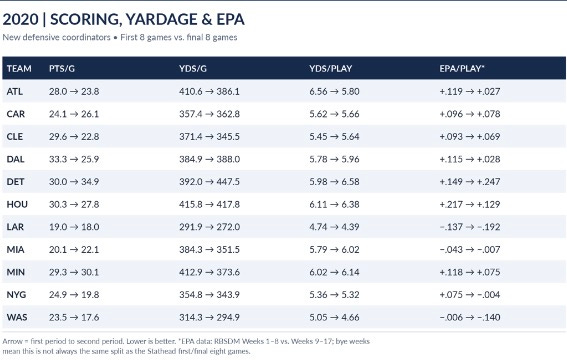
On the surface, the numbers do give that argument some life. Seven of the 11 teams with a new defensive coordinator allowed fewer points per game in the second half of the season, and seven also improved in total yards allowed per game. But once you start digging a little deeper, it gets less clean. Only five of the 11 improved in yards allowed per play, which is a better indicator of down-to-down defensive efficiency than just raw yardage totals.