

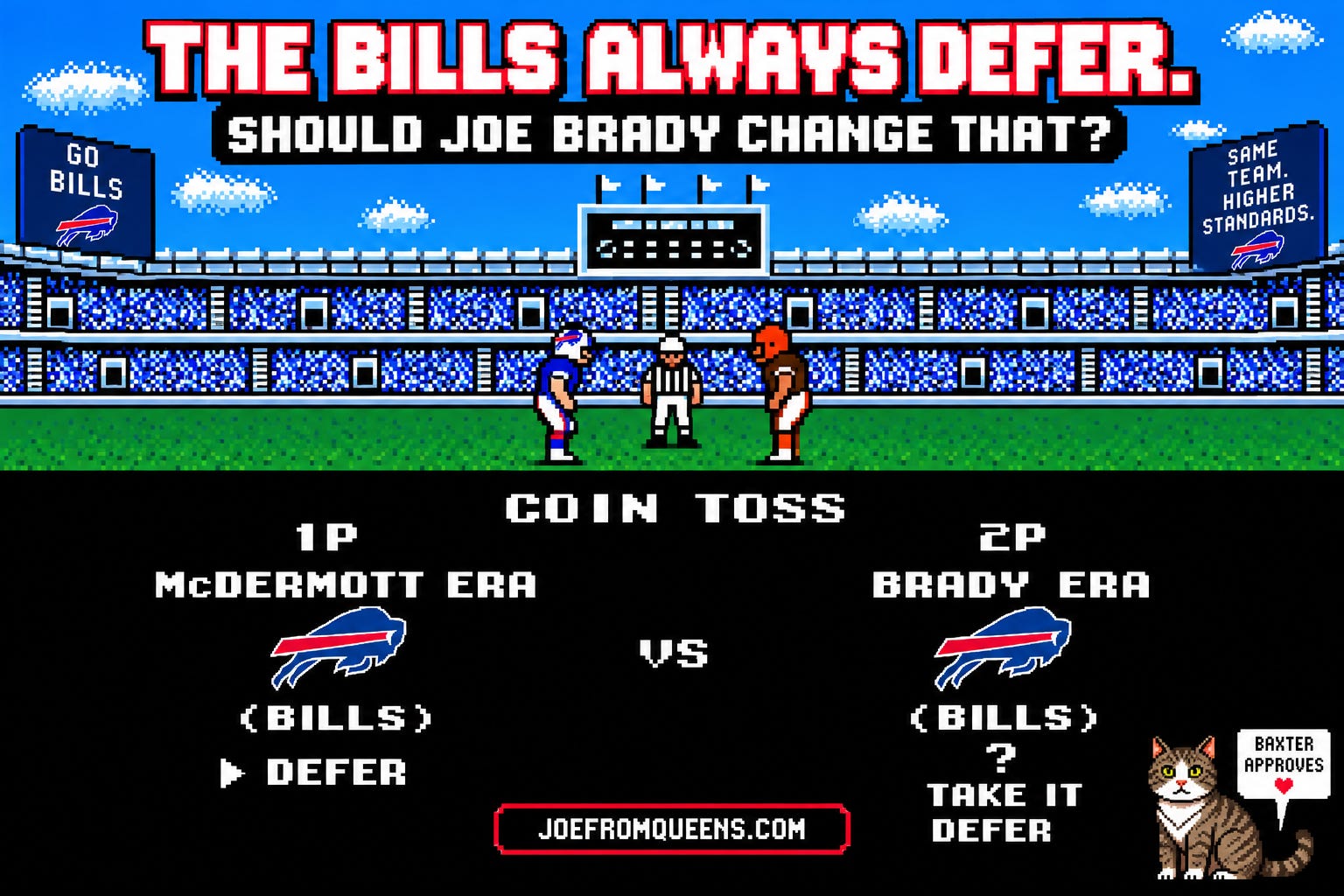
If you watched the Buffalo Bills under Sean McDermott for any length of time, you knew exactly what was coming when they won the coin toss:
“We’ll defer to the second half.”
Every. Damn. Time.
OK, maybe not literally every time, but it sure as hell felt like it.
And the numbers back that up.
Going back to 2010, Buffalo has deferred 87% of the time when it has won the opening coin toss.
So this wasn’t just something Bills fans imagined during the McDermott years. Buffalo has been one of those franchises where winning the toss usually meant giving the football to the other team and waiting until the second half.
To be fair, the rest of the NFL has increasingly agreed with that philosophy.
In 2010, only 28% of coin-toss winners deferred. By 2025, that number had climbed all the way to 72%.
So McDermott wasn’t exactly standing alone on an island screaming DEFER while everyone else took the football. The entire league moved in that direction, but, Buffalo took it to another level.
And now I’m curious whether Joe Brady will as Sean McDermott isn’t the head coach anymore.
For years, deferring was basically part of the McDermott Bills starter pack:
Clapping, yelling, changing eyeglasses, complimentary football, winning the coin toss and immediately giving the ball away.
Now Brady gets to decide whether that continues. The theory behind deferring makes perfect sense. Let the defense start the game, get the football to begin the second half and give yourself a chance at the magical football “double dip”: score before halftime, get the ball right back after halftime and score again.
Fourteen points around halftime can completely change a game.
But here’s what I wanted to know:
How often did the Bills actually pull it off?
Because getting the ball after halftime doesn’t mean shit if you go three-and-out. So I went back through the Bills from 2020 through 2025 and looked specifically at games where Buffalo won the opening coin toss and deferred.
I wanted to know what the opponent did with that first possession, what Buffalo did on its final meaningful possession before halftime, what the Bills did with the opening possession of the second half and, most importantly, how often they actually completed the double dip.
For this exercise, my definition is simple: Buffalo has to score on its final meaningful offensive possession of the first half and then score again on its first offensive possession of the second half. The opponent can possess the ball in between as that doesn’t erase what Buffalo did. We’re measuring whether the Bills successfully scored on both sides of halftime.
And once you start going year by year, you can see why McDermott loved doing it and also why Brady might want to rethink automatically doing it every week.
2020: When the Double Dip Became a Weapon
This is basically the season that explains why a coach could fall in love with the idea.
The 2020 Bills offense was becoming a monster.
Josh Allen made the leap, Stefon Diggs arrived, and Brian Daboll had the offense rolling. Buffalo suddenly had a team that could put up points in a hurry instead of making me wonder if 17 points would be enough to win.
And around halftime, that offense could be lethal and that’s the entire point of deferring. You’re not giving away the opening possession just because football coaches enjoy making things more complicated than they need to be.
You’re trying to control the middle of the game.
Score late in the second quarter.
Go into the locker room.
Come back out.
Score again.
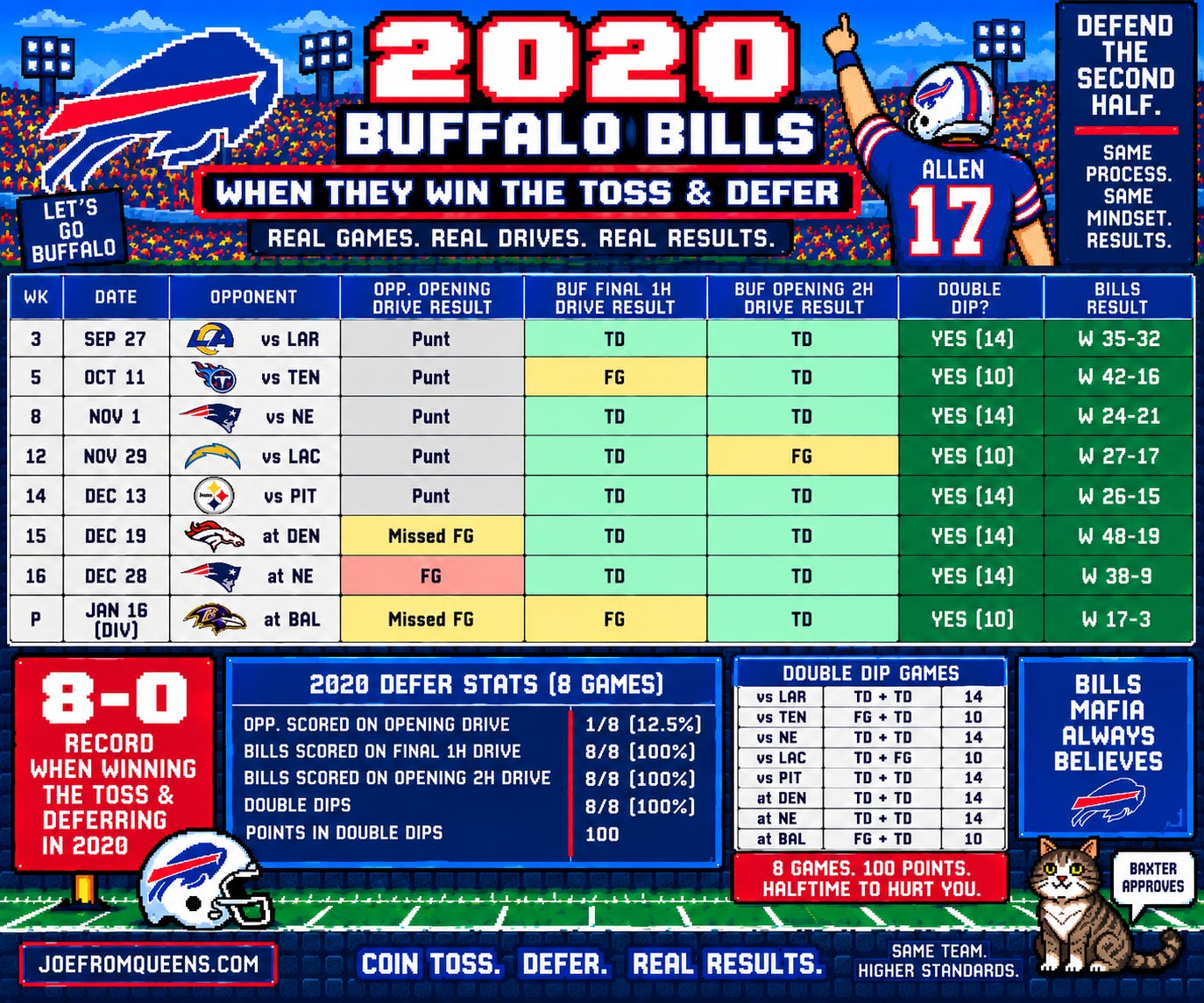
Their game against Denver is a good example of why I count the double dip the way I do. Buffalo scored a touchdown late in the first half. Denver answered with a touchdown of its own before halftime. Buffalo then received the second-half kickoff and scored another touchdown. The Broncos getting the ball in between doesn’t change what I’m trying to measure.
Buffalo scored on its final meaningful offensive possession of the first half and its first possession of the second half.
That’s a double dip.
And when you’re watching Josh Allen do this repeatedly, of course you’re going to keep deferring because 2020 was the season that sold the concept.
Once football coaches find something that works, good luck getting them to stop doing it.
2021: Still Working
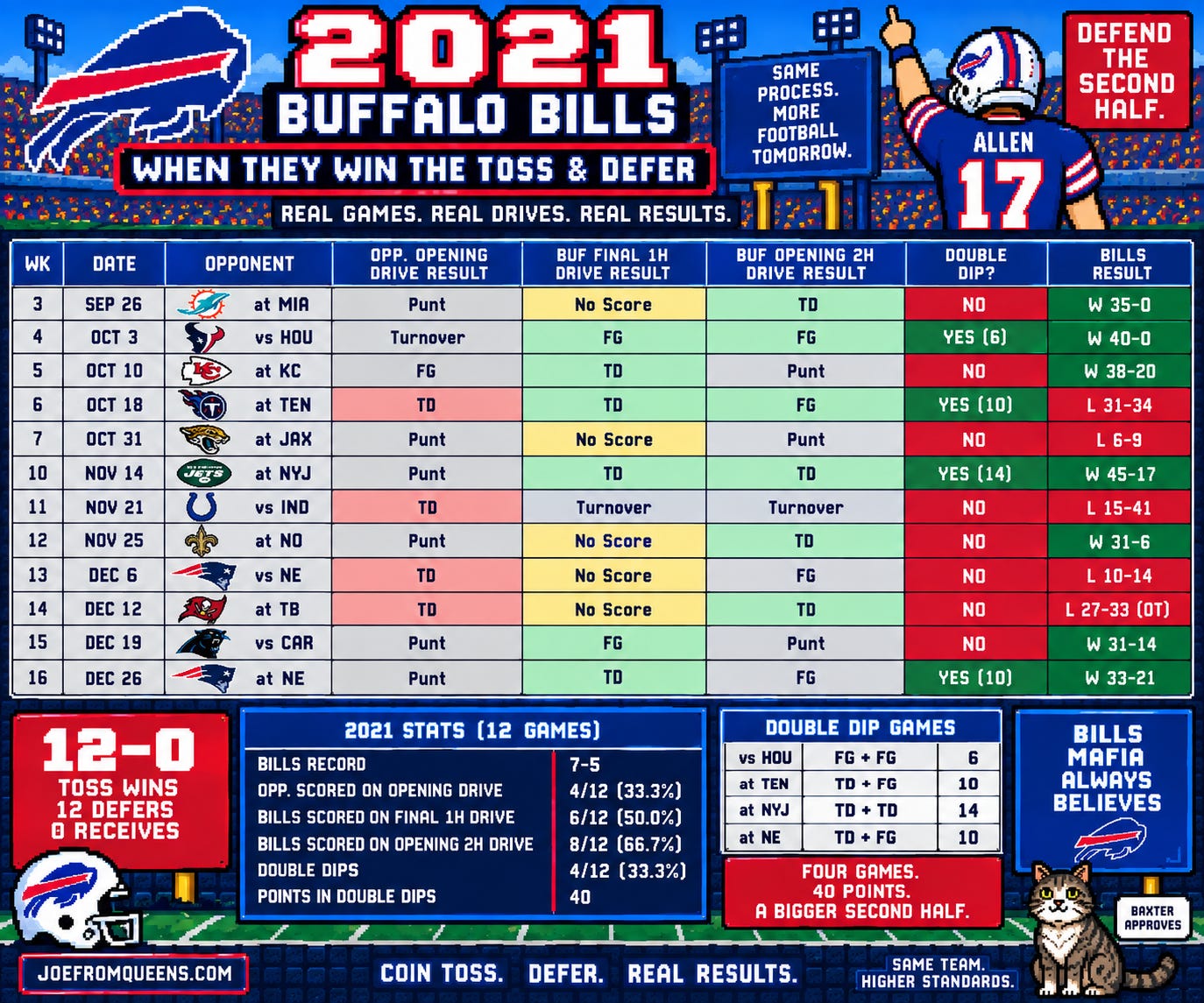
Buffalo won the toss and deferred 12 times in our qualifying 2021 sample.
The Bills went 7-5.
Opponents scored on their opening possession four times, or 33.3%.
Buffalo scored on its opening possession of the second half eight times in 12 games giving them 66.7%.
That’s pretty damn good.
The Bills completed four double dips: Houston, Tennessee, the Jets and New England.
Houston: FG-FG.
Tennessee: TD-FG.
Jets: TD-TD.
New England: TD-FG.
That’s 40 points generated from those paired possessions surrounding halftime. The Tennessee game is also an important reminder that none of this guarantees anything as Buffalo double dipped and still lost, 34-31.
The coin toss isn’t a cheat code.
Still, if I’m McDermott looking at what my team was doing in 2021, I’m probably continuing to defer too.
The opponent scored to begin the game 33% of the time.
My offense scored to begin the second half 67% of the time.
Give me the football after halftime.
2022: Where Did Everybody Go?
Then we get to 2022 and suddenly the sample becomes tiny as Buffalo had only five qualifying defer games in our sample.
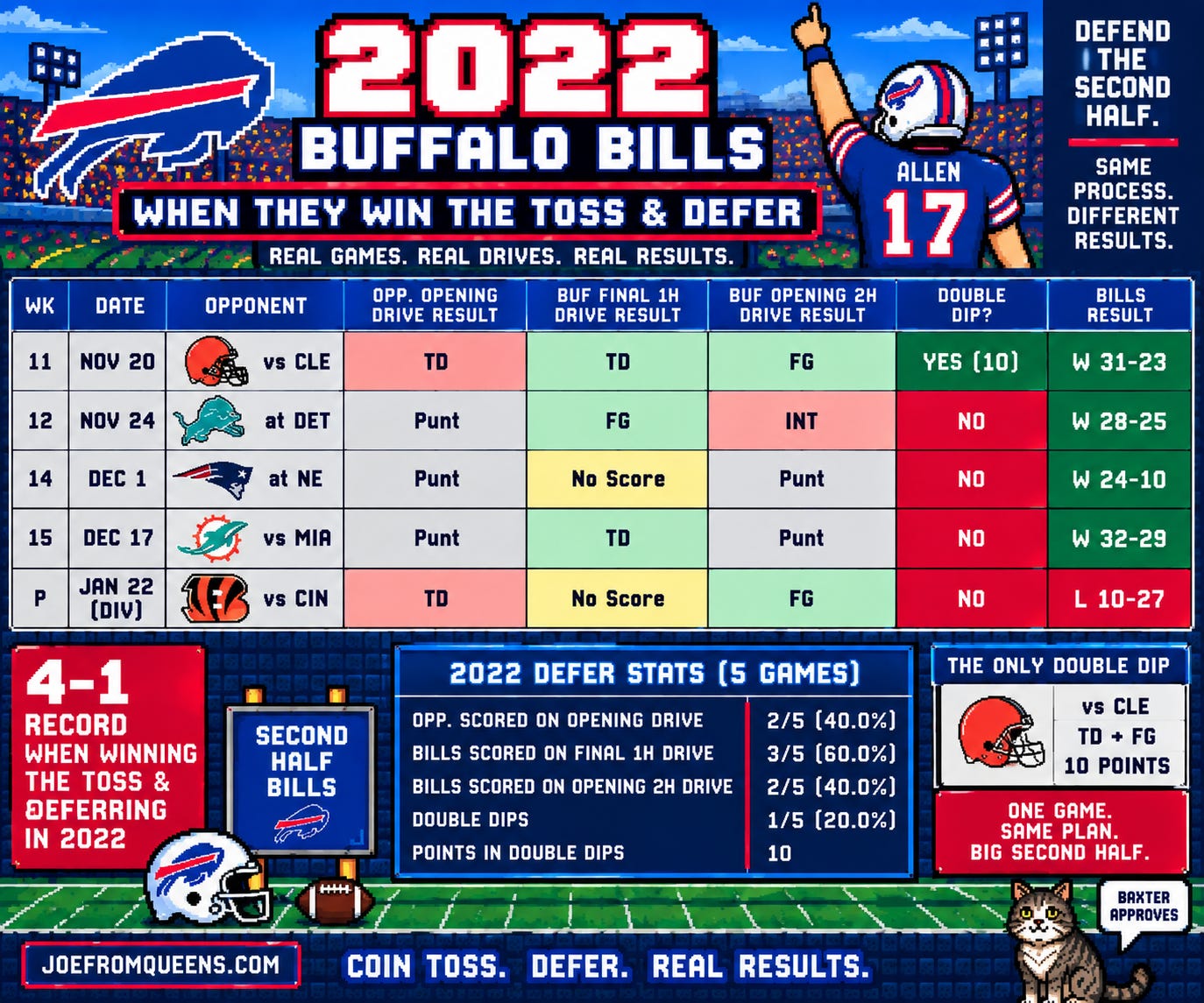
They went 4-1 which sounds fantastic, but this is exactly why I don’t want to simply look at Buffalo’s record and declare that deferring worked.
Josh Allen was the quarterback.
The Bills were really freaking good.
They won a lot of games no matter who received the opening kickoff.
Opponents scored on their opening possession twice and Buffalo scored on its opening second-half possession twice.
Only against Cleveland did Buffalo complete a double dip
2023: Now We’re Cooking Again
This is probably the best argument for continuing to defer.
Buffalo went 7-2 in nine qualifying games and they scored on their opening second-half possession six times. (66.7%)
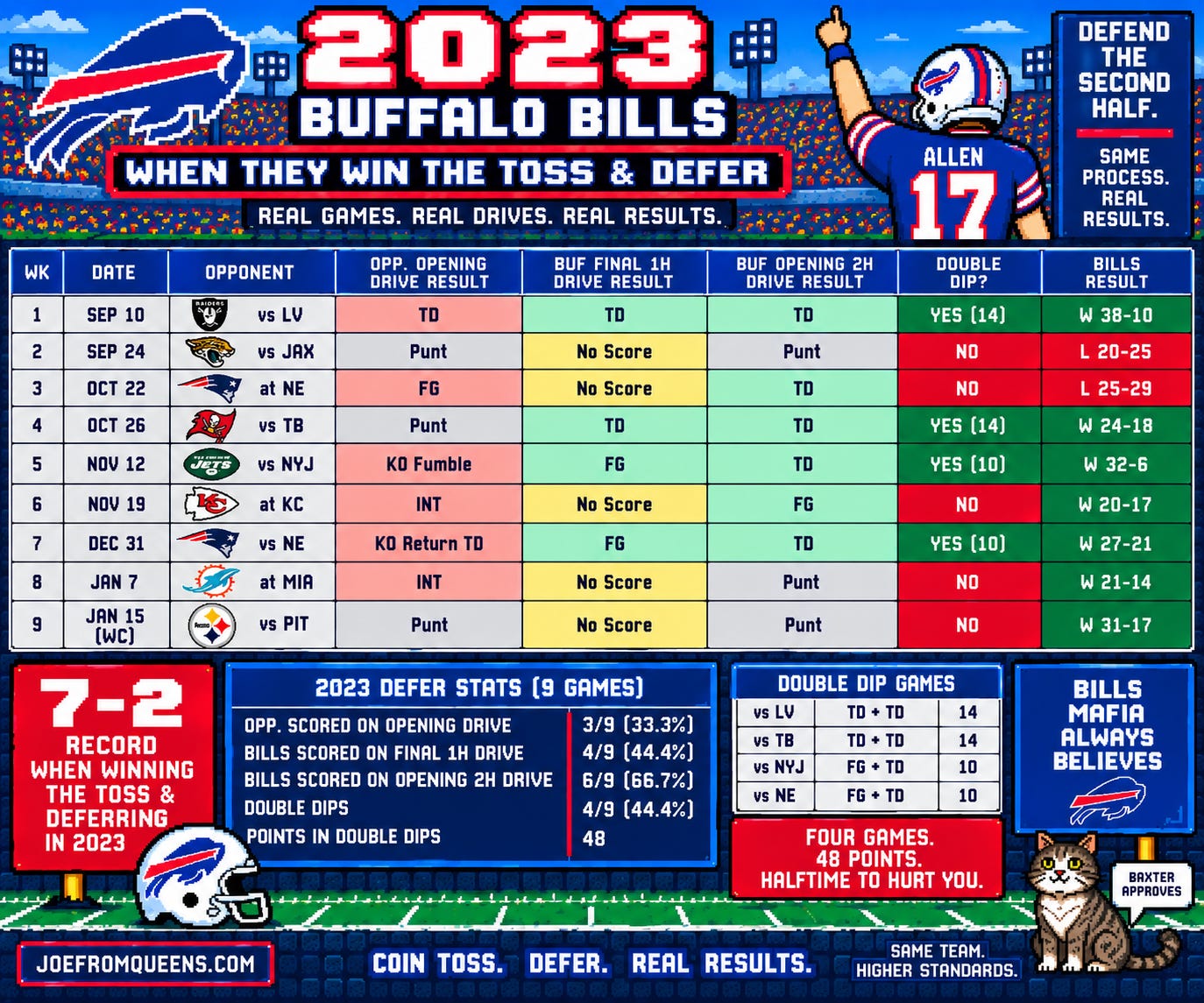
And they completed four double dips.
Raiders: TD-TD.
Tampa Bay: TD-TD.
Jets: FG-TD.
New England: FG-TD.
That’s 48 points surrounding halftime in those four games and Buffalo won all four games
2024: And Then It Basically Disappeared
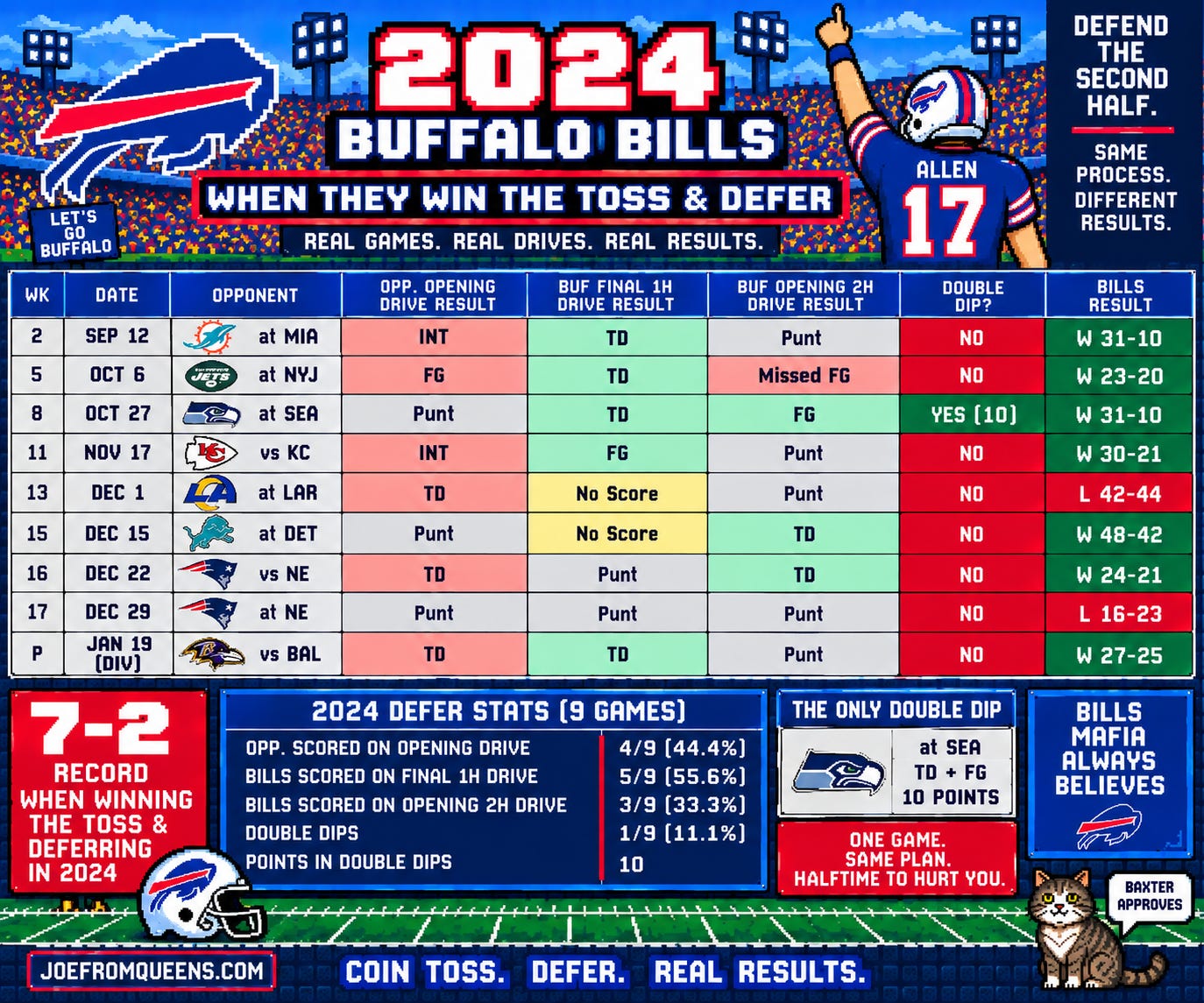
Buffalo went 7-2 in nine qualifying games in 2024.
Again, if we’re just looking at the record:
DEFER FOREVER!
Except opponents scored on their opening possession four times in nine games (44.4%) and Buffalo scored on its opening second half possession only three times. (33.3%)
And the Bills completed exactly one double dip against Seattle. (TD-FG)
2025: Almost Nothing
By 2025, the double dip was basically on life support as Buffalo went 6-3 in our nine-game regular-season defer sample. Opponents scored on their opening possession only twice, so there’s at least an argument that giving the defense the football first wasn’t hurting Buffalo very much. But the Bills scored on their final meaningful possession before halftime only twice
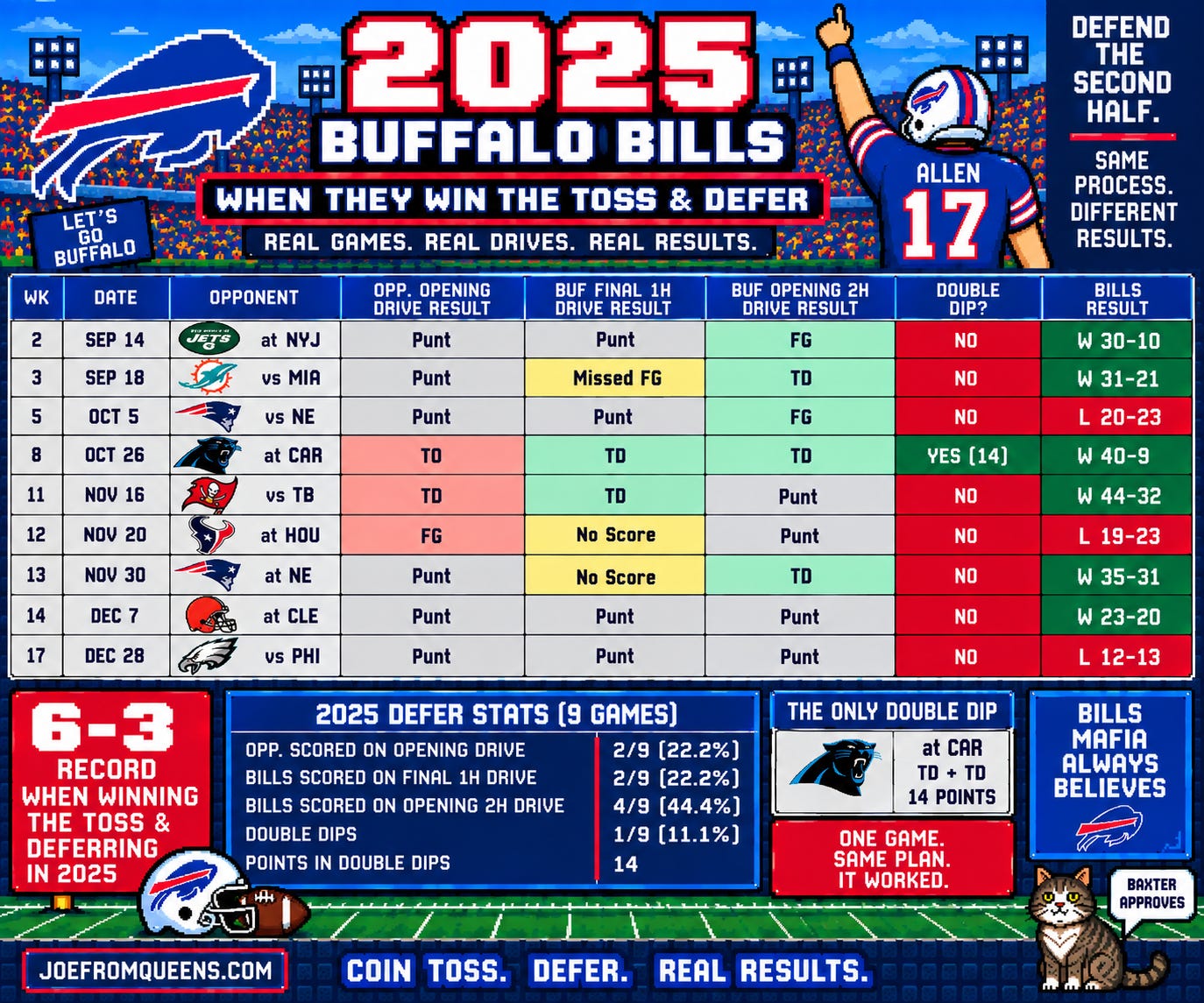
They scored on their opening second-half possession four times and completed one double dip against Carolina.
Buffalo scored a touchdown with 1:52 remaining before halftime and Carolina got the football afterward, but again, that doesn’t matter for this exercise. Buffalo had scored on its final meaningful possession. Then the Bills came out after halftime and Josh Allen hit Khalil Shakir for a 54-yard touchdown.
TD-TD.
Fourteen points.
The perfect double dip.
And basically the only time all season the strategy produced exactly what you’re hoping for.


So What Does Joe Brady Do?
This is the reason I find all of this more interesting now than I would have a year ago.
Sean McDermott is gone.
Joe Brady doesn’t have to keep doing something simply because that’s what Buffalo has always done. And remember just how ingrained this philosophy has become. As I wrote earlier, the league as a whole deferred 72% of the time in 2025, up from only 28% in 2010.
That’s an incredible philosophical shift across football.
But here’s another number that matters:
Across more than 4,000 regular-season games since 2010, the team winning the opening coin toss went on to win the game only about 51% of the time.
Basically a coin flip after the coin flip. So merely winning the toss isn’t giving you some enormous competitive advantage.
Brady obviously isn’t some outsider walking into the building who has never seen Buffalo operate this way. He has watched Josh Allen stand on the sideline to begin plenty of games because Buffalo wanted the ball after halftime.
Now it’s his call.
Does he continue the McDermott philosophy or does an offensive coach look at Josh Allen and say:
Why the hell am I voluntarily making the best player on the field stand on the sideline to begin the game?
Because the next time we hear:
“Buffalo has won the toss…”
For the first time in a long time, I’m actually going to wait to hear the rest.
Research note: This piece used research and data from NFL Toss Stats, Pro Football Reference, and official NFL gamebooks and play-by-play to verify coin-toss decisions, drives, scoring sequences, and game results.
I will never forget the Denver MNF home game when McDermott broke type and took the ball because the team was struggling and he wanted momentum..only for the Bills to turn the ball over on the first play of the game.