

There are certain conversations in sports that make me want to turn off the television, throw my phone across the room, and find something more productive to do with my life. The James Cook fumbling debate is quickly climbing that list. It’s exactly the type of subject that was made for sports-talk radio, where somebody can scream about accountability for four hours without actually offering a reasonable solution. And unfortunately, it’s a conversation we’re probably going to have every time Cook puts the football on the ground for the foreseeable future.
I’ve talked about this before when I’ve appeared with Pat Moran on Talking Buffalo. I hate turnover conversations. Not because turnovers aren’t important, but because the discussion surrounding them is almost always so painfully predictable. Somebody fumbles, somebody calls for accountability, somebody suggests benching the player, and everybody acts like they’ve discovered some revolutionary approach to football. We get it. Turning the ball over is bad. Thank you for that groundbreaking analysis.
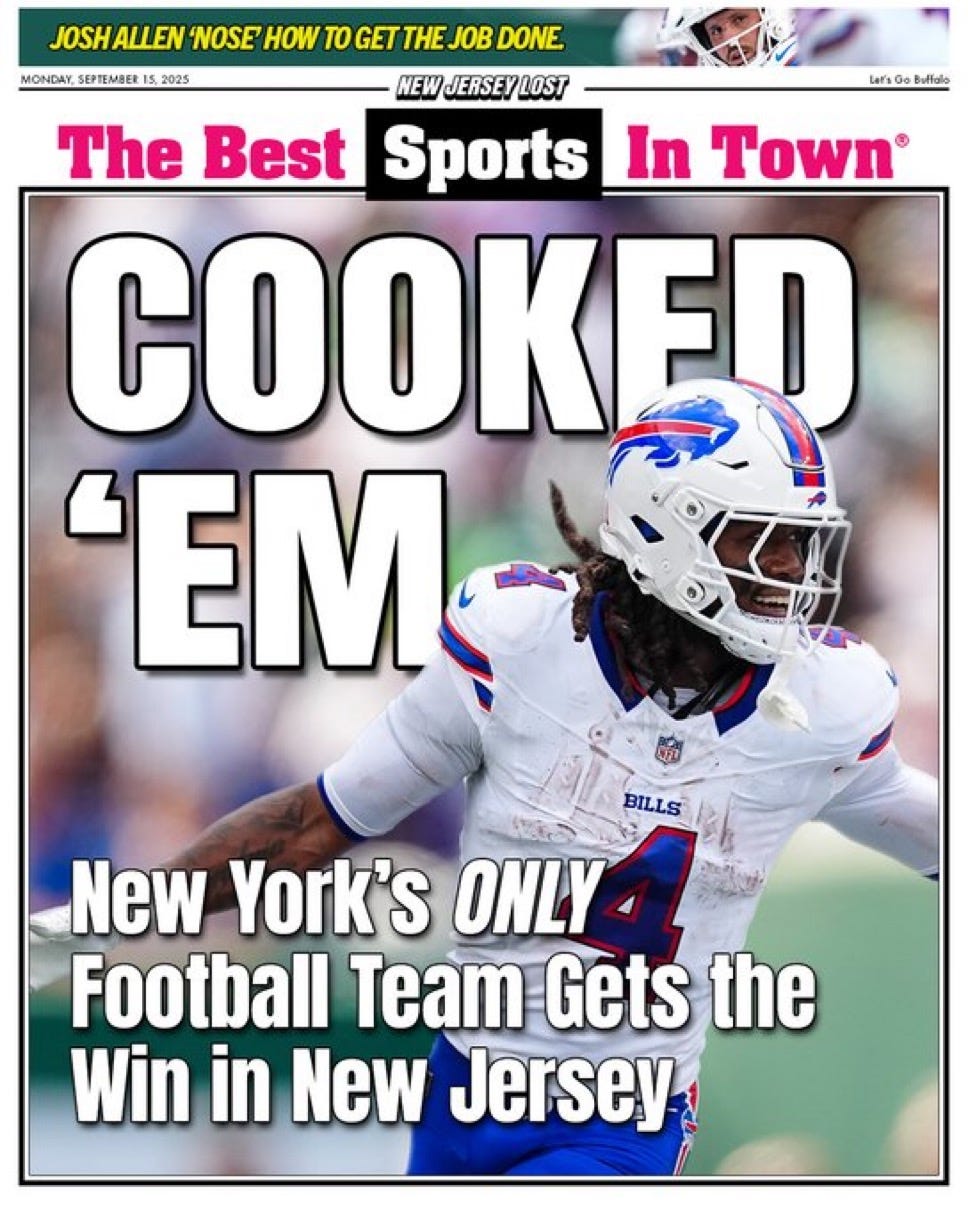
Now, before somebody accuses me of being a James Cook apologist, let me make something perfectly clear. Yes, Cook needs to protect the football better. He’s fumbled four times in five games this season, including twice against the Los Angeles Rams on Monday night. His overtime fumble nearly cost Buffalo a game it eventually won 37-34. That’s unacceptable, and I’m sure Cook would be the first person to admit it. But there is a pretty significant difference between acknowledging a problem and deciding the solution is to take the football away from one of the best running backs in the NFL.
What Exactly Is Joe Brady Supposed to Say?
Joe Brady was asked about Cook’s ball security after the Rams game, and his response immediately became a talking point. He acknowledged everything Cook has been doing well, expressed confidence in him, and then warned that his carries could decrease if the fumbling continues. Naturally, people on social media took the part about decreasing carries and ran with it, as though Brady had announced he was putting Cook on the bench for the rest of the season.
What exactly was he supposed to say?
“Oh, keep fumbling, buddy. We love you. Don’t worry about holding onto the football. Just keep doing your thing.”
Of course not. He’s the head coach of the Buffalo Bills, and he has to publicly address a legitimate problem. He can’t stand in front of reporters and tell everybody that fumbling doesn’t matter, especially when his team nearly lost a game because of it. But Brady also made a point that seems to have gotten lost in the hysteria. He said he has confidence in Cook, which is precisely why he put him right back on the field. To me, that says a lot more about his actual intentions than one sentence about potentially decreasing carries.

Fumbles Are Also a Volume Stat
Here’s something that gets lost in these conversations. Fumbles are, at least in part, a volume stat. The more times you touch the football, the more opportunities somebody has to punch it out, strip it, or knock it loose. That’s not an excuse for poor ball security. It’s simply how the sport works. And if you’re going to judge a running back by his total number of fumbles, it might be worth looking at some of the other names on that particular list.
Take a look at the five running backs with the most recorded career fumbles in NFL regular-season history.
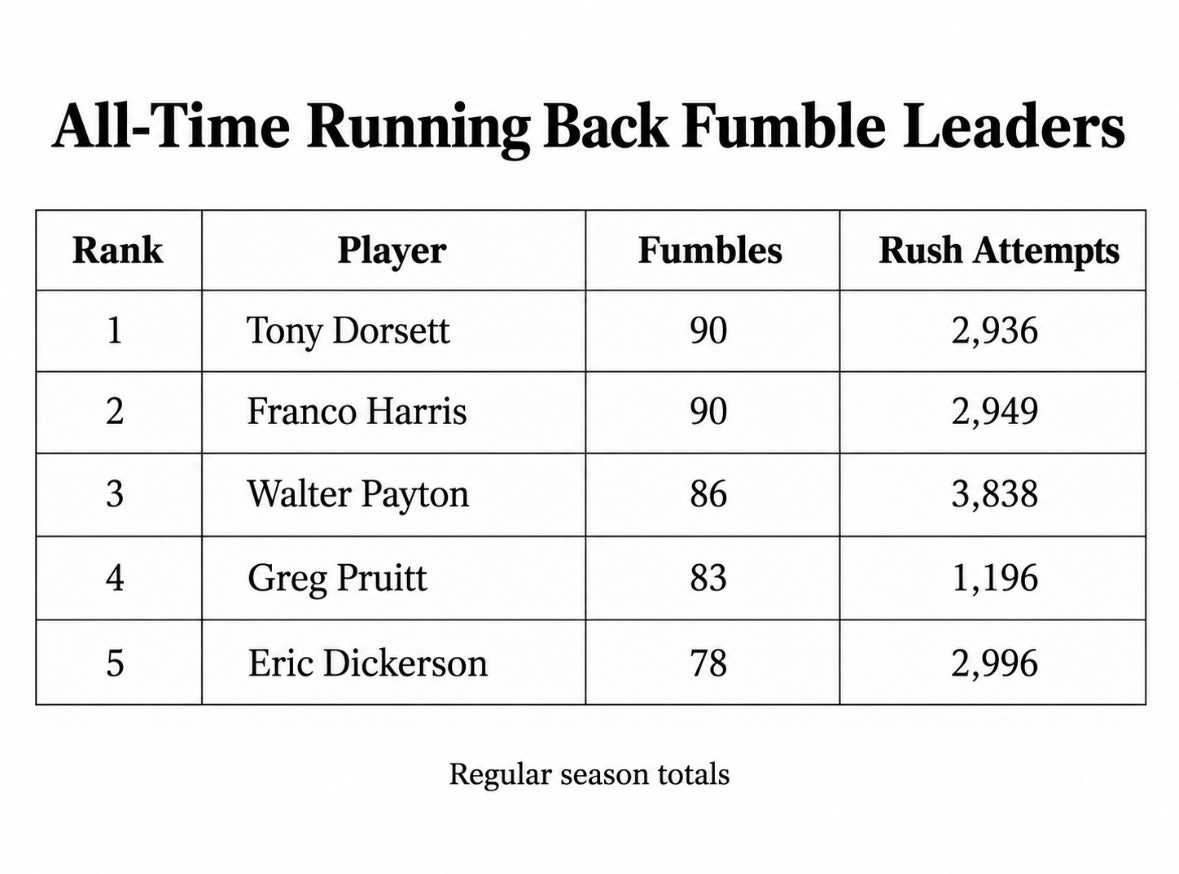
Look at those names. Tony Dorsett. Franco Harris. Walter Payton. Eric Dickerson. Four Hall of Fame running backs who collectively won five Super Bowls and accumulated more than 54,000 rushing yards. They also put the football on the ground a combined 344 times. Somehow, the sport survived, and their coaches continued giving them the ball.
I don’t remember Mike Ditka bringing Refrigerator Perry into the backfield to take meaningful rushing attempts away from Walter Payton because Sweetness had a fumbling problem. I don’t remember the Steelers deciding that Franco Harris needed to sit down because he’d lost the football again. These guys were given the ball because they were great football players, and when you’re responsible for carrying an offense, sometimes bad things are going to happen.
Now, the important distinction is that total fumbles don’t tell you everything. Greg Pruitt, for example, had 83 fumbles on just 1,196 rushing attempts, so clearly volume alone cannot explain every player’s fumbling issues. You need to consider the rate, the circumstances, and how often the player touches the football. That’s the difference between an actual discussion about ball security and somebody yelling at a television camera.
The Numbers Say Two Things Can Be True
Here’s where I think we can have a more intelligent conversation about James Cook. Yes, the more carries a running back gets, the more opportunities he has to fumble. But there’s another number that matters just as much: how frequently those fumbles happen. That’s where Cook’s recent performance becomes a legitimate concern, and I’m not going to pretend otherwise just because I think the reaction to it has been ridiculous.
Consider how much his workload has changed over the last few seasons. In 2024, Cook carried the football 207 times and fumbled just once. In 2025, his workload increased to 309 rushing attempts, and his fumbles increased to six. Through five games this season, he’s already fumbled four times on 95 carries. Obviously, the increased workload creates more opportunities, but the rate has also gotten worse. That’s something the coaching staff absolutely needs to address.
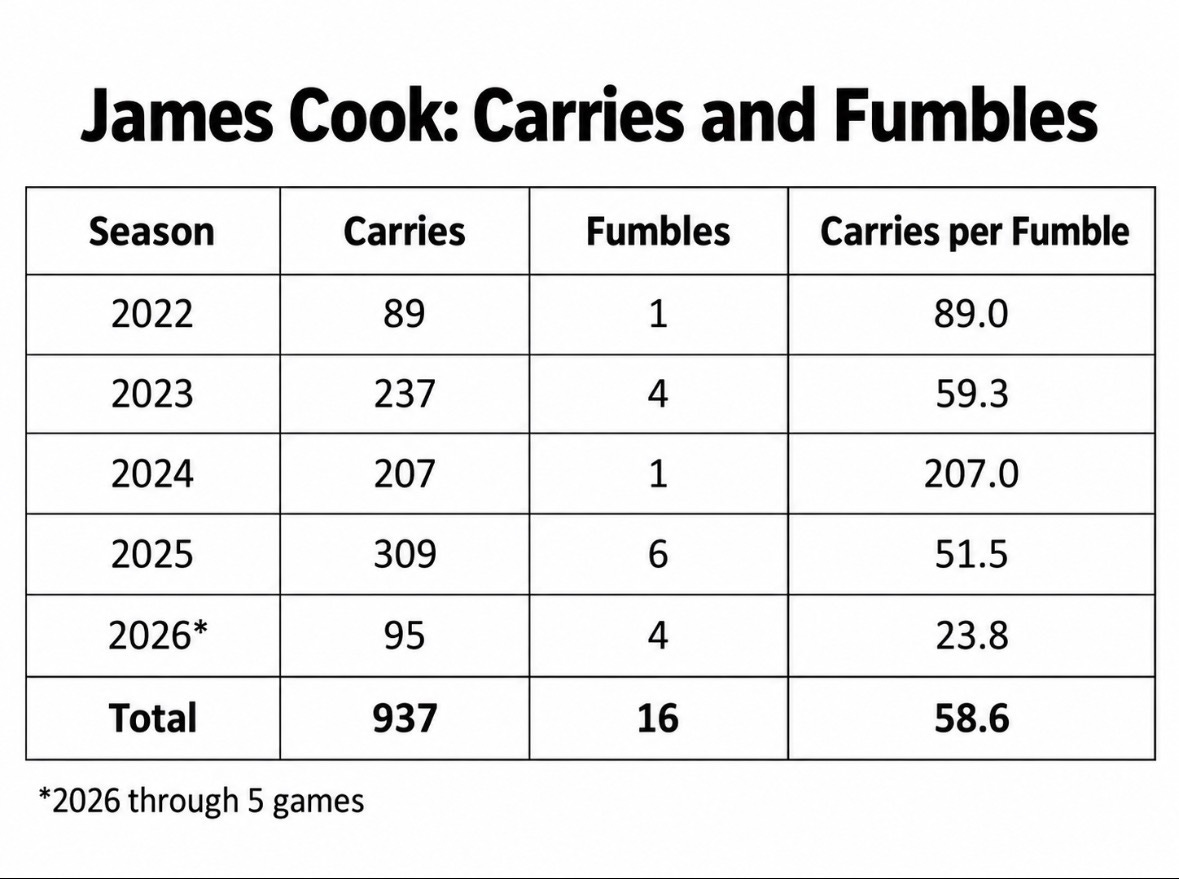
That’s the part I can’t ignore. Cook has been fumbling more frequently, not simply fumbling more because he’s carrying the ball more. In fact, Buffalo Rumblings calculated that he has been fumbling approximately once every 44 touches since the beginning of last season, compared with roughly once every 125 touches earlier in his career. Those are concerning numbers, and dismissing them entirely would be just as silly as demanding that he be benched.
But I also want to point out something else. Through five games this season, Cook has rushed for 532 yards on 95 carries, averaging 5.6 yards per attempt with five rushing touchdowns. That’s after winning the league rushing title with 1,621 yards last season. We’re talking about one of the most productive running backs in football, not some interchangeable guy who happens to be getting 20 carries because the coaching staff doesn’t have anybody better.

This Is a Problem That Can Be Fixed
Here’s another thing that gets lost in all the James Cook hysteria. Fumbling is a problem that can actually be fixed.
Two running backs who immediately come to mind are Tiki Barber and former Bills running back Travis Henry.
Henry had 11 fumbles in 2002, including eight lost, but reduced that number to seven the following season and eventually had just three in 2006 while rushing for 1,211 yards.
Barber is an even better example. He had 29 fumbles from 2000 through 2003 before Tom Coughlin arrived in New York and helped completely overhaul how he carried the football.
Barber subsequently fumbled just nine times over his final three seasons. These weren’t bad running backs who needed to be replaced. They were talented players with correctable problems.
Coughlin and running backs coach Jerald Ingram worked with Barber on carrying the ball higher and tighter against his body, eventually developing a technique where he held it almost vertically near his chest.
Barber later admitted, “Coach Tom Coughlin came in here, and he figured out that, mechanically, I was carrying the ball wrong.” In December 2004, Coughlin praised Barber’s improvement, saying, “Ball security, for the most part, has been outstanding.”
Barber himself explained that Coughlin’s coaching changed his mentality and helped him concentrate on protecting the football.
That’s what I want to see from the Bills. Identify the problem, fix the technique, and keep giving your best players opportunities to make plays. Barber even said years later that fumbling problems are “easily fixable,” while crediting Ingram for helping solve his. That’s a much more productive approach than threatening to bench Cook every time the football hits the ground. The solution isn’t necessarily fewer carries. It might simply be better coaching, better technique, and a little patience. And considering what Cook means to this offense, shouldn’t that be the first approach before we start handing his job to somebody else?
Please Don’t Call WGR and Tell Me Ray Davis Should Start
This is where the conversation inevitably becomes unbearable. Somewhere in Western New York, there’s a guy sitting in his truck listening to sports-talk radio, just waiting for his opportunity to explain how the Bills need to establish accountability. He’s probably been waiting on hold for 35 minutes, and I can already hear the phone call in my head.
“Hi, my name is Buck. I’m calling from the Town of Tonawanda. Listen, I like James Cook, but I think they gotta sit him down and give Ray Davis some carries. He’s gotta learn a lesson.”
Buck, please.
I would like somebody to escort that man down to Lake Erie and ceremonially launch his terrible football opinion into the water. He can stay on dry land. His take, however, belongs at the bottom of the lake.
Look, I have absolutely nothing against Ray Davis. He’s a perfectly capable NFL running back, and there are situations where he should get opportunities. Ty Johnson has also demonstrated that he can contribute to this offense. But neither one is James Cook, and pretending that Buffalo can simply remove one of the most explosive players in football without creating other problems is absurd.
Football is a game of risk and reward. Every time Josh Allen drops back to pass, there’s a possibility he’ll throw an interception. Every time he takes off running, there’s a possibility he’ll fumble or get injured. Should the Bills tell Allen to stop improvising because sometimes things go wrong? Of course not. His ability to make extraordinary plays is one of the reasons Buffalo wins football games. Cook deserves some of that same consideration, even if the mistakes need to be corrected.

Fix the Problem. Don’t Eliminate the Player.
The Bills need to work with Cook on ball security. Maybe it’s how he’s carrying the football in traffic. Maybe defenders have identified something about his technique. Maybe the coaching staff needs to emphasize two hands on the ball in certain situations, particularly late in games. Those are reasonable things to examine, and I have no problem with Brady making it clear that the mistakes cannot continue.
What I have a problem with is the idea that accountability automatically means somebody needs to lose playing time. Sometimes accountability means working harder in practice, correcting the technique, and trusting a talented player to respond. You don’t improve a running back’s ball security by taking away everything else that makes him valuable to your offense. And you certainly don’t improve your chances of winning games by voluntarily removing one of your best offensive weapons.
James Cook has a fumbling problem. That’s undeniable. He needs to fix it, and the Bills shouldn’t have to live with four fumbles every five games. But I also think we’re losing our minds if we start treating him like a liability instead of one of the most important players on this roster. The great running backs throughout NFL history weren’t perfect, and their coaches didn’t expect them to be. They expected them to make far more positive plays than negative ones.
The answer isn’t to pretend the fumbles don’t matter. It’s to make sure the fumbles don’t become the only thing we talk about.
And for the love of God, please don’t make me listen to Buck from Tonawanda explain why Ray Davis should be getting James Cook’s carries.
References & Sources
Breaking Take: James Cook’s Fumble Fuss
1. Tiki Barber on Fixing His Fumbling Problem — Tampa Bay Buccaneers. Barber discusses how Tom Coughlin corrected his ball-carrying technique.
2. Tom Coughlin Press Conference — December 22, 2004 — New York Giants. Coughlin praises Barber’s improvement in ball security.
3. Travis Henry Career Statistics — NFL.com. Documents Henry’s improvement from 11 fumbles in 2002 to seven in 2003 and three in 2006.
4. Travis Henry — Pro Football Reference — Complete season-by-season rushing and fumbling statistics.
That headline tho 🙌