
Let me give everyone a warning right now. My Bills–Jets recap might be a little late this Sunday.
Why? Because I’m going to the game, and there’s a very good chance I’m going to be drunk.
Via The Astoria Bills Backers…We’re taking a bus out to New Jersey, we’re tailgating, and it’s going to be sick. I’m also going to be hanging out with JFQ contest winner Rory Parker, which should make the whole experience even more entertaining. Hopefully he’s not a serial killer.
I’m going to try to take some photos and videos throughout the day, but I’m not making any promises about the quality of my reporting by the fourth quarter. I have a feeling this is going to be one of those days where I wake up Monday and have to piece together exactly what happened. This is daddy’s first outing like this since the Bills opener last season without kids and responsibilities.
I believe this will be my fourth or fifth Bills–Jets game in New Jersey. I’ve gone to quite a few over the years, but I haven’t been back since 2022.
Remember that game? Somehow, Zach freaking Wilson beat the Bills.
Buffalo lost 20-17, Josh Allen threw two interceptions, and I remember walking out of MetLife Stadium wondering how the hell we managed to lose that game. Of all the quarterbacks to lose to, it had to be Zach Wilson.
So I’m ready to get back there. I’m ready for the tailgate, I’m ready for a few beers, and I’m hoping this time I leave New Jersey a little happier.
As for the actual game, the Bills are 7-1, winners of four straight, while the Jets are 2-7 and have lost four in a row.

On paper, this shouldn’t be particularly close.
But I’ve watched enough Bills–Jets games over the years to know that sometimes you can throw the records out the window. For whatever reason, these division games can turn into an absolute mess.
The Jets aren’t a good football team, but believe it or not, they’re better than last year’s three-win team in a few areas. They’re more aggressive defensively, they have some talented young players, and their quarterback has actually put together some respectable numbers.
So let’s go down the rabbit hole.

I always enjoy doing these comparisons because sometimes the numbers tell you something you wouldn’t necessarily notice just by watching the games.
And there are three things that really caught my attention.
First, look at the difference in offensive production.
Buffalo is averaging 32 points per game, first in the NFL. The Jets are averaging 20.2, ranking 25th.
The Bills are also averaging 386.4 yards per game, compared with 309.9 for the Jets. Buffalo is fourth in yards per play at 6.01, while New York is 17th at 5.26.
That’s a pretty significant difference. The Bills are getting almost 77 more yards and nearly 12 more points per game despite actually playing fewer offensive snaps per game than the Jets.
That’s what makes Buffalo’s offense so dangerous. They don’t necessarily need to dominate time of possession or run 75 plays to put up a bunch of points. They’re generating more yards out of the opportunities they get.
Second, believe it or not, the Jets have better quarterback accuracy numbers than Buffalo.
New York is completing 67.5% of its passes, compared with 66.1% for Buffalo. The Jets also have a team passer rating of 100.5, while the Bills are at 99.3.The Jets are also completing a higher percentage of their on-target throws, and their poor-throw percentage is slightly lower.
Now, does that mean Geno Smith is having a better season than Josh Allen? No. That’s not what I’m saying.
But it does show you how misleading some statistics can be without looking at everything else.
Buffalo is averaging 8.6 yards per pass attempt, the best in football. The Jets are averaging 7.7. The Bills are getting much more production out of their passing game, even though New York has slightly better numbers in a few efficiency categories.
And that’s why I love looking at these things. Sometimes the numbers surprise you.

Third, look at the difference on third down and in pass protection.
Buffalo is converting 43.2% of its third downs, eighth in football. The Jets are converting only 35.4%, ranking 26th. On fourth down, the Bills are eight for ten, an 80% conversion rate. New York is six for eleven, or 54.5%.
And when it comes to protecting the quarterback, the Jets are losing an average of 26.2 yards per game on sacks. That’s the worst in the NFL. Buffalo is losing 13.6.
Those are the types of numbers that explain why one team is 7-1 and the other is 2-7.
The Jets can complete a bunch of passes, move the football between the 20s, and occasionally put together a nice drive. But if you’re taking sacks, struggling on third down, and settling for field goals, you’re going to lose a lot of games.
Are the Jets Better Than Last Year’s Team?
Believe it or not, yes.
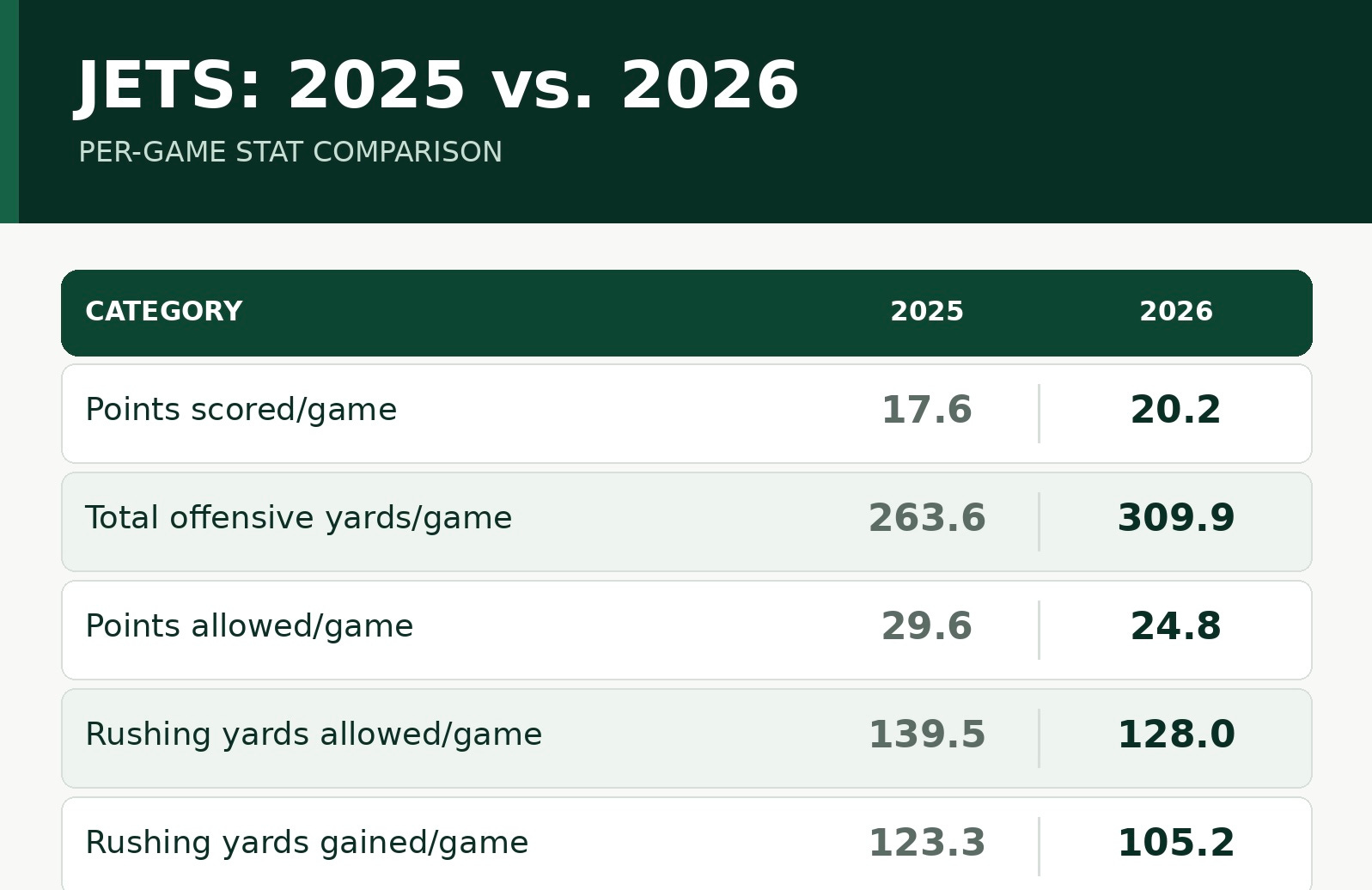
Last year, the Jets finished 3-14, scored 17.6 points per game, and allowed 29.6. They were absolutely terrible on both sides of the football.
This year, they’re scoring 20.2 and allowing 24.8. Their offense has also improved from 263.6 yards per game to 309.9, an increase of more than 46 yards.
That’s a pretty significant improvement, especially considering how bad they were last year.
But here’s where things get interesting. Their rushing attack has actually gotten worse.
The Jets averaged 123.3 rushing yards per game last season. This year, they’re down to 105.2, ranking 20th.
And considering they have Breece Hall and Braelon Allen, I find that a little surprising.
Under Aaron Glenn, the Jets have also become more aggressive defensively. They’re sending extra rushers, disguising pressure, and trying to create turnovers rather than simply sitting back and allowing opposing offenses to pick them apart.
The results have been mixed, but there are a few things they’re doing really well.
Unfortunately for them, winning football games isn’t one of them.
The Jets Blitz Almost 40% of the Time
Here’s one of my favorite numbers heading into Sunday.
According to Sharp Football Analysis, the Jets blitz on 39.1% of their defensive plays. That’s the fourth-highest rate in the NFL.
The only teams blitzing more are Minnesota, Tampa Bay and Washington.
And what’s funny about that is Buffalo just played Minnesota, which blitzes an absolutely ridiculous 69.7% of the time.
So the Bills are going from one of the most aggressive defenses in football to another.
The difference is that the Jets haven’t been nearly as effective at preventing offensive success.
New York’s defense uses light boxes on 41.8% of its plays and heavy boxes on 29.1%. They’re willing to disguise their looks and send players from different positions.
But just because you’re blitzing doesn’t mean you’re necessarily getting to the quarterback. The Bills have already dealt with the most extreme version of this against Minnesota, so I would hope Joe Brady has a pretty good idea of what to expect.
I’d love to see Buffalo use the running game, force New York to respect James Cook, and then take advantage of the space created when the Jets bring additional rushers.
And if they’re going to blitz Josh Allen nearly 40% of the time, there should be opportunities to make them pay.
Can the Jets Stop James Cook?
This might be the biggest mismatch in the entire game. The Jets are allowing 128 rushing yards per game, ranking 26th in the NFL.
And it’s actually gotten worse as the season has progressed.
During their first five games, New York was allowing approximately 118 rushing yards per game. Over its last four, that number has climbed above 140. Meanwhile, Buffalo is averaging 146.6 rushing yards per game, second in football.
James Cook has rushed for 814 yards on 169 carries, averaging 4.82 yards per attempt. He’s averaging more than 100 yards per game and already has eight rushing touchdowns.
What I find interesting about Buffalo is how comfortable they’ve become running the football.
We have Josh Allen, arguably the most talented quarterback in football, and Joe Brady has built an offense that’s perfectly happy running the ball 30 or 40 times if that’s what the defense is giving them.
Against Minnesota, the Bills ran the ball 44 times, including 31 carries for Cook.
I’m not saying Buffalo has to run the football 44 times every week. But when you’re playing a Jets team that’s struggling against the run, why wouldn’t you make them prove they can stop it?
The Jets Are Vulnerable Against Tight Ends
Here’s another matchup Buffalo should be able to take advantage of.
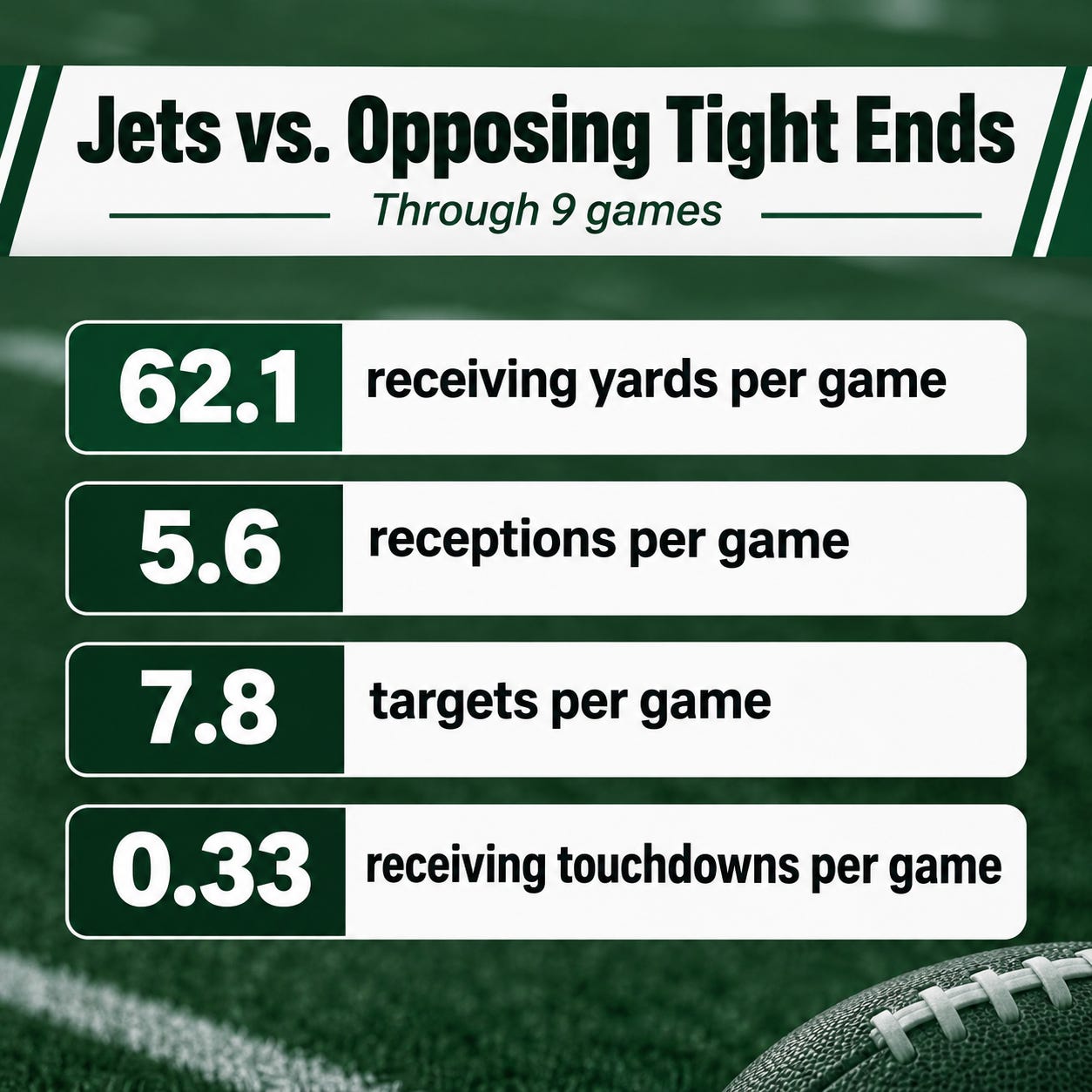
Through nine games, the Jets are allowing opposing tight ends an average of 62.1 receiving yards per game. That’s the ninth-most in the NFL.
So if I’m Joe Brady, I’m looking at ways to get Dalton Kincaid involved early and often. Kincaid has 30 receptions for 429 yards this year, averaging 14.3 yards per catch.
And I thought it was interesting that Buffalo used three-tight-end personnel on 31 plays against Minnesota. That was the most they’ve used that formation in a game this season.
Maybe we’re starting to see a little more creativity with this group.
I know the tight ends have been criticized over the past few years, and I’ve certainly been part of that conversation. But this is a game where I’d love to see them become a bigger part of the offense.
Especially against a defense that sends extra rushers as frequently as the Jets.
If New York is bringing pressure, make their linebackers and safeties defend the middle of the field.

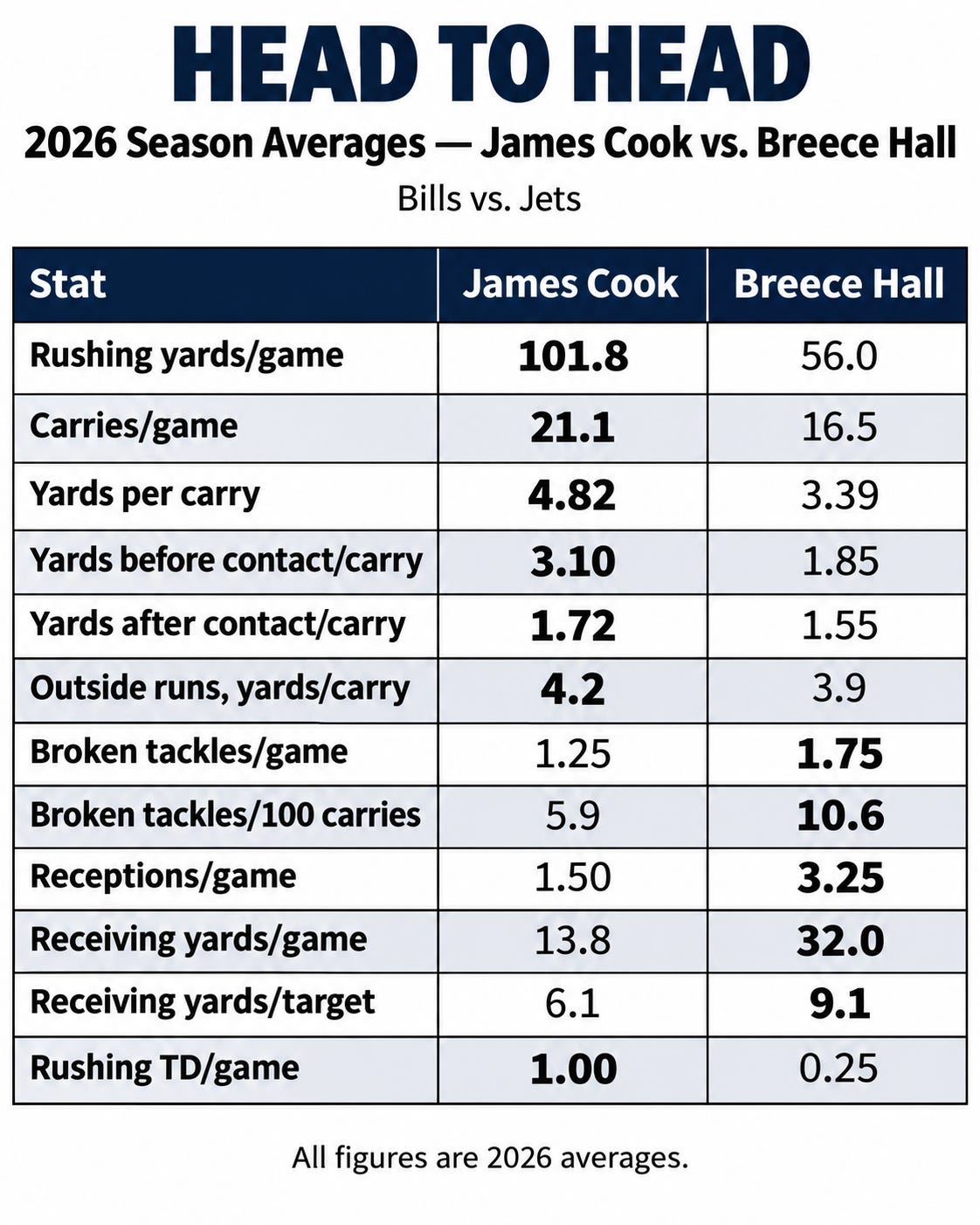
I love these comparisons because you can see the differences between two talented running backs beyond just looking at their total rushing yards.
Cook is averaging 101.8 rushing yards per game, compared with 56 for Hall. Cook is also averaging 4.82 yards per carry, while Hall is at 3.39.
The advanced numbers are interesting, too.
According to Pro Football Reference’s charting, Cook is averaging approximately 3.1 yards before contact per carry. Hall is at 1.85.
That’s a pretty significant difference, and it tells you something about the running lanes Buffalo is creating compared with what Hall has been working with.
Cook is also averaging 1.72 yards after contact per carry, compared with 1.55 for Hall.
But Hall has been a more productive receiver this season, averaging 3.25 receptions and 32 receiving yards per game. Cook is averaging 1.5 receptions and 13.8 receiving yards.
Now, Hall has played only four games because of an injury, so we’re dealing with a much smaller sample size.
And the Jets also have Braelon Allen, who’s actually their leading rusher with 598 yards and five yards per carry.
But when I look at these numbers, the biggest difference is consistency.
Buffalo has been able to rely on Cook almost every week. The Jets haven’t been able to establish that same type of running game.
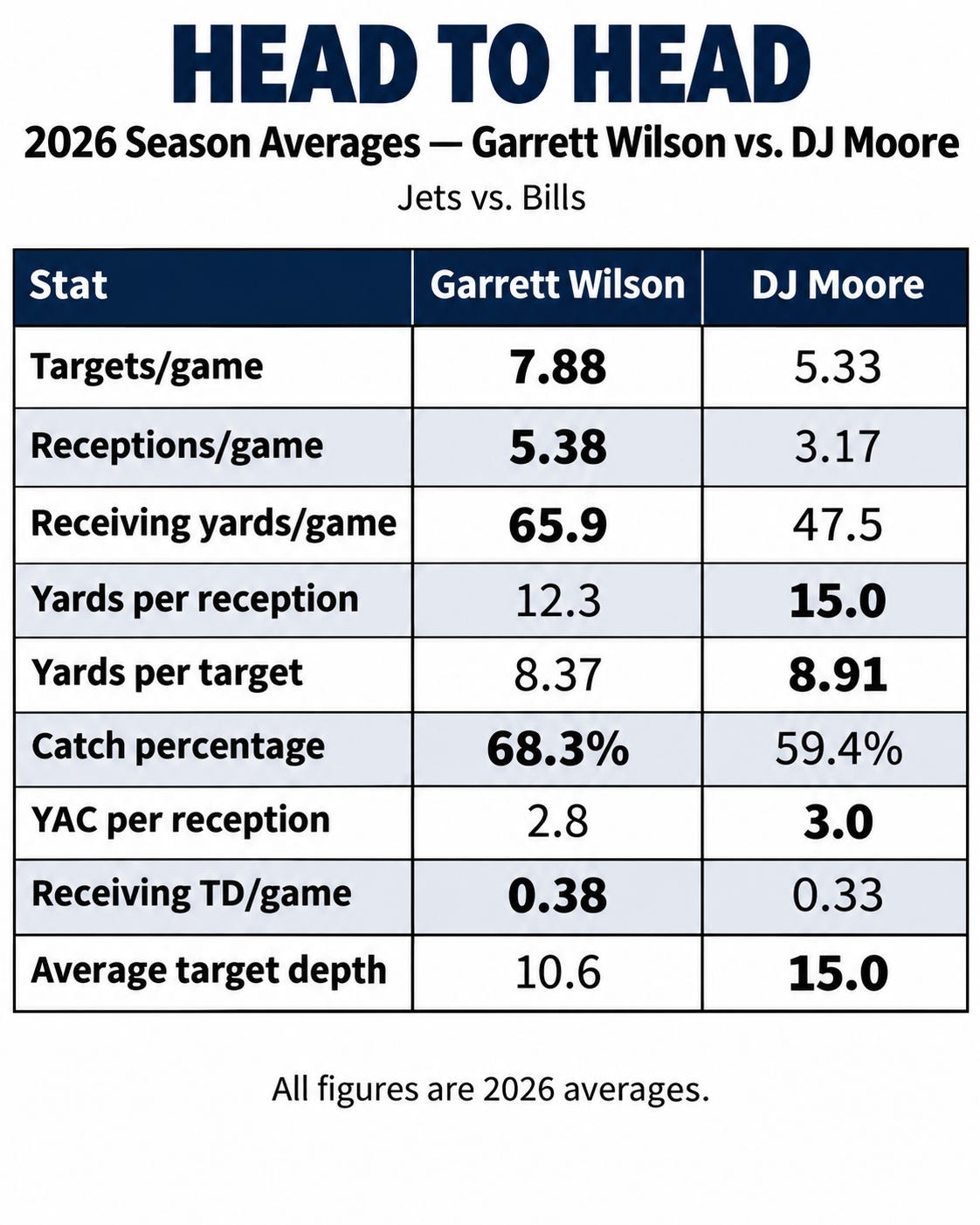
This is another one of those comparisons where the numbers are interesting because the two players are being used differently.
Garrett Wilson has 43 receptions for 527 yards and three touchdowns in eight games. That’s 65.9 receiving yards per game, compared with 47.5 for DJ Moore.
Wilson is getting almost eight targets per game, while Moore is getting a little over five.And Wilson is catching 68.3% of his targets compared with Moore’s 59.4%.
But Moore has the advantage when it comes to yards per reception, averaging 15 compared with Wilson’s 12.3.
Moore is also averaging 8.91 yards per target, while Wilson is at 8.37.
So Wilson is getting more opportunities and catching a higher percentage of passes, but Moore has been producing more yardage when the ball comes his way.
That’s what I find interesting.
Wilson is the focal point of the Jets’ passing game. Moore is part of a Buffalo offense that has several different options and doesn’t necessarily need him catching eight passes every week.
I’d still love to see Moore get more involved, particularly as teams start concentrating on stopping Cook and Kincaid.
And it’ll be interesting to see whether Wilson is available Sunday after dealing with a concussion.
Greg Rousseau vs. David Bailey
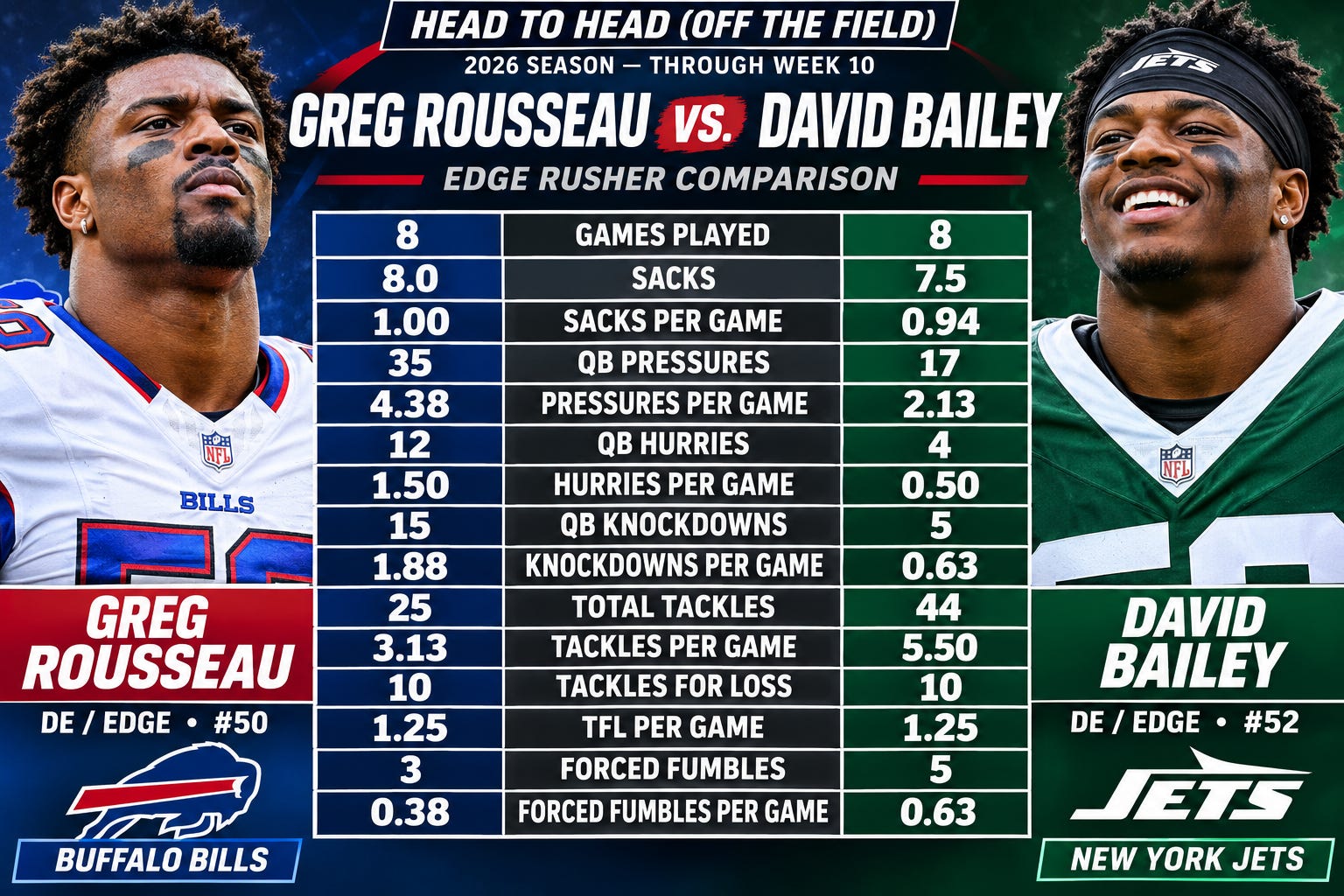
This might be my favorite of the three comparisons.
Greg Rousseau has eight sacks in eight games. David Bailey has 7.5 sacks in eight games.
And Bailey is a rookie!
The Jets might be having a terrible season, but they’ve found themselves a pretty damn good pass rusher.
Rousseau is averaging one sack per game, while Bailey is at 0.94.
And the advanced pressure numbers tell you that Rousseau is doing much more than just getting sacks. He’s consistently disrupting quarterbacks, getting into the backfield, and forcing offenses to account for him.
But Bailey has one statistic that really jumps out.
He’s forced five fumbles in eight games.
Five!
Rousseau has forced three, which is impressive in its own right, but Bailey has already become one of the best players in football at knocking the ball loose. Against Kansas City last week, Bailey recorded two sacks and forced two fumbles on the same drive. The Jets have found themselves a legitimate young defensive player, and Buffalo absolutely has to account for him.
Because for all the Jets’ problems, this defense can take the football away.

Four More Jets Stats That Caught My Attention
1. They’re forcing more fumbles than anybody in football.
The Jets have forced 13 fumbles and recovered nine through nine games. Both numbers lead the league.
That’s pretty remarkable for a team that’s 2-7.
And with Bailey responsible for five of those forced fumbles, this is something Buffalo has to be careful about.
2. They have only one interception.
This might be my favorite Jets statistic.
They went the entire 2025 season without recording an interception. This year, through nine games, they have only one.
So they’re extremely good at knocking the ball out, but apparently catching a pass thrown by the opposing quarterback is a different story.
3. Their red-zone offense is awful.
The Jets are scoring touchdowns on only 40.7% of their red-zone trips, ranking 31st in the league.
That’s one of the reasons their offense has struggled despite Geno Smith putting together respectable passing numbers.
They can move the football, but they can’t consistently finish drives.
4. Their red-zone defense has problems, too.
Opponents have scored touchdowns on 11 consecutive red-zone possessions against the Jets.
That’s almost unbelievable.
Buffalo has been one of the better red-zone offenses in football, so this should be an area where the Bills can take advantage.
Three Bills–Jets Games
I always enjoy going through old Bills games when I’m writing these previews.
Sometimes it’s because of a great play, sometimes it’s because of a horrible loss, and sometimes it’s because of something completely ridiculous that happened outside the stadium.
And when it comes to the Jets, three games immediately come to mind.
December 19, 1998: The Day We Lost the Division and Left the Car Door Wide Open
This was the Doug Flutie season.
The Bills were playing the Jets at Rich Stadium, and New York came into Buffalo with an opportunity to clinch the AFC East.
Bill Parcells had turned the Jets into one of the best teams in football, and Vinny Testaverde was having a tremendous season.
The Jets won 17-10.
And what a miserable game it was.
The Bills were hanging around late, and there was a controversial interception by Jets safety Victor Green on a tipped Doug Flutie pass.
The question was whether the ball had actually hit the ground before Green secured it.
The Jets got the call, eventually held on, and celebrated winning their first division title since 1969.
So that sucked.


But here’s what I remember more than anything.
We went to that game, parked the car, walked into the stadium, watched the Bills lose the division, and came back to discover that we had left one of the car doors completely open.
And when I say open, I mean WIDE OPEN.
Not unlocked. Not slightly cracked.
The freaking door was wide open for the entire game.
How the hell do you do that?
I have absolutely no idea. But somehow we managed to leave a car sitting in the parking lot with its door completely open for hours.
And here’s the best part.
Nobody stole anything.
Nothing was missing. Nobody robbed us. The car was just sitting there waiting for us to come back.
I guess there’s something to be said about the honesty of people attending Bills games back in the late 1990s.
Or maybe somebody looked inside and figured there wasn’t anything worth stealing.
Either way, we lost the division, but at least we didn’t lose the car.

October 28, 2007: J.P. Losman to Lee Evans
If you ever watch a J.P. Losman highlight package, there’s a pretty good chance this play is going to be in there.
The Bills were playing the Jets in New Jersey, and Trent Edwards had gotten injured [Shocking!] forcing Losman into the game.
It wasn’t exactly an offensive masterpiece.
Buffalo was leading 6-3 late in the fourth quarter when Losman dropped back and launched a deep pass down the right sideline to Lee Evans.
Evans was being covered by rookie cornerback Darrelle Revis. Now, Revis would eventually become one of the best cornerbacks in NFL history, but on this particular play, Evans got the better of him.
Revis actually had his hands on the football.But Evans somehow managed to wrestle it away and take off for an 85-yard touchdown.
Bills win, 13-3.


That’s probably the defining highlight of Losman’s career in Buffalo.
And listen, I know Losman had plenty of problems as a quarterback, but the guy could throw a beautiful deep ball.
He and Evans had some pretty memorable connections over the years, and that one will always stand out to me.
Especially because it came against Revis.
October 21, 1990: The Jamie Mueller Game
This is one of those games that I can still remember watching as a kid. The Jets came into Rich Stadium and jumped out to a 14-0 lead.
Eventually, they were up 21-7 and Thurman Thomas was hurt which was a big loss, especially when you consider he had over 200 yards a month earlier in NJ.
But this was the 1990 Buffalo Bills, and those teams had a way of making you feel like no game was ever really over. Jim Kelly threw two touchdown passes to Andre Reed and a 60-yard touchdown to James Lofton.
Eventually, the Bills tied the game at 24.
Then the Jets kicked a field goal with 2:46 remaining to take a 27-24 lead.
Kelly got the ball back and drove Buffalo down the field.
And with 19 seconds remaining, he found fullback Jamie Mueller for a 14-yard touchdown.
Bills win, 30-27.
What I remember most about that touchdown isn’t even the play itself.It’s the graphic that appeared on television afterward.
I swear there was something about Mueller scoring his first touchdown in four years, or something along those lines. I looked it up, and it was actually the first touchdown reception of his NFL career, which came during his fourth season with Buffalo.
So maybe that’s what the graphic said.
It’s funny how the brain works. I can remember some random television graphic about Jamie Mueller from 36 years ago, but I probably couldn’t tell you what I had for dinner three nights ago.
That’s one of the things I love about being a sports fan.
Certain games and certain moments stick with you forever, even if they don’t mean anything to anybody else.
And that’s always going to be one of mine. Oh and Bruce Smith got into a fight after the game which I definitely didn’t remember.


Prediction